Introduction
In today's data-first economy, organizations collecting information from across the web face a consistent challenge: raw data is rarely usable in its native form. For businesses relying on Enterprise Web Crawling to gather competitive intelligence, pricing signals, or market trends, having a structured pipeline that converts noisy inputs into reliable outputs is no longer optional; it is a fundamental operational requirement.
Inconsistencies, duplicates, missing fields, and structural mismatches make it difficult to extract meaningful conclusions without substantial processing effort. Across industries, data engineering teams report spending nearly 60–70% of their working hours on data preparation rather than actual analysis. This imbalance reflects a broader infrastructure gap that smarter pipeline design can address directly.
The integration of Automated Data Transformation Pipelines for Web Scraped Data into enterprise workflows has emerged as a strategic response to this challenge, enabling organizations to reduce manual preprocessing efforts, improve consistency, and accelerate time-to-insight significantly. This report examines how modern transformation pipelines are reshaping the standards of web data management, from normalization and deduplication to structured output delivery and scalable processing architectures.
Market Landscape: The Scale and Complexity of Web Data Ingestion
Web-sourced data volumes have expanded dramatically. By early 2025, global data creation was projected to surpass 120 zettabytes annually, with a significant portion originating from structured and semi-structured web sources. Enterprises operating across e-commerce, finance, logistics, and healthcare now ingest data from hundreds of sources simultaneously, each delivering varied schemas, formats, and refresh cycles.
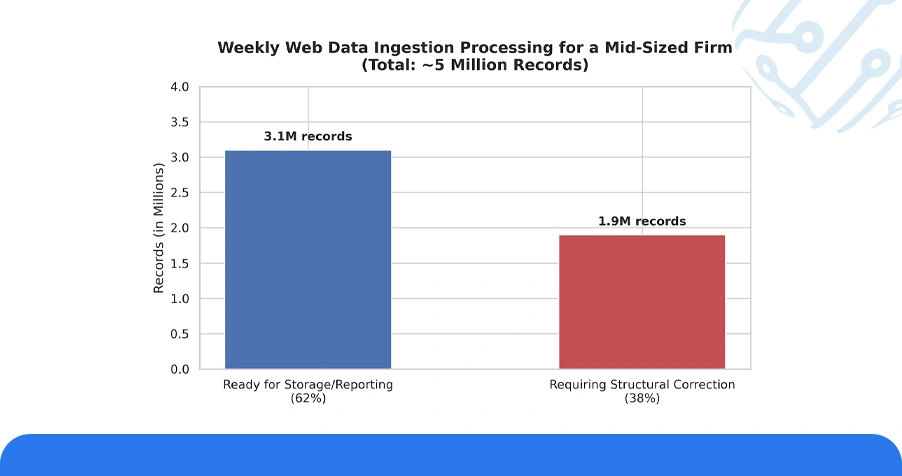
The diversity of input formats HTML tables, JSON feeds, CSV exports, nested XML structures creates substantial downstream processing challenges. A single mid-sized e-commerce analytics firm may process upwards of 4–6 million scraped records weekly, with nearly 38% of those records requiring structural correction before they are fit for storage or reporting.
Table 1: Web Data Ingestion Complexity by Industry Vertical
| Industry | Avg. Weekly Records (M) | Format Variety | Structural Error Rate | Avg. Sources |
|---|---|---|---|---|
| E-commerce | 5.8 | 6 | 37% | 140 |
| Financial Services | 3.2 | 5 | 29% | 95 |
| Healthcare | 1.9 | 4 | 41% | 60 |
| Logistics | 4.1 | 7 | 33% | 112 |
| Real Estate | 2.4 | 5 | 44% | 78 |
The adoption of a well-structured Web Scraping Data Cleaning and Transformation Pipeline has proven critical in reducing these error rates. These figures highlight not just the operational value of cleaner pipelines but also their direct contribution to analytical reliability across departments.
Historical Analysis: Evolution of Data Transformation Practices
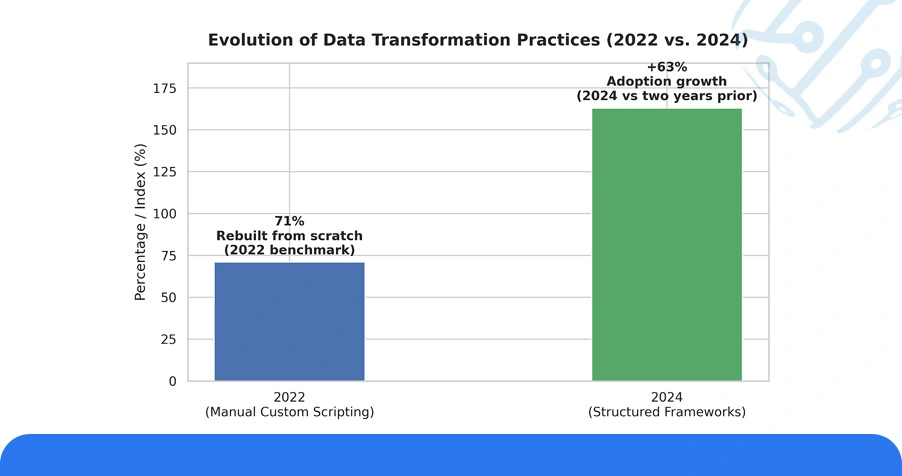
Before dedicated transformation tooling became mainstream, data engineering teams relied heavily on manual scripting custom Python or R scripts written per source, often with limited reusability and fragile maintenance cycles. A 2022 industry benchmark found that 71% of data teams rebuilt transformation logic from scratch for each new scraping project, leading to compounded inefficiencies over time.
The shift toward modular, reusable pipeline architectures began accelerating around 2023, coinciding with the maturation of tools such as Apache Spark, dbt (data build tool), and cloud-native ETL services. By 2024, adoption of structured pipeline frameworks had grown by 63% among mid-to-large enterprises compared to two years prior.
Table 2: Transformation Approach Adoption Trends (2022–2025)
| Approach | 2022 Usage (%) | 2023 Usage (%) | 2024 Usage (%) | 2025 Usage (%) |
|---|---|---|---|---|
| Manual Scripting | 71 | 58 | 41 | 26 |
| Semi-Automated ETL | 22 | 31 | 38 | 39 |
| Fully Automated Pipelines | 7 | 11 | 21 | 35 |
The evolution also reflects a growing understanding that the Data Processing Pipeline for Web Scraping Projects must account for schema drift and the tendency of source websites to change their structure over time. In 2025, approximately 52% of scraping teams cited schema drift as their top pipeline maintenance challenge, reinforcing the demand for adaptive transformation logic that can detect and reconcile structural changes without manual re-intervention.
Smarter Engineering: Core Components of an Automated Transformation Stack
A production-grade automated pipeline is rarely a single tool; it is an orchestrated sequence of processing layers, each responsible for a specific quality dimension. Web Scraping Services deployed at scale benefit enormously from pipelines that separate these concerns cleanly. When ingestion, transformation, and validation are decoupled, teams can update any single layer independently without disrupting the entire workflow, a critical advantage when source schemas shift or business rules evolve.
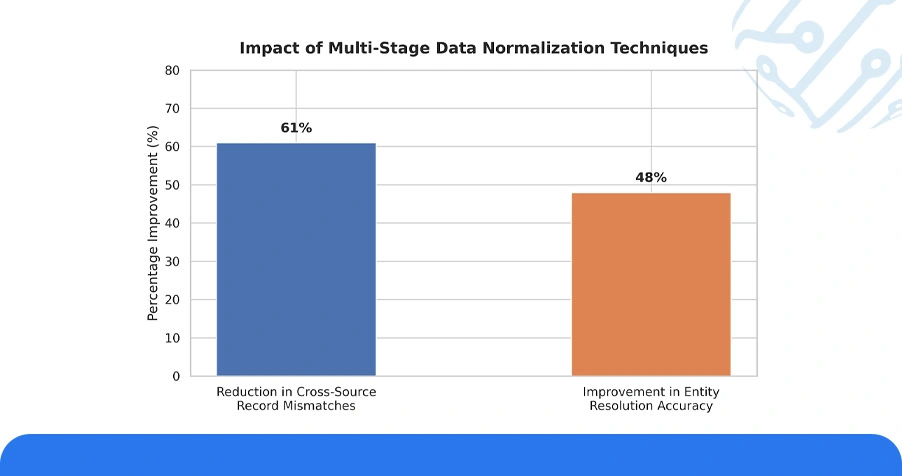
The application of systematic Data Normalization Techniques for Scraped Data is particularly impactful at the transformation layer. In controlled benchmarks, pipelines that applied multi-stage normalization reduced cross-source record mismatches by 61% and improved entity resolution accuracy by 48%.
Table 3: Core Pipeline Component Performance Benchmarks
| Pipeline Layer | Function | Error Reduction (%) | Processing Speed Gain (%) | Automation Rate (%) |
|---|---|---|---|---|
| Ingestion & Encoding | Raw capture, format routing | 22 | 35 | 91 |
| Transformation Logic | Rule-based field mapping | 47 | 28 | 87 |
| Data Normalization | Standardization & harmonization | 61 | 19 | 83 |
| Deduplication | Record matching & merging | 54 | 31 | 89 |
| Validation & Scoring | Quality checks & output control | 38 | 24 | 94 |
Organizations running fully automated stacks across all five layers reported an overall data quality improvement of 73% compared to baseline manual processes, alongside a 41% reduction in engineering hours allocated to preprocessing tasks.
Use Case: Transforming Scraped Outputs Into Structured Business Intelligence
The practical impact of a well-designed transformation workflow becomes most visible at the analytics delivery stage. Mobile App Data Scraping operations face an added layer of complexity; mobile-sourced data frequently arrives in compressed, proprietary formats that require specialized parsing before standard transformation rules can be applied.
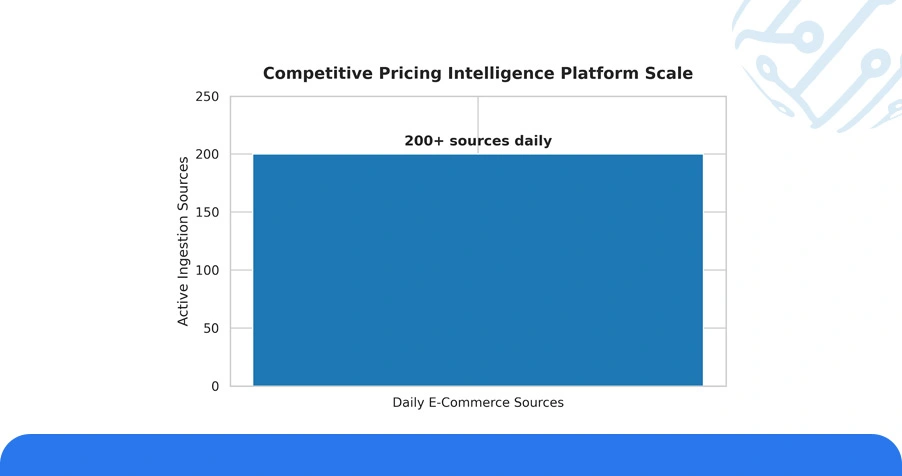
Consider a competitive pricing intelligence platform that scrapes product data from 200+ e-commerce sources daily. The task of Transforming Raw Scraped Data Into Actionable Insights requires the pipeline to unify all of these dimensions systematically before any analyst or algorithm can draw meaningful comparisons.
Table 4: Business Outcome Metrics Post-Pipeline Implementation
| Business Function | Pre-Pipeline Issue Rate (%) | Post-Pipeline Issue Rate (%) | Time-to-Insight Reduction | Analyst Hours Saved/Week |
|---|---|---|---|---|
| Pricing Intelligence | 44 | 8 | 68% | 18 hrs |
| Job Market Analytics | 38 | 6 | 71% | 14 hrs |
| Real Estate Valuations | 51 | 9 | 63% | 22 hrs |
| Product Review Analysis | 33 | 5 | 74% | 11 hrs |
| Financial Data Feeds | 29 | 4 | 79% | 16 hrs |
In documented implementations across retail analytics firms, the introduction of a structured Data Transformation Workflow for Web Scraping reduced the time from data collection to dashboard-ready output by an average of 68%. Additionally, the volume of analyst-flagged data quality issues dropped by 57% within the first quarter of deployment.
Numeric Overview: Pipeline Efficiency and Data Quality Metrics
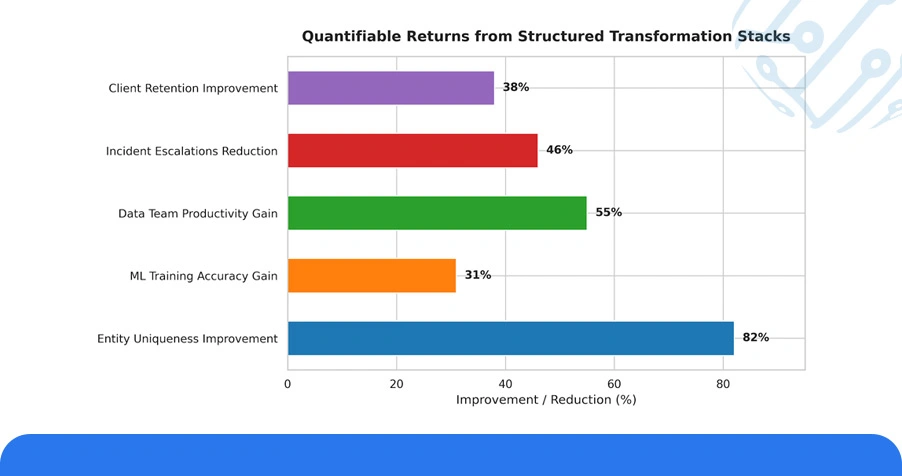
A closer look at aggregated performance data from 2025 deployments reveals the quantifiable returns that well-engineered transformation stacks deliver across operational dimensions.
- The application of consistent Data Normalization Techniques for Scraped Data across multi-source environments reduced entity duplication rates from an average of 23.4% to just 4.1%, representing an 82% improvement in record uniqueness across datasets exceeding 10 million rows.
- In platforms that implemented a comprehensive Data Transformation Workflow for Web Scraping, downstream model training accuracy for machine learning applications improved by an average of 31%, attributed directly to improvements in input data consistency and completeness.
- Pipelines integrating real-time Web Scraping Data Cleaning and Transformation Pipeline logic rather than batch-only processing demonstrated a 2.7x faster anomaly response rate, enabling teams to correct source deviations within minutes rather than hours.
- Overall, organizations that shifted from ad hoc preprocessing to structured transformation architecture reported a 55% improvement in data team productivity and a 46% reduction in data-related incident escalations across quarterly reporting cycles.
Web Scraping API Services platforms that embedded transformation layers natively within their delivery infrastructure saw client retention rates improve by 38%, as end-users received cleaner, more consistently structured outputs requiring minimal post-delivery processing.
Conclusion
In a landscape where decision quality is directly tied to data quality, building a reliable and scalable transformation layer is among the highest-leverage investments a data-driven organization can make. We specialize in designing and deploying enterprise-grade Automated Data Transformation Pipelines for Web Scraped Data, customized to the unique structural demands of your data sources, business rules, and delivery requirements.
Contact ArcTechnolabs today to discuss your pipeline requirements, request a technical consultation, or explore how we can elevate the quality and efficiency of your data operations. The process of Transforming Raw Scraped Data Into Actionable Insights requires more than tools; it requires a thoughtful architecture partner who understands your data from ingestion to output.