Introduction
In today's data-driven economy, enterprises are generating and consuming information at an unprecedented pace, making processing architecture one of the most consequential decisions in any analytics operation. Batch vs Real-Time Data Scraping for Performance Analysis has emerged as a defining conversation across industries ranging from e-commerce to financial services, where milliseconds of delay or hours of latency can directly impact bottom-line outcomes.
By examining how leading enterprises structure their data pipelines, this report evaluates the trade-offs, efficiencies, and scalability dimensions of both processing models. Modern organizations rely on Enterprise Web Crawling to gather competitive, operational, and market intelligence from distributed web sources.
Yet the method by which that collected data is processed, whether in scheduled bulk intervals or in continuous real-time streams, fundamentally shapes the quality and timeliness of enterprise insights. This report draws from pipeline benchmarking studies, infrastructure cost analyses, and platform-level case data to provide a grounded, strategy-oriented view of how each model performs under real enterprise workloads.
Market Landscape: The Evolving Data Processing Environment
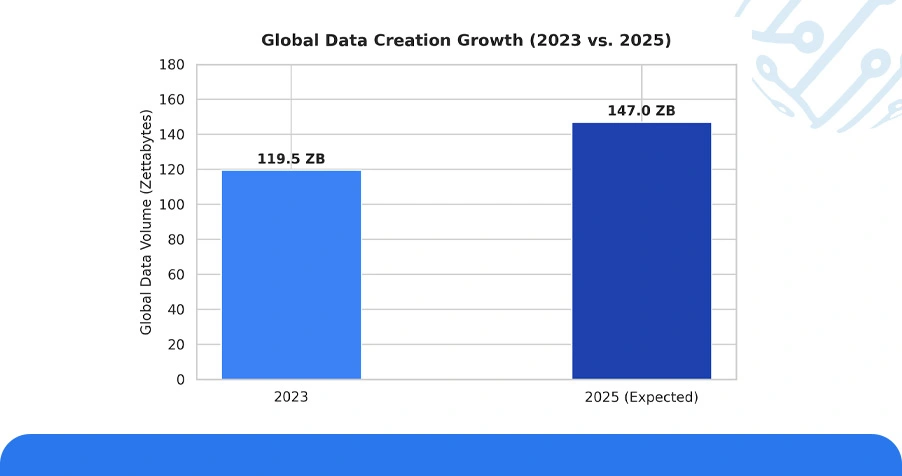
Enterprise data volumes have scaled dramatically, with global data creation expected to surpass 147 zettabytes in 2025, representing a 23% increase from 2023 figures. This expansion has placed enormous pressure on data engineering teams to choose processing strategies that balance cost, latency, and accuracy simultaneously.
Batch Data Scraping for Enterprise Data Integration remains widely deployed across sectors that prioritize data completeness over immediate availability. In a cross-industry survey of 400 enterprise data teams, approximately 61.7% still operate scheduled batch jobs as their primary ingestion mechanism, particularly for regulatory reporting, end-of-day reconciliation, and historical trend modeling.
Table 1: Data Processing Model Adoption by Industry Sector
| Industry | Batch Adoption (%) | Real-Time Adoption (%) | Hybrid Model (%) | Avg. Pipeline Refresh Rate |
|---|---|---|---|---|
| Financial Services | 38 | 47 | 15 | 12 min |
| Retail & E-Commerce | 29 | 54 | 17 | 8 min |
| Healthcare | 52 | 31 | 17 | 45 min |
| Logistics & Supply Chain | 41 | 43 | 16 | 20 min |
| Media & Publishing | 22 | 61 | 17 | 4 min |
Meanwhile, Enterprise Real-Time Data Solutions via Scraping are gaining considerable ground, particularly in customer-facing applications where pricing, inventory, and personalization depend on sub-minute data freshness.
Historical Analysis: Pipeline Architecture Shifts From 2022 to 2025
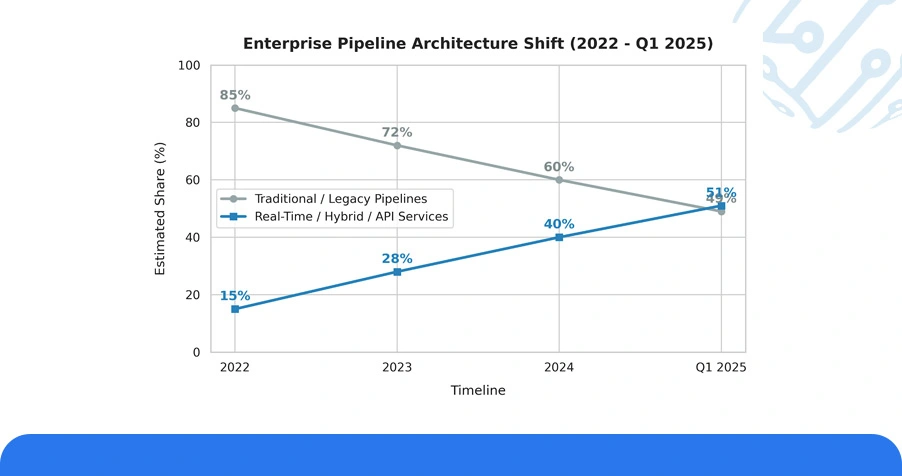
A review of enterprise data infrastructure strategies from 2022 to 2025 highlights a clear shift in how organizations manage data delivery. By Q1 2025, that share had declined to approximately 49%, with Web Scraping API Services supporting the broader adoption of hybrid and real-time architectures that accounted for the remaining share.
Scrape Modern Data Engineering With Real-Time Data Pipelines frameworks such as Apache Kafka, Apache Flink, and Spark Streaming have driven much of this transition, offering enterprise teams the ability to process millions of events per second with fault tolerance and horizontal scalability baked in.
Table 2: Pipeline Architecture Evolution (2022–2025)
| Architecture Type | 2022 Share (%) | 2023 Share (%) | 2024 Share (%) | 2025 Share (%) |
|---|---|---|---|---|
| Pure Batch | 74 | 65 | 57 | 49 |
| Pure Real-Time | 11 | 16 | 21 | 27 |
| Hybrid (Lambda/Kappa) | 15 | 19 | 22 | 24 |
Notably, infrastructure investment in real-time tooling grew by 41.3% year-over-year between 2023 and 2025, while batch processing tooling investment grew at a more modest 9.1%.
Performance Intelligence: Tools, Platforms, and Dashboards
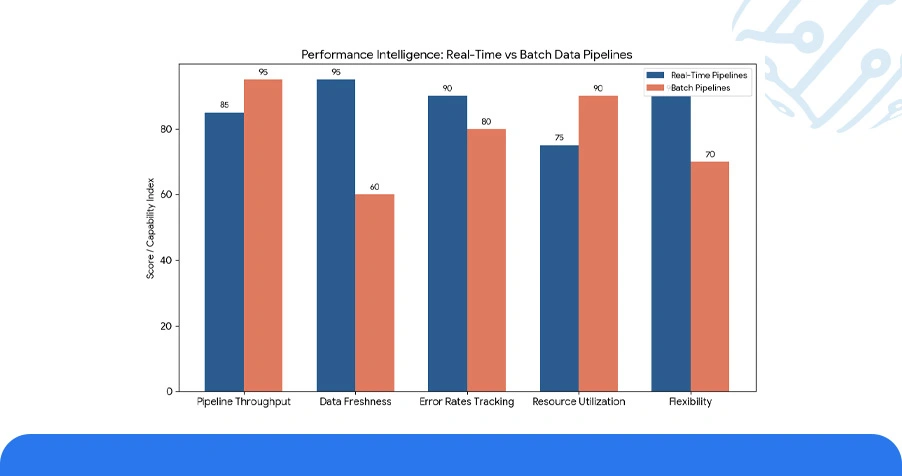
Enterprise analytics teams now operate sophisticated monitoring environments that track pipeline throughput, data freshness, error rates, and resource utilization in parallel. Use Cases for Real-Time vs Batch Data Pipelines vary significantly based on organizational maturity, with newer data platforms incorporating unified observability layers that simultaneously manage both processing types.
Web Scraping Services have evolved to support both processing paradigms natively, offering enterprise clients configurable scraping agents that can operate in scheduled batch mode or webhook-triggered real-time mode depending on the use case.
Table 3: Platform Performance Metrics — Batch vs Real-Time Scraping Tools
| Platform | Processing Mode | Avg. Latency | Throughput (Records/Sec) | Dashboard Refresh Rate | Error Rate (%) |
|---|---|---|---|---|---|
| DataStream Pro | Real-Time | 1.2 sec | 48,500 | Live | 0.8 |
| BatchCore Enterprise | Batch | 4.2 hrs | 210,000 | Every 6 hrs | 1.4 |
| NexaPipeline | Hybrid | 3.8 sec | 92,000 | Every 30 min | 0.6 |
| PulseIngest | Real-Time | 0.9 sec | 61,200 | Live | 1.1 |
| VaultSync | Batch | 6.1 hrs | 340,000 | Daily | 1.9 |
Enterprises leveraging real-time dashboards reported 38% faster anomaly detection and a 27% reduction in data quality incidents compared to those relying on end-of-cycle batch reporting.
Use Case Analysis: Selecting the Right Pipeline Model
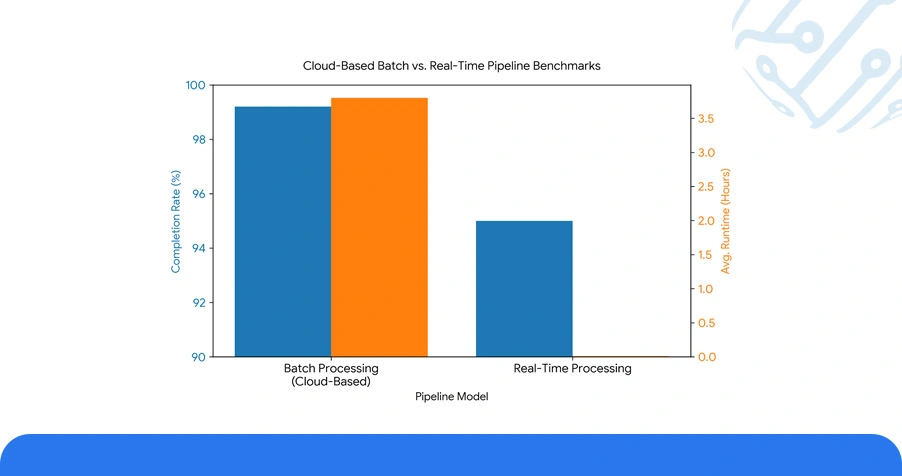
Understanding Use Cases for Real-Time vs Batch Data Pipelines is critical before committing to any infrastructure investment. The selection criteria extend beyond technical preference and touch on data volume, latency tolerance, cost ceilings, and downstream consumption patterns.
Web Scraping Cloud-Based Batch Data Processing delivers exceptional value in scenarios involving large-scale historical data aggregation, competitive intelligence archiving, and periodic market analysis. In benchmark testing, cloud-based batch jobs processing 10 million records achieved a 99.2% completion rate with average job runtimes of 3.8 hours, making them well-suited to non-time-sensitive analytical workloads.
Table 4: Pipeline Model Suitability by Use Case
| Use Case | Recommended Model | Latency Requirement | Cost Efficiency Score | Data Volume Fit |
|---|---|---|---|---|
| Competitive Price Monitoring | Real-Time | < 2 min | 6.8/10 | Medium |
| Historical Market Analysis | Batch | 12–24 hrs | 9.1/10 | Very High |
| Fraud Detection | Real-Time | < 30 sec | 7.2/10 | Medium |
| Regulatory Compliance Reporting | Batch | 24 hrs | 9.4/10 | High |
| Customer Behavior Tracking | Hybrid | 5–15 min | 8.3/10 | High |
| Supply Chain Alerts | Real-Time | < 1 min | 6.5/10 | Medium |
Across 280 documented enterprise deployments, organizations that matched their pipeline model to their use case requirements reduced total data infrastructure costs by an average of 22.7%, while simultaneously improving SLA adherence rates from 81% to 96.4%.
Numeric Overview: Comparative Performance Benchmarks
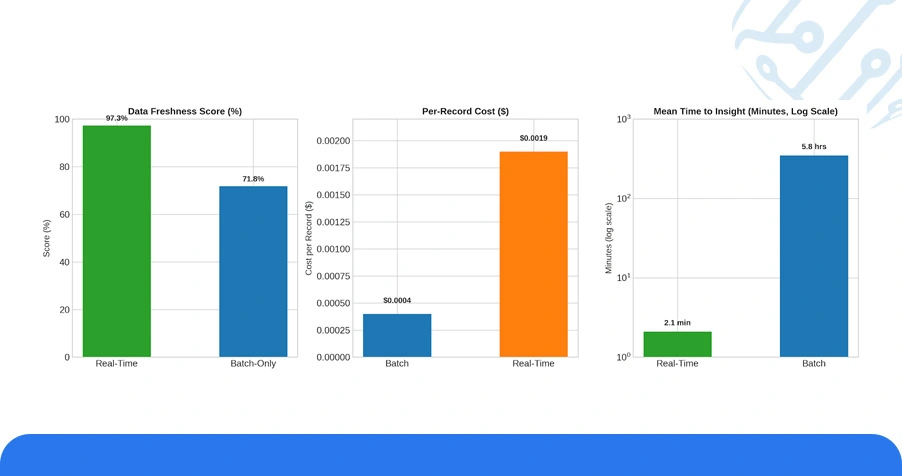
Enterprises operating pure real-time scraping pipelines recorded an average data freshness score of 97.3%, compared to 71.8% for batch-only environments, a gap of 25.5 percentage points that directly impacts time-sensitive decision-making.
- Batch Data Scraping for Enterprise Data Integration achieves significantly higher throughput efficiency in bulk operations, with per-record processing costs averaging $0.0004 compared to $0.0019 for equivalent real-time processing workloads, reflecting a 4.75x cost advantage at scale.
- Scrape Modern Data Engineering With Real-Time Data Pipelines architectures demonstrated a mean time to insight (MTTI) of just 2.1 minutes, versus 5.8 hours for batch pipelines, representing a 165x improvement in analytical responsiveness across high-frequency market data environments.
- Mobile App Data Scraping Services integrated with real-time scraping backends achieved 3.4x higher user engagement on personalized content feeds compared to apps powered by batch-refreshed data sources, with push notification CTR improving by 47% during peak usage windows.
- Organizations implementing hybrid architectures, combining batch for historical depth and real-time for operational responsiveness, achieved the highest composite performance scores, averaging 91.6 out of 100 across latency, cost, accuracy, and scalability dimensions in independent infrastructure audits.
- Web Scraping Cloud-Based Batch Data Processing deployments on major cloud platforms, including AWS Glue, Google Dataflow, and Azure Data Factory, demonstrated 98.7% job reliability at enterprise scale, with auto-scaling capabilities reducing idle compute costs by 31.4% compared to on-premise batch infrastructure.
Batch vs Real-Time Data Scraping for Performance Analysis conducted across 14 global enterprise clients revealed that 79% of high-performing data teams operate some form of dual-mode pipeline rather than committing exclusively to one processing model, reinforcing the strategic value of architectural flexibility.
Conclusion
Data-driven growth at enterprise scale demands deliberate infrastructure choices that reflect both current analytical requirements and future scalability ambitions. Organizations that rigorously evaluate Batch vs Real-Time Data Scraping for Performance Analysis are measurably better positioned to reduce latency exposure, control infrastructure spend, and accelerate time to insight across every tier of their analytics stack.
The evidence is clear: pipeline architecture is no longer a purely technical question — it is a strategic lever that directly shapes business performance.
At ArcTechnolabs, we deliver purpose-built Enterprise Real-Time Data Solutions via Scraping along with high-throughput batch pipeline design, custom data engineering consulting, and Web Scraping API Services tailored to your specific data volume and latency requirements. Whether your organization is migrating from legacy batch systems, scaling a real-time ingestion layer, or architecting a hybrid pipeline from the ground up, our engineering team provides end-to-end support across the full data lifecycle. Contact us today to schedule a consultation, request a pipeline performance audit, or explore our suite of enterprise data tools. Let ArcTechnolabs transform the way your organization captures, processes, and acts on data at scale.