Introduction
In the fast-evolving world of online retail, product data scattered across multiple marketplaces often arrives in inconsistent, duplicate, or conflicting formats. For ecommerce businesses managing thousands of SKUs, this creates serious challenges in pricing accuracy, catalog management, and customer trust. Entity Resolution Techniques in Ecommerce Data Scraping have emerged as a critical solution for brands that need clean, unified, and actionable product intelligence.
We worked closely with a growing ecommerce brand to design a structured approach that could reconcile fragmented product records across platforms. The engagement required deep expertise in Web Scraping Ecommerce Data to collect raw marketplace listings at scale before any normalization or resolution logic could be applied. The outcome was a transformation in how the client viewed and used its product catalog data.
This case study outlines how we tackled product identity conflicts, SKU-level mismatches, and cross-platform catalog inconsistencies through a methodical, automation-first strategy that delivered measurable improvements in data quality, operational speed, and marketplace competitiveness.
The Client
The client is a mid-sized ecommerce retailer with an active catalog of over 85,000 products listed across Amazon, Flipkart, Meesho, and its own direct-to-consumer website. Operating in categories like electronics accessories, home essentials, and fashion, the brand relied heavily on accurate product data to maintain pricing parity and promotional relevance.
Despite a growing digital presence, the client struggled with product records that varied significantly between platforms. The same item would appear under different titles, brand names, or specifications depending on the marketplace. Entity Resolution Techniques in Ecommerce Data Scraping were identified early as the foundation needed to fix these inconsistencies and consolidate the brand's data infrastructure.
The client wanted a reliable partner to implement Product Identity Resolution via Ecommerce Scraping at scale, helping them build a single source of truth for every product in their portfolio. They needed this resolved across platforms, regions, and third-party seller listings without disrupting their existing catalog management workflows.
Key Challenges
Before we could deploy a resolution framework, it was important to fully understand where and how data inconsistencies were surfacing. The brand's internal teams had been managing these issues manually, which was neither scalable nor accurate.
The core problems identified during the discovery phase included:
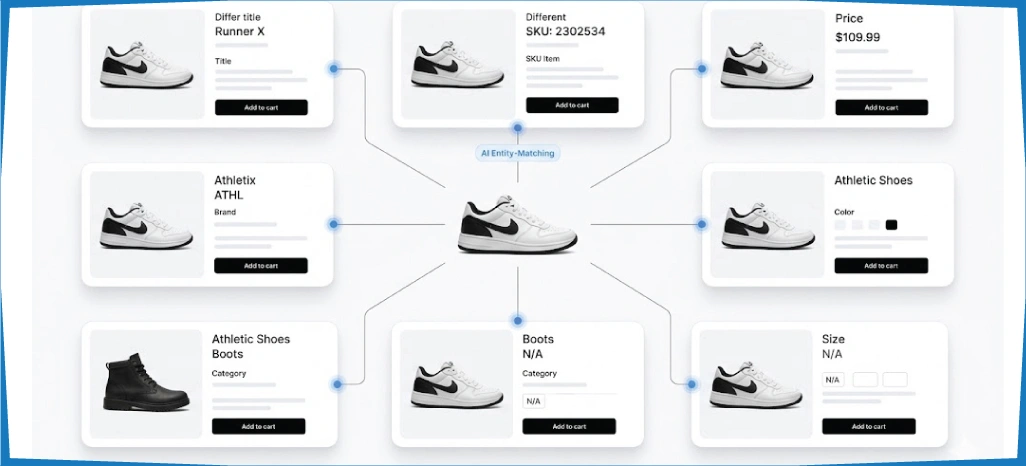
- Product titles differ by platform due to character limits, seller customizations, and regional naming conventions.
- Duplicate SKUs created when the same product was listed by multiple third-party sellers with minor attribute differences.
- Price discrepancies of up to 22% for the same item across platforms due to absence of a unified reference dataset.
- Missing or mismatched product attributes like color, size, and model number that caused incorrect search rankings.
- Inability to match competitor listings to the client's own catalog for meaningful price benchmarking.
- Poor category tagging leading to irrelevant product recommendations and low conversion rates.
- Brand name variations, abbreviations, and transliterations creating identity confusion across regional marketplaces.
These challenges made it clear that the client needed a systematic solution rooted in intelligent data matching and classification, not just additional data collection.
Key Solution
The results of our engagement were visible within the first 30 days of deployment and continued to improve as the resolution models were fine-tuned based on live data.
- The pipeline also incorporated Product Mapping Analytics Using Scraper for E-Commerce, which allowed the team to build cross-platform product maps that tied every marketplace listing to a canonical product ID in the client's master catalog.
- E-Commerce Datasets were enriched using structured attribute extraction from product descriptions, image metadata, and specification tables, giving the client complete and consistent product profiles.
- Entity Resolution Scraping for SKU Matching was further extended to handle competitor product mapping, enabling the brand to benchmark its pricing and positioning against similar products from rival sellers in real time.
- Through Product Identity Resolution via Ecommerce Scraping, the brand was able to identify 4,200 previously untracked competitor listings that were directly competing with their top 500 SKUs.
- How Entity Resolution Improves Ecommerce Data Scraping Accuracy also showed measurable gains in search ranking, with the client's products appearing in the top 5 search results for 62% of target keywords, up from 31% before the engagement.
Enterprise Web Crawling infrastructure deployed by us ensured that large-scale data collection remained stable, fast, and compliant with platform-specific crawling protocols, processing over 2 million product records weekly without performance degradation.
Product Mapping Analytics Using Scraper for E-Commerce further enabled the client to identify catalog gaps in specific categories, prompting the addition of 1,800 new product listings that had been missed due to inconsistent classification in prior systems.

Impact of Data Inconsistencies on Business Performance
Understanding the downstream business effects of poor data quality helped us prioritize resolution efforts and allocate technical resources effectively.
The table below reflects the measurable impact the client experienced before implementing entity resolution, across key performance parameters:
| Performance Metric | Before Entity Resolution | After Entity Resolution |
|---|---|---|
| SKU Duplicate Rate | 34% across platforms | Reduced to under 4% |
| Price Matching Accuracy | 61% correct alignment | 94% correct alignment |
| Catalog Processing Time | 11 hours per batch | Under 2.5 hours per batch |
| Attribute Completeness | 57% fields populated | 91% fields populated |
| Competitor Match Rate | 38% successful matches | 89% successful matches |
| Search Visibility Score | Low across 3 platforms | Improved on all 4 platforms |
These numbers represented not just operational improvement but a direct financial impact. Faster catalog processing reduced time-to-market for new listings, while improved price alignment minimized revenue leakage.
The data above reflects averages measured over a 90-day period post-implementation, validated through the client's internal BI reporting tools and third-party marketplace analytics dashboards.
Advantages of Implementing ArcTechnolabs
-
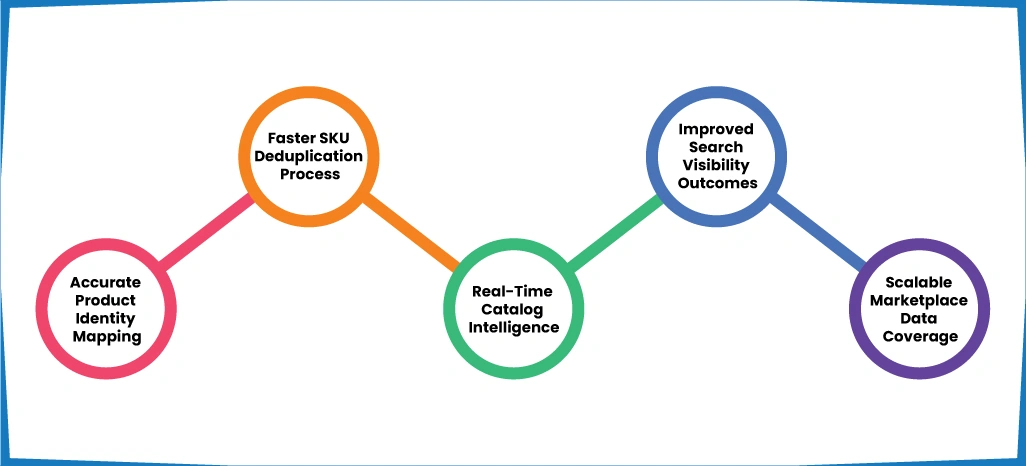
Accurate Product Identity Mapping
We enable Product Identity Resolution via Ecommerce Scraping by building precise cross-platform product maps, eliminating identity confusion and ensuring each SKU is correctly unified across all marketplaces.
-
Faster SKU Deduplication Process
Using Entity Resolution Scraping for SKU Matching, we significantly reduced duplicate records, cutting manual catalog review time and accelerating product listing accuracy for ecommerce operations.
-
Real-Time Catalog Intelligence
Product Mapping Analytics Using Scraper for E-Commerce enables brands to monitor competitor listings, detect pricing gaps, and refresh product maps every few hours with reliable marketplace intelligence.
-
Improved Search Visibility Outcomes
We apply How Entity Resolution Improves Ecommerce Data Scraping Accuracy to enrich product attributes, directly contributing to better search rankings and higher product discoverability across major ecommerce platforms.
-
Scalable Marketplace Data Coverage
Through E-Commerce Datasets built from multi-platform crawling, we deliver comprehensive, structured product data at scale, supporting catalog expansion without compromising data quality or operational speed.
Client Testimonial
ArcTechnolabs brought structure to what felt like an impossible data problem. Their approach to Entity Resolution Techniques in Ecommerce Data Scraping was methodical and results-driven. We finally had a catalog we could trust. The Mobile App Data Scraping Services they provided for marketplace-specific data added another dimension to our competitive intelligence that we hadn't anticipated but immediately valued.
– Head of Digital Catalog & Marketplace Strategy, Leading Ecommerce Retailer
Conclusion
Product data inconsistencies are not a minor inconvenience; they are a structural problem that erodes pricing confidence, catalog reliability, and competitive positioning in any marketplace environment. Entity Resolution Techniques in Ecommerce Data Scraping address these problems at the root level, converting scattered and conflicting records into a unified, trusted product intelligence layer.
For ecommerce brands managing large catalogs across multiple platforms, the path to cleaner data starts with the right technology partner. Product Mapping Analytics Using Scraper for E-Commerce enables the kind of cross-platform product clarity that supports faster decisions, better rankings, and stronger revenue performance.
Contact ArcTechnolabs today to discuss how we can help you fix product data inconsistencies, resolve SKU conflicts, and build a catalog intelligence system that scales with your business growth and evolving marketplace demands.