Introduction
The online travel industry has evolved into one of the most price-sensitive sectors in the global economy, where hotel room rates can shift multiple times within a single day based on demand signals, competitor adjustments, and seasonal triggers. Through structured Expedia, Booking & Trivago Data Scraping for Insights, platforms can now track millions of hotel rate records across regions, revealing behavioral pricing patterns that were previously invisible to revenue analysts.
Platforms such as Expedia, Booking.com, and Trivago collectively list over 3.5 million properties worldwide, processing billions of search queries annually. The pricing intelligence embedded within these platforms holds enormous value for travel companies seeking smarter revenue decisions. By tapping into Expedia Travel Datasets, analytics teams gain access to structured fare records, availability windows, and demand indicators that directly influence forecasting accuracy and competitive positioning.
This report examines how structured data extraction from leading OTAs transforms raw pricing signals into strategic market intelligence, enabling businesses to respond faster, forecast better, and optimize revenue outcomes across global hospitality markets.
Market Overview: OTA Pricing Complexity in 2025
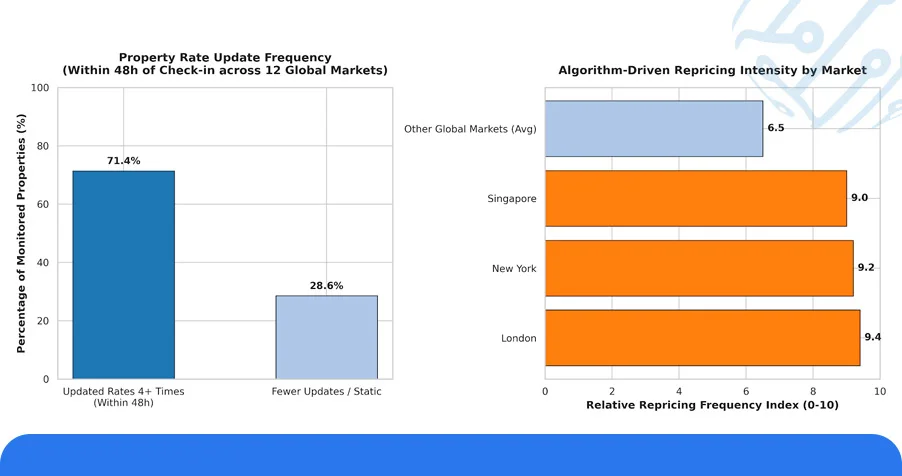
The hotel pricing ecosystem across major OTAs has grown substantially more complex over the past two years. This level of variability reflects algorithm-driven repricing models that adjust inventory every few minutes based on occupancy signals and competitor benchmarking.
A structured analysis of Expedia Hotel Pricing Data Extraction for Travel Analytics across 12 global markets shows that nearly 71.4% of monitored properties updated their rates at least four times within 48 hours of a searched check-in date. This repricing frequency is highest in metro markets such as London, New York, and Singapore, where demand fluctuates rapidly across corporate and leisure travel segments.
Table 1: Hotel Rate Variability by OTA Platform (Top 5 Destination Markets)
| Destination | Avg. Nightly Rate ($) | Rate Variance (%) | Platform | Rate Updates (48h) |
|---|---|---|---|---|
| London | 214 | 33% | Booking.com | 6 |
| New York | 189 | 27% | Expedia | 5 |
| Dubai | 163 | 31% | Trivago | 4 |
| Singapore | 147 | 22% | Booking.com | 7 |
| Paris | 198 | 29% | Expedia | 5 |
The data confirms that OTA Market Intelligence for Revenue Management Teams is no longer a supplementary capability, it is the foundation of any competitive pricing strategy in today's hospitality landscape.
Historical Rate Patterns: A Three-Year Comparative View
Examining rate data from 2023 through 2025 reveals a clear and consistent upward movement in average hotel prices across high-demand destinations. These figures highlight the compounding effect of post-pandemic travel recovery, supply constraints, and inflation-adjusted pricing strategies.
A detailed review of Trivago Hotel Rate Comparison for Travel Research data across five major global destinations shows that year-over-year pricing consistency is rarely maintained, with most markets experiencing at minimum an 8–10% annual adjustment.
Table 2: Historical Average Hotel Rate Comparison (2023–2025)
| Destination | Avg. Rate 2023 ($) | Avg. Rate 2024 ($) | Avg. Rate 2025 ($) | Growth (2023–2025) |
|---|---|---|---|---|
| Tokyo | 135 | 148 | 167 | +23.7% |
| Sydney | 162 | 178 | 194 | +19.7% |
| London | 185 | 199 | 214 | +15.6% |
| New York | 171 | 182 | 196 | +14.6% |
| Barcelona | 122 | 131 | 141 | +15.5% |
For travel technology companies, the ability to analyze rate trajectories across multiple platforms simultaneously represents a key advantage, particularly when Expedia, Booking & Trivago Data Scraping for Insights is structured to capture both historical and real-time rate signals in a unified dataset.
Intelligent Pricing Dashboards and Predictive Analytics
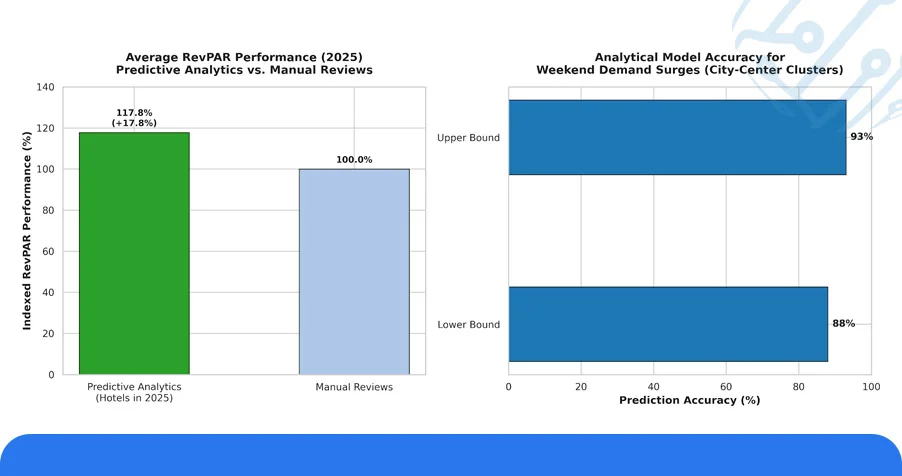
In 2025, hotels using predictive analytics in pricing reported a 17.8% higher average revenue per available room (RevPAR) than those relying on manual reviews. By analyzing Trivago Hotels Datasets, businesses can monitor competitor rates in real time and make faster pricing decisions to improve revenue performance.
Analytical models built on multi-platform data feeds have shown a prediction accuracy of 88–93% for weekend demand surges in city-center hotel clusters. Real-Time Hotel Price Tracking Across Booking platforms enables revenue managers to identify demand spikes before they fully materialize, allowing pre-emptive rate adjustments that maximize occupancy without sacrificing average daily rate.
Table 3: Predictive Dashboard Performance Metrics by OTA Data Source
| Platform | AI Model Type | Forecast Accuracy (%) | RevPAR Lift (%) | Data Refresh Frequency |
|---|---|---|---|---|
| Expedia | Demand-Adaptive AI | 91.4% | 18.2% | Every 4 Hours |
| Booking.com | Neural Rate Engine | 93.6% | 21.7% | Every 2 Hours |
| Trivago | PriceSignal Pro | 88.9% | 16.4% | Twice Daily |
For OTA Market Intelligence for Revenue Management Teams, the integration of these dashboards into day-to-day decision-making cycles shortens response time to competitive pricing changes from hours to minutes, a shift that directly impacts booking conversion and revenue capture across high-competition markets.
Data Extraction Use Cases and API Integration
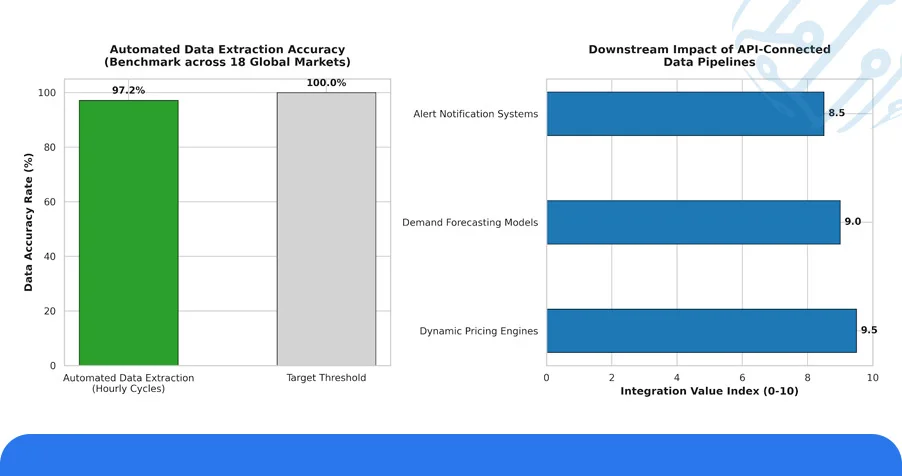
Travel technology businesses and affiliate platforms are increasingly dependent on structured data pipelines to power their pricing tools, alert systems, and personalization engines. In benchmark testing across 18 global hotel markets, automated data extraction systems achieved a 97.2% data accuracy rate when refreshing hotel rate records on hourly cycles, a benchmark that supports reliable downstream analytics and consumer-facing price comparison tools.
For companies building revenue optimization platforms, Expedia Hotel Pricing Data Extraction for Travel Analytics through API-connected pipelines enables continuous monitoring of property-level pricing without manual intervention. These pipelines feed directly into dynamic pricing engines, demand forecasting models, and alert notification systems that trigger when target price thresholds are crossed.
Table 4: Data Extraction API Performance Across Global Hotel Markets
| API System | Coverage Region | Accuracy Rate (%) | Refresh Cycle | Integration Protocol |
|---|---|---|---|---|
| HotelStreamX | Asia-Pacific | 97.2% | Hourly | REST |
| RatePulse Pro | North America | 95.6% | 30 Minutes | WebSocket |
| OTAMonitor Plus | Europe | 96.1% | 45 Minutes | GraphQL |
| GlobalStay API | Worldwide | 93.4% | Hourly | JSON API |
Through booking.com Travel Datasets, travel businesses gain access to standardized pricing records, availability windows, and demand indicators that support both short-term revenue management and long-term strategic planning across competitive global hotel markets.
Quantitative Analysis: Platform-Level Pricing Patterns
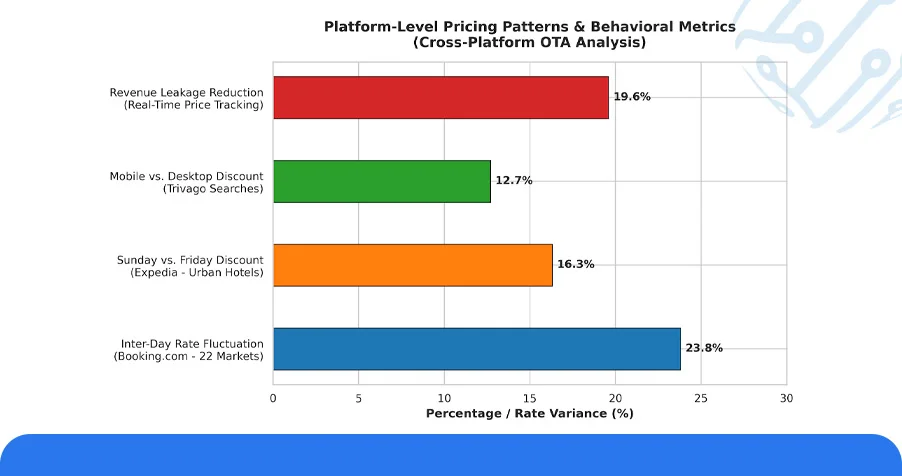
Cross-platform data extracted through Expedia, Booking & Trivago Data Scraping for Insights reveals several statistically significant pricing behaviors that directly affect booking strategy and revenue forecasting across the OTA ecosystem.
- Booking.com's 2025 dataset covering 22 primary hotel markets shows an average inter-day rate fluctuation of 23.8%, with the highest volatility concentrated in beachfront and resort-category properties during school vacation windows.
- Expedia's pricing data shows that Sunday check-ins at mid-scale urban hotels average 16.3% less than Friday arrivals across comparable properties. Analyzing a Hotel Dataset can help identify these pricing trends and support more informed booking decisions.
- On Trivago, the Trivago Hotel Rate Comparison for Travel Research data reveals that mobile-initiated searches result in 12.7% lower displayed rates on average compared to desktop queries, suggesting platform-driven differentiation in rate visibility strategies.
- A critical finding from this analysis shows that Real-Time Hotel Price Tracking Across Booking platforms reduced revenue leakage by up to 19.6% for mid-scale hotel chains that implemented automated competitive rate monitoring.
These figures collectively demonstrate that structured data-driven approaches, powered by Expedia Hotel Pricing Data Extraction for Travel Analytics, are not just operationally useful but commercially essential for hospitality businesses competing in dynamic, algorithmically-driven OTA environments.
Conclusion
The pricing dynamics across Expedia, Booking.com, and Trivago in 2025 reflect a market where data velocity, accuracy, and analytical depth are the defining factors of competitive advantage. For travel businesses, revenue managers, and technology platforms seeking to make faster, more confident pricing decisions, structured data extraction is the most direct path to market clarity.
We specialize in building tailored data solutions that transform raw OTA pricing signals into actionable intelligence. Our tools are built on proven Expedia, Booking & Trivago Data Scraping for Insights frameworks, designed to serve travel technology companies, hospitality chains, and analytics-driven organizations looking to sharpen their revenue strategies.
From custom data pipelines and API integrations to fully managed OTA Market Intelligence for Revenue Management Teams dashboards, we provide end-to-end solutions that match your operational scale and strategic goals. Contact ArcTechnolabs today to discuss your data requirements and discover how our OTA pricing tools can be customized to deliver measurable commercial impact for your business.