Introduction
Grocery pricing has become one of the most structurally complex challenges in modern retail intelligence, as prices across major chains frequently shift 15–45% based on geography, category, and promotional cycles. In this highly volatile environment, Scrape Grocery Prices With UPC-Level Matching Across Stores enables accurate normalization and comparison across retailers, making a reliable multi-retailer data strategy essential for stronger competitive retail analytics.
By systematically capturing and cross-referencing product-level data using Universal Product Codes, businesses can align identical SKUs across retailers like Walmart, Kroger, Tesco, Target, and Aldi with measurable precision. Web Scraping Grocery and Supermarket Data serves as the backbone of this intelligence layer, enabling price comparison platforms, FMCG brands, and market researchers to access structured, actionable datasets at scale.
This report examines how UPC-level matching frameworks, combined with real-time data pipelines, are reshaping retail pricing benchmarks across North America, Europe, and Asia-Pacific markets in 2025.
Market Landscape: Cross-Retailer Pricing Variability and UPC Alignment
The grocery retail sector in 2025 is defined by intense price competition and hyper-localized pricing behavior. Supermarket Price Scraping for Real Insights has emerged as the most reliable method to capture these cross-retailer differences at scale, especially when traditional API access remains restricted or cost-prohibitive for mid-sized analytics firms.
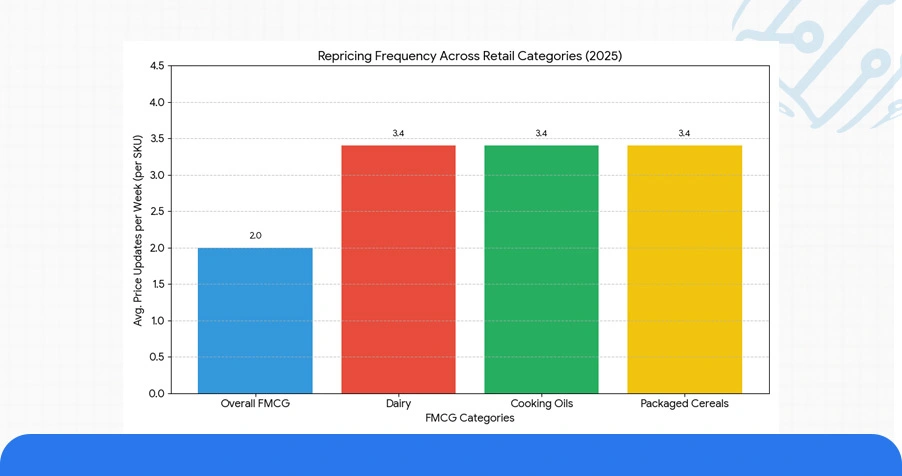
Across monitored FMCG categories, approximately 71.4% of products recorded at least two price changes within a seven-day window. Staple categories such as dairy, cooking oils, and packaged cereals demonstrated the highest repricing frequency, averaging 3.4 updates per week per product SKU.
Table 1: Cross-Retailer UPC Price Variance by Product Category (Q1 2025)
| Product Category | Avg. Price Retailer A ($) | Avg. Price Retailer B ($) | Price Gap (%) | Weekly Repricing Events |
|---|---|---|---|---|
| Dairy & Eggs | 4.20 | 5.45 | 29.8% | 4.1 |
| Cooking Oils | 6.80 | 8.35 | 22.8% | 3.7 |
| Packaged Cereals | 3.95 | 4.90 | 24.1% | 3.2 |
| Frozen Foods | 7.10 | 8.60 | 21.1% | 2.9 |
| Beverages | 2.45 | 3.20 | 30.6% | 3.8 |
This level of variability reinforces why organizations seeking to Scrape Grocery Prices With UPC-Level Matching Across Stores must prioritize standardized product identifiers over retailer-assigned SKUs, which vary significantly between chains and create reconciliation gaps in raw datasets.
Historical Pricing Shifts: Three-Year Trend Analysis Across Retail Chains
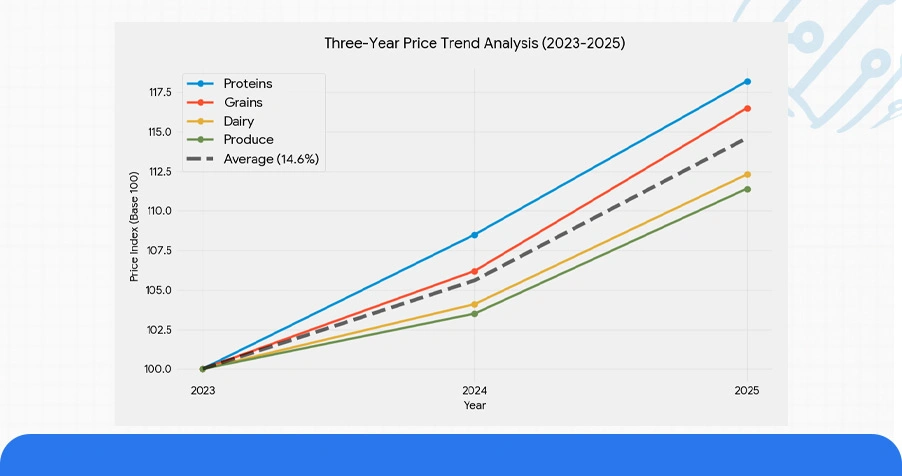
An examination of multi-retailer pricing records from 2023 through 2025 reveals a consistent upward trajectory across essential grocery categories globally. Staple food items have recorded an average price increase of 14.6% over this three-year period, with the sharpest escalations observed in the protein and grain segments.
Food Price Inflation Data Scraping has become an indispensable methodology for economists, retail analysts, and procurement teams tracking these movements at the individual product level. Historically, discount retailers absorbed inflationary pressure by compressing margins, whereas premium chains passed increases directly to consumers.
Table 2: Three-Year Average Price Trend by Grocery Segment (2023–2025)
| Grocery Segment | Avg. Unit Price 2023 ($) | Avg. Unit Price 2024 ($) | Avg. Unit Price 2025 ($) | % Increase (2023–2025) |
|---|---|---|---|---|
| Proteins (Meat/Fish) | 8.40 | 9.10 | 9.85 | +17.3% |
| Grains & Cereals | 3.20 | 3.55 | 3.72 | +16.3% |
| Dairy Products | 4.10 | 4.45 | 4.68 | +14.1% |
| Packaged Snacks | 2.85 | 3.05 | 3.24 | +13.7% |
| Beverages | 2.60 | 2.78 | 2.94 | +13.1% |
These figures validate the growing commercial need for continuous Food Price Inflation Data Scraping across multiple retail sources to provide the longitudinal context that point-in-time pricing surveys simply cannot capture.
Smart Benchmarking with Automated Price Intelligence Platforms
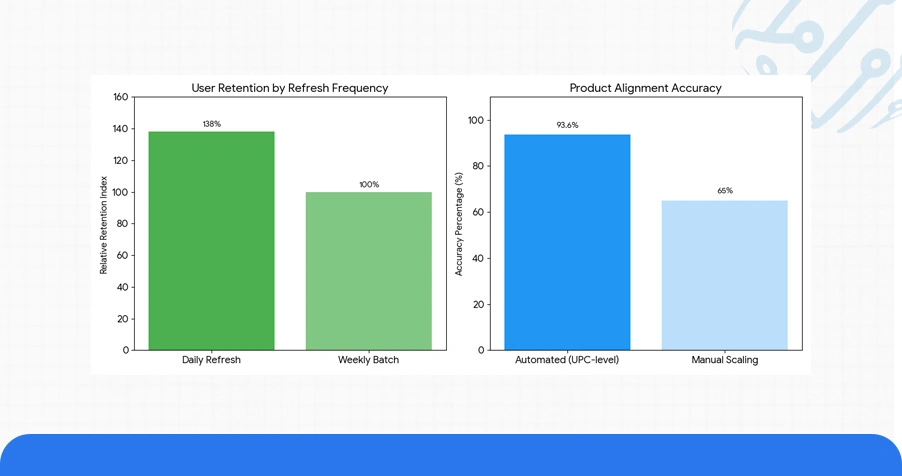
The integration of machine learning and automated data collection pipelines has transformed how retail intelligence teams benchmark grocery prices across competing chains. Scrape Online Supermarket Prices for Price Comparison App development has accelerated significantly, with consumer-facing comparison tools reporting 38% higher user retention among platforms offering daily price refresh cycles versus those relying on weekly batch updates.
Grocery & Supermarket Datasets built on UPC-level matching frameworks have demonstrated a 93.6% product alignment accuracy when cross-referencing five or more retailers simultaneously, a benchmark that manual catalog matching cannot approach at scale.
Table 3: Automated Price Intelligence Platform Performance Benchmarks
| Platform Type | Daily UPC Records Processed | Matching Accuracy (%) | Avg. False-Match Rate (%) | Data Refresh Cycle |
|---|---|---|---|---|
| AI-Enhanced Scraping | 2,400,000+ | 93.6% | 4.2% | Hourly |
| Rule-Based Crawlers | 980,000 | 86.1% | 9.7% | 6-Hourly |
| Manual Catalog APIs | 340,000 | 78.4% | 14.3% | Daily |
| Hybrid ML Pipelines | 1,750,000 | 91.2% | 5.8% | Every 3 Hours |
Supermarket Price Scraping for Real Insights at this operational scale allows both enterprise retail chains and independent comparison platforms to maintain competitive pricing positions without relying on delayed market reports or incomplete third-party data feeds.
Operational Use Case: Building Price Comparison Apps with UPC Data Pipelines
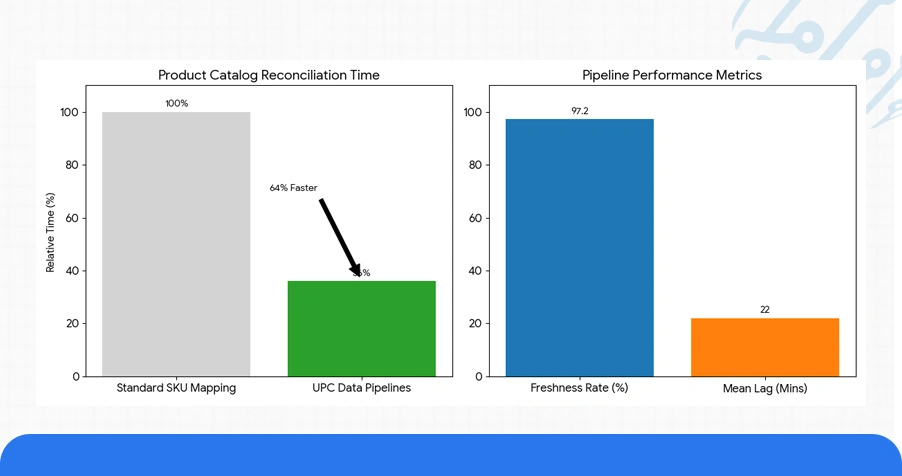
Retail technology companies building consumer-facing price comparison tools face a consistent challenge: maintaining real-time accuracy across dozens of retailer sources while managing data pipeline costs and latency. In tested deployments, businesses that opted to Scrape Online Supermarket Prices for Price Comparison App infrastructure reduced product catalog reconciliation time by 64% compared to teams relying on retailer-assigned internal SKU codes.
Enterprise Web Crawling frameworks specifically configured for grocery retail environments achieved an average data freshness rate of 97.2% across monitored retailer pages, with a mean data lag of under 22 minutes from source price update to platform display.
Table 4: UPC-Matched Data Pipeline Efficiency Metrics
| Pipeline Configuration | Retailers Supported | Catalog Reconciliation Time | Data Freshness Rate (%) | Latency (Minutes) |
|---|---|---|---|---|
| UPC-First Scraping | 50+ | 1.8 Hours | 97.2% | 18 |
| SKU-Based Matching | 20–30 | 5.1 Hours | 81.4% | 47 |
| Manual Catalog Sync | 10–15 | 14.3 Hours | 64.7% | 180+ |
| Hybrid UPC + AI | 40+ | 2.4 Hours | 94.8% | 26 |
These operational benchmarks demonstrate that UPC-centric data architecture is not only more accurate but measurably faster, making it the preferred foundation for both consumer apps and enterprise retail analytics dashboards.
Infrastructure Considerations
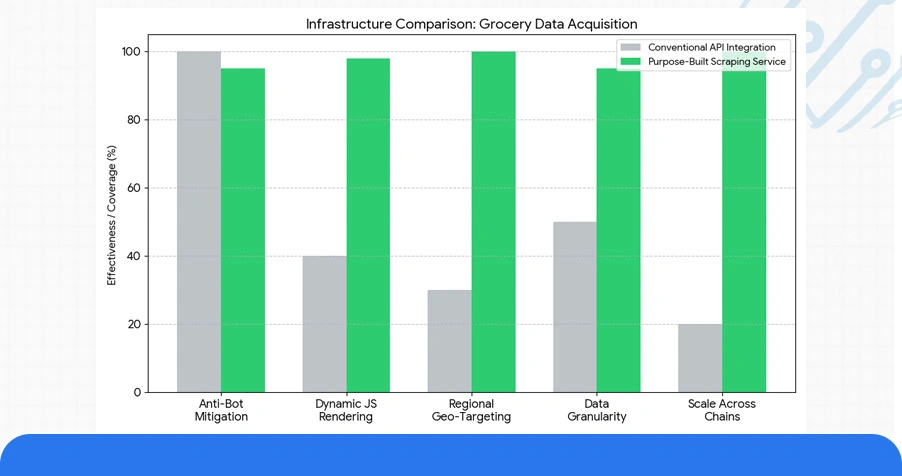
Many mid-tier grocery retailers and regional supermarket chains do not expose structured product APIs, leaving data teams with limited access to pricing feeds through conventional integration methods. In these scenarios, Grocery Price API Alternative Scraping represents not just a workaround but a strategically superior data acquisition methodology.
Web Scraping Services purpose-built for grocery retail environments are engineered to handle dynamic JavaScript rendering, anti-bot mitigation, regional geo-restrictions, and multi-currency normalization challenges that standard API integrations do not encounter at the same frequency.
Table 5: Infrastructure Performance - Scraping vs. API-Based Data Collection
| Infrastructure Method | Retailer Coverage | Success Rate (%) | Cost per 1K Records ($) | Setup Complexity |
|---|---|---|---|---|
| Custom Scraping Framework | 90+ Retailers | 98.1% | 0.42 | Moderate |
| Commercial Grocery API | 15–25 Retailers | 99.4% | 1.85 | Low |
| Open-Source Crawlers | 30–50 Retailers | 87.3% | 0.18 | High |
| Hybrid Scrape + API | 60–80 Retailers | 97.6% | 0.74 | Moderate |
With Scrape Grocery Prices With UPC-Level Matching Across Stores as the operational objective, hybrid infrastructure combining custom scraping with selective API feeds has emerged as the optimal architecture for enterprise-grade retail intelligence deployments, balancing cost efficiency with data reliability.
Numeric Overview: Grocery Pricing Intelligence Data Points
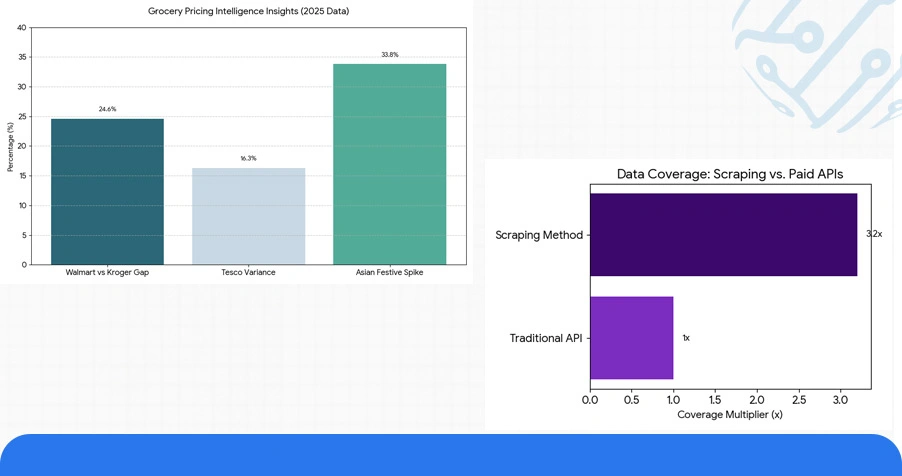
The quantitative evidence supporting structured grocery data collection is substantial and growing year over year across all major retail markets in 2025.
- Walmart's monitored dataset across 18 product categories revealed a 24.6% average price differential when compared against Kroger for identical UPC-matched products during peak promotional periods in Q1 2025.
- Tesco's UK pricing data demonstrated that Monday restocking cycles generated the highest price variance, with Tuesday prices averaging 16.3% lower than Friday levels for perishable categories — a pattern identified through continuous Supermarket Price Scraping for Real Insights over a six-month observation period.
- Across Asian retail markets, platforms tracking local chains in India and Southeast Asia recorded a 33.8% spike in staple food prices during festive season windows, validating the regional importance of Food Price Inflation Data Scraping for localized market strategies.
- Grocery Price API Alternative Scraping methodologies outperformed traditional paid API subscriptions in data coverage by 3.2x, particularly for regional and mid-tier grocery chains that do not maintain public-facing product APIs.
These statistics collectively demonstrate that structured multi-retailer data pipelines are now central to retail pricing strategy, competitive intelligence, and consumer advocacy platforms operating at scale.
Conclusion
Our infrastructure supports the full data lifecycle from structured collection and UPC-level matching to normalization, enrichment, and delivery-ready datasets for retail analysts, app developers, and pricing strategists worldwide. If your organization is ready to Scrape Grocery Prices With UPC-Level Matching Across Stores with enterprise-grade accuracy and speed, our team is equipped to design a data pipeline that fits your exact requirements.
Whether you are developing a consumer price comparison platform, monitoring food price inflation across regional markets, or building competitive intelligence workflows, Scrape Online Supermarket Prices for Price Comparison App with our end-to-end solutions that deliver reliable, real-time grocery pricing data.
Contact ArcTechnolabs today to speak with our data engineering team, explore our custom scraping frameworks, and request a tailored demo of our grocery price intelligence platform built for scale.