Introduction
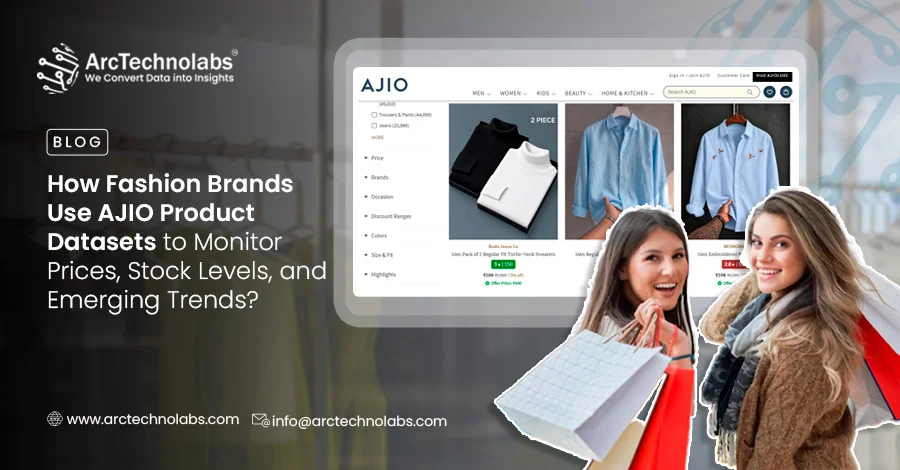
Competing in India’s fast-moving online apparel market requires granular visibility into competitor assortments, discounting cycles, and consumer demand shifts. Relying on manual tracking leaves retail teams blind to rapid marketplace changes. By studying How Fashion Brands Use AJIO Product Datasets, merchandising leaders turn raw catalog listings into actionable commercial intelligence.
Through specialized AJIO Data Scraping Services, apparel companies collect structured records covering SKU pricing, size availability, fabric tags, and customer ratings across thousands of brands. Instead of guessing which silhouettes or price points resonate with shoppers, decision-makers base their seasonal buying and markdown calendars on real-time marketplace evidence.
Implementing AJIO E-Commerce Product Catalog Scraping allows direct-to-consumer labels and multi-brand retailers to benchmark their catalogs daily. Whether launching a new ethnic wear line or adjusting festive promotions, structured marketplace intelligence ensures every pricing, inventory, and design move aligns with actual shopper behavior.
Dynamic Price Benchmarking and Competitive Promotional Intelligence Strategies
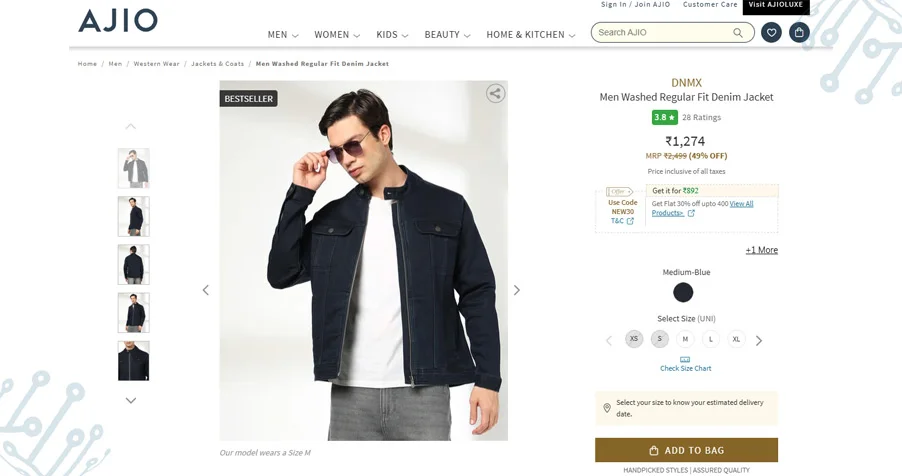
Fashion retail runs on razor-thin margins where overpricing stalls sell-through and premature discounting erodes profitability across seasonal collections. Industry benchmarks indicate that retailers using automated competitive price monitoring improve gross margins by 3% to 6% during peak festive quarters. Tracking Maximum Retail Price, active selling price, and flash sale durations helps revenue teams protect profitability without losing price-sensitive shoppers to rival storefronts.
Leveraging a structured E-Commerce Dataset in the middle of daily pricing workflows reveals exactly when competitors initiate end-of-season markdowns or bundle discounts across specific categories like denim, athleisure, and fusion wear. Instead of applying blanket storewide price cuts, commercial analysts execute targeted adjustments only on overlapping styles where price elasticity is highest, preserving full-price realization on differentiated designs.
- Automated tracking of daily discount percentages across competing private labels and national brands.
- Identification of underserved mid-premium price tiers where competitor SKU density remains low.
- Early detection of aggressive clearance markdowns on slow-moving seasonal inventory.
| Pricing Metric Tracked | Marketplace Signal Captured | Strategic Retail Action |
|---|---|---|
| Discount Depth (%) | Gap between MRP and active selling price | Match promotional tiers selectively on high-volume basics |
| Markdown Velocity | Days elapsed from product launch to first price drop | Identify slow-moving competitor styles early |
| Price Band Distribution | SKU concentration across ₹500–₹4,000+ tiers | Spot underserved mid-premium pricing white spaces |
| Coupon & Bank Offers | Cart-level promotional mechanics during sales | Calibrate net effective pricing before major sale events |
Deploying AJIO E-Commerce Product Catalog Scraping across high-volume apparel categories also uncovers hidden promotional mechanics such as cart-level bank offers, tiered coupon codes, and weekend flash deals. Pricing managers evaluate historical discount curves to determine the optimal launch price point and avoid premature markdowns that train customers to wait for steep sales.
Real-Time Stock Level and Size Availability Tracking Methods
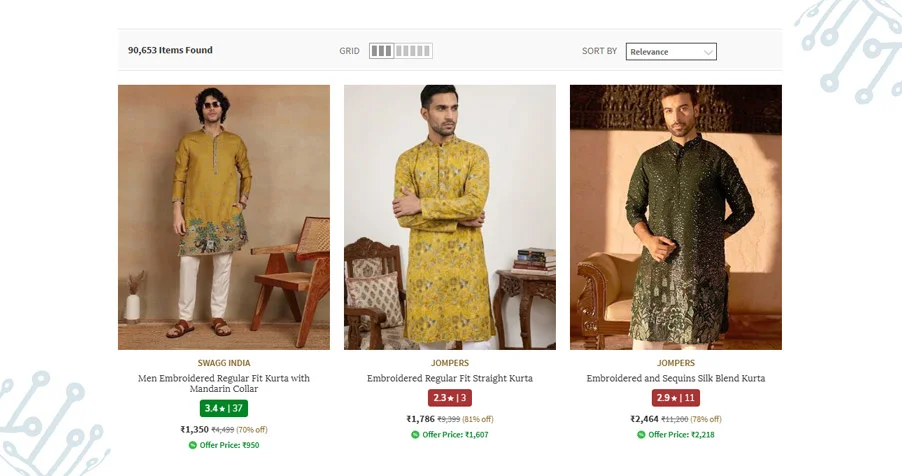
Stockouts on core sizes cost apparel brands up to 12% in lost revenue each season, while overstocking niche sizes ties up working capital in dead inventory. Supply chain planners monitor SKU-level availability, size-curve depletion rates, and restock frequencies across competing storefronts to keep bestsellers consistently in stock during high-traffic sale events.
Integrating Ecommerce Data Scraping Services into demand forecasting workflows also exposes regional warehouse fulfillment patterns and supplier replenishment lead times across categories. Buying teams analyze how quickly top-performing labels restock depleted variants, using those signals to negotiate tighter production turnaround windows with their own garment manufacturers.
- Continuous monitoring of variant-level availability across XS to XXL sizing matrices.
- Instant alerts when top-ranked competitor listings go out of stock in core sizes.
- Benchmarking of category assortment breadth ahead of major festive collection drops.
| Inventory Indicator | Data Extraction Field | Merchandising & Supply Chain Impact |
|---|---|---|
| Size-Curve Depletion | Availability status across XS to XXL variants | Adjust future production ratios toward fast-selling sizes |
| Out-of-Stock (OOS) Alerts | Timestamp when top-ranked SKUs turn unavailable | Redirect marketing budgets to capture competitor spillover |
| Restock Frequency | Time taken for sold-out items to reappear live | Gauge competitor supply chain agility and vendor reliability |
| Assortment Breadth | Active SKU count per sub-category and brand | Benchmark catalog depth before seasonal collection drops |
Utilizing AJIO Fashion Product Data Scraping during peak shopping cycles enables merchandising teams to pinpoint the exact moment rival bestsellers sell out in popular sizes like Medium or Large. Once a competitor experiences a stockout on a high-demand silhouette, competing brands immediately scale paid ad spend on their equivalent in-stock styles to capture unmet shopper demand.
Spotting Emerging Fashion Trends and Catalog Assortment Gaps
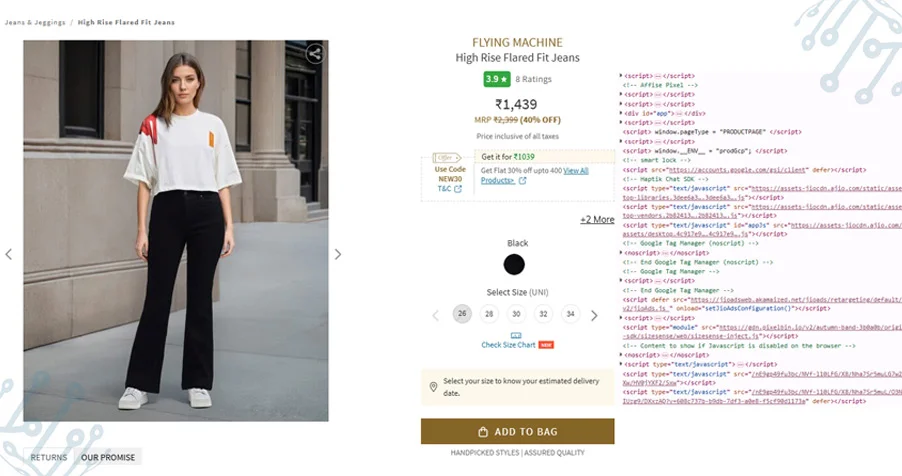
Trend cycles in online fashion have compressed from six months to under four weeks, driven by social media micro-trends and regional festive calendars. Industry studies show that data-driven assortment planning reduces unsold seasonal inventory by up to 18%, allowing design teams to allocate fabric budgets toward silhouettes with proven commercial traction.
Extracting an AJIO E-Commerce Dataset gives creative directors early visibility into rising colorways, necklines, prints, and sustainable fabric tags based on new-arrival velocity. Rather than relying solely on runway forecasts, buyers validate which micro-trends are gaining genuine momentum across mass and premium segments before committing to bulk factory orders.
- Early detection of high-velocity colors, sleeve styles, and prints across newly uploaded catalogs.
- Sentiment analysis of verified buyer reviews to identify recurring fit or fabric complaints.
- Identification of catalog white spaces where shopper demand outpaces available brand offerings.
| Trend Signal Category | Catalog Attributes Analyzed | Product Development Outcome |
|---|---|---|
| Color & Print Velocity | Frequency of new SKUs in specific palettes/motifs | Prioritize winning colorways in upcoming capsule drops |
| Fabric & Fit Preferences | Cotton blends, linen, oversized vs. slim-fit tags | Align textile sourcing with documented buyer preferences |
| Review Sentiment & Ratings | Star ratings and fit feedback on newly launched styles | Refine garment sizing charts to cut return rates |
| New-Arrival Cadence | Weekly upload volume across private and global labels | Time collection launches ahead of peak category demand |
Through Web Scraping Services, brands aggregate thousands of product attributes alongside verified customer ratings and fit feedback to separate fleeting fads from high-converting staples. Connecting an AJIO Fashion Dataset API directly into internal business intelligence dashboards lets product teams spot underserved style niches and refine garment sizing charts to reduce return rates.
How ArcTechnolabs Can Help You?
Building reliable in-house crawlers to monitor dynamic fashion marketplaces requires constant maintenance against anti-bot defenses and frequent layout updates. Retail analytics teams looking at How Fashion Brands Use AJIO Product Datasets partner with us to receive clean, structured, and analysis-ready fashion intelligence without engineering overhead.
We tailor every delivery schedule and data schema to fit your exact merchandising, pricing, or supply chain objectives:
- Automated daily and hourly tracking of SKU prices, discount percentages, and promotional badges across targeted categories.
- Granular size-level stock monitoring to detect competitor sell-outs and replenishment patterns in real time.
- Rich product attribute extraction covering fabric composition, fit type, color family, pattern, and brand metadata.
- High-accuracy catalog deduplication and product matching to compare identical or similar styles across rival labels.
- Scalable cloud infrastructure engineered to process large seasonal catalog expansions without downtime or rate-limit bottlenecks.
- Flexible delivery formats including JSON, CSV, Parquet, and direct cloud warehouse integration for immediate BI visualization.
By integrating our AJIO Fashion Dataset API directly into your analytics ecosystem, your teams gain continuous marketplace visibility that turns competitive signals into measurable revenue growth.
Conclusion
Winning in modern apparel e-commerce depends on replacing gut-instinct merchandising with continuous, granular marketplace visibility. Understanding How Fashion Brands Use AJIO Product Datasets empowers retailers to protect profit margins through disciplined price benchmarking, prevent costly stockouts via size-level availability tracking, and validate upcoming seasonal collections using real shopper demand signals.
When backed by structured AJIO E-Commerce Product Catalog Scraping, every pricing adjustment, inventory replenishment, and design bet becomes sharper and more profitable. Ready to transform live marketplace data into your brand’s strongest competitive advantage? Contact ArcTechnolabs today to request a custom sample dataset and schedule a consultation with our retail data specialists.