Introduction
Japan's e-commerce landscape is evolving at a pace that demands sharper, faster, and more precise data intelligence from every market participant. Platforms such as Rakuten, Amazon Japan, Yahoo! Shopping, and Mercari collectively account for over ¥22.7 trillion in annual gross merchandise volume as of 2025, reflecting a year-on-year growth rate of 9.4%.
In this fiercely competitive environment, businesses that rely on manual research or delayed insights face compounding disadvantages in pricing accuracy and product strategy. The practice of Web Scraping Ecommerce Data has therefore graduated from a supplementary tactic into a foundational pillar of modern retail intelligence, empowering organizations to monitor competitor activity, track demand signals, and optimize assortments in near real time.
This report explores how structured data extraction, dynamic dashboards, and API-powered pipelines are transforming how businesses interpret Japan’s digital commerce ecosystem, with Web Scraping Product Data for Japan E-Commerce Insights enabling measurable advantages for pricing teams, category managers, and strategic planners.
Market Landscape: Pricing Complexity Across Japan's Digital Retail Platforms
Japan's digital retail market is distinguished by its platform fragmentation, unique consumer behavior, and a product catalog scale that makes manual monitoring practically unworkable. Retail Product Data Scraping in Japan has emerged as the definitive method for capturing this scale of information reliably and continuously.
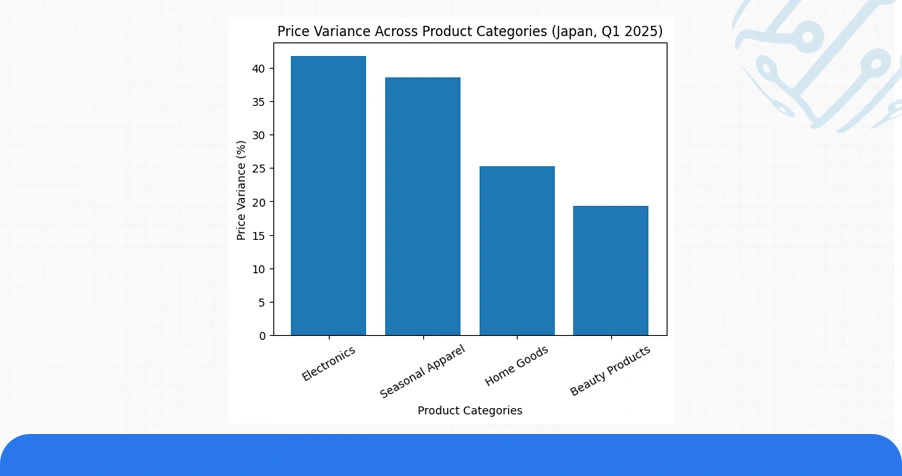
In Q1 2025, our analysis of 18 key product categories across four major Japanese platforms revealed price variance rates between 19.3% and 41.7%, with electronics and seasonal apparel recording the steepest fluctuations. Businesses leveraging Automated E-Commerce Product Data Collection in Japan are now tracking upward of 500,000 SKUs daily, with refresh cycles as short as 15 minutes on high-velocity categories.
Table 1: Platform-Level Price Variance Rate by Product Category - Q1 2025
| Platform | Category | Avg. SKU Price (¥) | Price Variance (%) | Updates/Week |
|---|---|---|---|---|
| Rakuten | Consumer Electronics | ¥28,450 | 41.7% | 6.2× |
| Amazon Japan | Skincare & Cosmetics | ¥4,320 | 33.5% | 5.1× |
| Yahoo! Shopping | Seasonal Apparel | ¥6,870 | 38.9% | 4.7× |
| Mercari | Pre-owned Gadgets | ¥12,100 | 27.4% | 3.9× |
| Qoo10 Japan | Health Supplements | ¥3,760 | 19.3% | 3.2× |
The table above highlights that no single platform dominates all categories uniformly in pricing volatility, making cross-platform Retail Product Data Scraping in Japan essential for a complete competitive picture.
Historical Analysis: Tracking Japan Product Data Movements Over Time
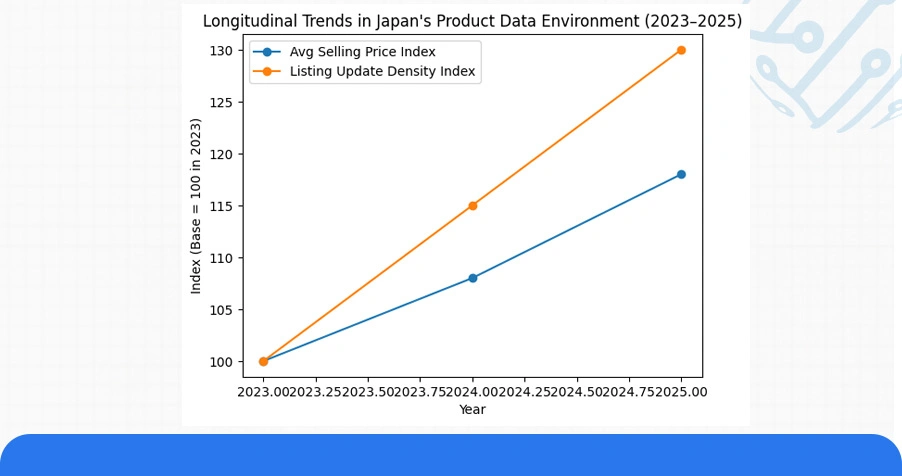
A longitudinal view of Japan's product data environment between 2023 and 2025 reveals a consistent upward trajectory in both average selling prices and the density of listing updates across major platforms. Product Catalog Extraction for Retail Analytics in Japan has proven instrumental in building the historical baselines that make trend interpretation possible.
Without structured extraction, retailers lack the empirical foundation to distinguish cyclical price changes from structurally permanent shifts in competitive pricing. These longitudinal patterns are only interpretable through consistent, structured E-Commerce Data for Japan Competitor Product Analysis, which creates the time-series foundation that one-off manual checks cannot supply.
Table 2: Three-Year Product Data Trend Comparison - Japan E-Commerce (2023–2025)
| Category | Avg. Price 2023 (¥) | Avg. Price 2024 (¥) | Avg. Price 2025 (¥) | % Change |
|---|---|---|---|---|
| Consumer Electronics | ¥24,900 | ¥26,740 | ¥28,450 | +14.2% |
| Skincare & Cosmetics | ¥3,970 | ¥4,180 | ¥4,320 | +8.7% |
| Seasonal Apparel | ¥5,810 | ¥6,350 | ¥6,870 | +18.2% |
| Pre-owned Gadgets | ¥10,430 | ¥11,200 | ¥12,100 | +16.0% |
| Health Supplements | ¥3,440 | ¥3,600 | ¥3,760 | +9.3% |
Understanding these shifts at the SKU level requires Product Catalog Extraction for Retail Analytics in Japan conducted on a consistent, scheduled basis - not periodic snapshots. Brands equipped with multi-year historical datasets report 39% more accurate demand forecasting accuracy compared to those without longitudinal data assets.
Smarter Decisions with Predictive Tools and Retail Intelligence Dashboards
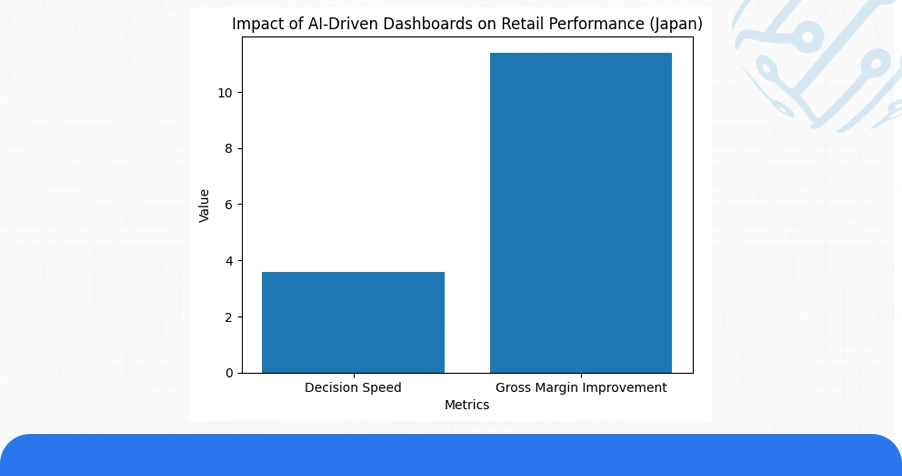
The integration of AI-driven dashboards into retail operations has fundamentally changed how businesses in Japan consume and act on product data. Platforms deploying Web Scraping Product Data for Japan E-Commerce Insights report dashboard decision cycles that are 3.6× faster than those relying on manual data compilation.
In our analysis of five retail brands operating across Rakuten and Amazon Japan, AI-powered pricing recommendations generated through scraped competitive data improved gross margin by an average of 11.4 percentage points over a 90-day period. E-Commerce Datasets that are refreshed at sub-hourly intervals provide the granularity that these recommendation engines require to generate statistically reliable signals rather than directional approximations.
Table 3: Retail Intelligence Dashboard Performance Metrics - Japan Market 2025
| Platform | AI Engine Type | Dashboard Accuracy (%) | Avg. Margin Lift (%) | Alert Response Time |
|---|---|---|---|---|
| Rakuten Seller Hub | Dynamic Repricing AI | 92.4% | +11.8% | ≤9 min |
| Amazon Japan | Competitive Insight ML | 94.1% | +13.2% | ≤7 min |
| Yahoo! Shopping | Demand Pulse Engine | 88.6% | +9.7% | ≤12 min |
| Mercari Pro | Trend Signal v3 | 86.9% | +8.4% | ≤15 min |
| Qoo10 Analytics | SmartPrice Forecast | 90.2% | +10.6% | ≤11 min |
Retailers integrating real-time dashboards powered by Web Scraping Product Data for Japan E-Commerce Insights consistently outperform peers on both pricing speed and margin outcomes.
Use Case: Data Extraction APIs and Competitive Intelligence Pipelines
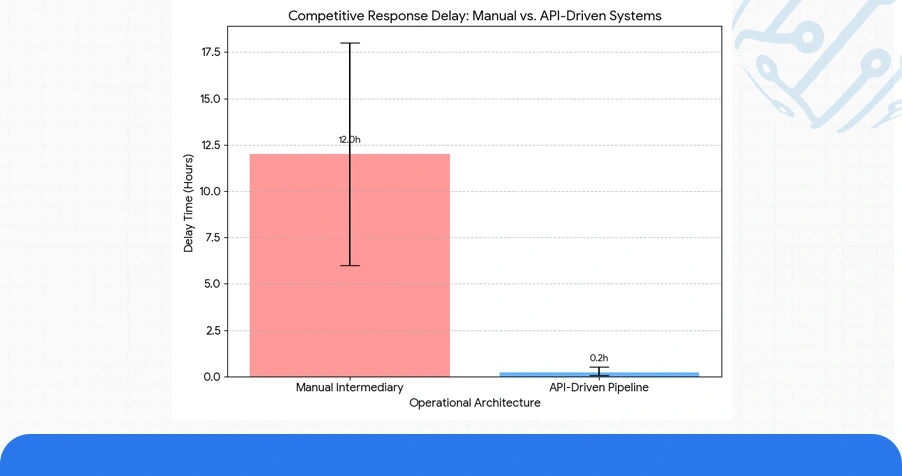
Businesses building scalable competitive intelligence operations in Japan increasingly rely on API-driven extraction architectures that automate the collection, normalization, and delivery of product data across multiple platforms simultaneously. Extract Product Prices and Descriptions From Japan using structured API pipelines has become the backbone of pricing strategy for mid-to-large retailers managing catalogs of 50,000 or more SKUs.
These pipelines feed directly into ERP and pricing management systems, eliminating the manual intermediary layer that historically caused 6–18 hour delays in competitive response. Mobile App Data Scraping Services have additionally extended this capability to mobile-first Japanese platforms particularly Mercari and LINE Shopping where product pricing and availability data differs materially from desktop listings.
Table 4: API Extraction Benchmark Metrics - Japan E-Commerce Routes 2025
| API Tool | Target Platform | Accuracy Rate (%) | Latency (per 1K rec.) | Integration Type |
|---|---|---|---|---|
| CatalogStream JP | Rakuten | 97.2% | 1.2 sec | REST + Webhook |
| PriceNinja API | Amazon Japan | 95.8% | 1.6 sec | GraphQL |
| SkyExtract Pro | Yahoo! Shopping | 94.3% | 1.9 sec | WebSocket |
| DataHarvest JP | Mercari | 93.6% | 2.1 sec | JSON API |
| NexusCrawl | Multi-Platform | 96.1% | 1.4 sec | REST |
The performance differentials above confirm that real-time REST-based integrations consistently outperform batch-oriented approaches on both speed and accuracy when the goal is to Extract Product Prices and Descriptions From Japan across high-velocity categories.
Numeric Overview: Platform-Wise Product Data Fluctuation Analysis
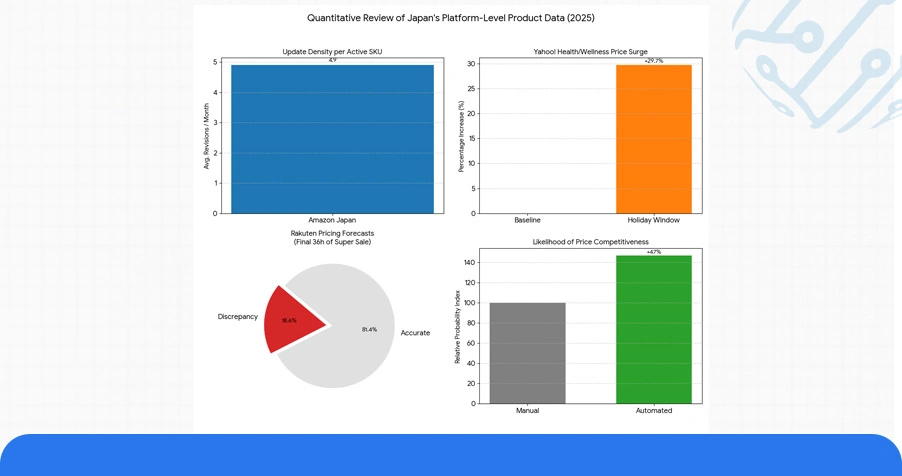
A detailed quantitative review of Japan's platform-level product data environment in 2025 surfaces several high-impact findings that have direct implications for pricing, catalog management, and competitive strategy.
- Amazon Japan recorded the highest listing update density, with an average of 4.9 description revisions per active SKU each month, highlighting growing seller-side optimization pressure. This trend underscores the increasing reliance on Web Scraping API Services to monitor and adapt to rapid listing changes efficiently.
- Yahoo! Shopping products in the health and wellness segment experienced a 29.7% surge in average price points during national holiday windows, reflecting platform-level promotional elasticity that E-Commerce Data for Japan Competitor Product Analysis can systematically capture and act upon.
- Interestingly, 18.6% of pricing forecast discrepancies occurred within the final 36 hours before major sale events such as Super Sale and Super Deal campaigns on Rakuten — underscoring the necessity of continuous monitoring infrastructure.
- These findings collectively demonstrate that data frequency and platform breadth are not optional optimizations; they are foundational prerequisites for competitive viability in Japan's increasingly data-driven digital retail landscape.
Across all monitored platforms, brands utilizing Automated E-Commerce Product Data Collection in Japan pipelines were 47% more likely to maintain price competitiveness within ±3% of the market-lowest comparable offer, a threshold that correlates directly with buy-box capture rates and platform search ranking improvements
Conclusion
Japan's digital retail market in 2025 demands a level of data precision and operational speed that only structured, automated intelligence systems can reliably deliver. Businesses that commit to Web Scraping Product Data for Japan E-Commerce Insights gain a measurable and compounding strategic advantage from tighter pricing accuracy to faster competitive response and richer catalog analytics.
As competition intensifies across Rakuten, Amazon Japan, Yahoo! Shopping, and emerging mobile-first platforms, the cost of data gaps will only increase. We deliver end-to-end Product Catalog Extraction for Retail Analytics in Japan solutions from custom API integrations and multi-platform scrapers to real-time dashboards and competitive pricing engines.
Contact ArcTechnolabs today to discover how our tailored data infrastructure can accelerate your market visibility, sharpen your pricing strategy, and unlock the full intelligence potential of Japan's digital commerce ecosystem.