Introduction
Technology retailers operate in an environment where pricing dynamics shift rapidly across physical stores and digital platforms. Micro Center, a leading electronics retailer, presents a compelling case of how pricing differences emerge between in-store and online channels. These variations often range from 15–20%, influencing buyer decisions, inventory movement, and brand competitiveness.
Retail analysts and e-commerce strategists increasingly rely on structured datasets like E-Commerce Product & Review Datasets to decode consumer response patterns, pricing elasticity, and purchase timing. By comparing real-world store prices with online listings, brands can detect hidden margins, demand fluctuations, and location-based pricing tactics.
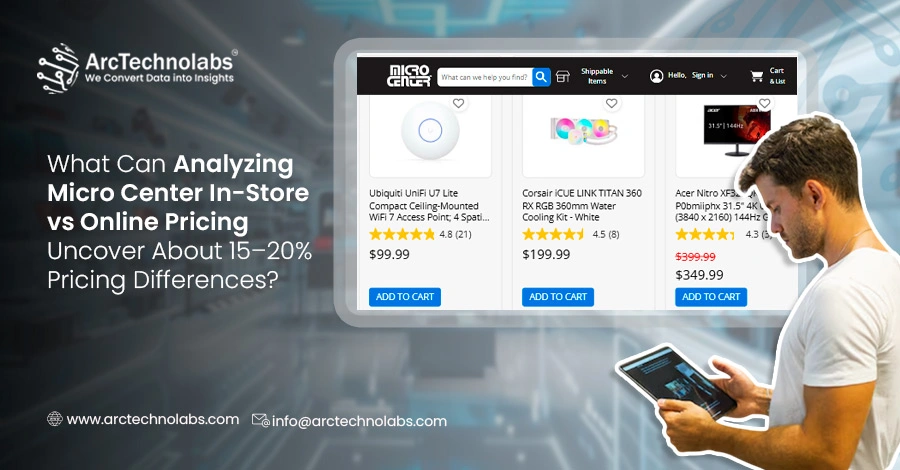
The core of this insight lies in Analyzing Micro Center In-Store vs Online Pricing, which enables businesses to understand where price mismatches exist and why. Whether driven by clearance stock, logistics costs, promotional strategies, or regional demand, these differences can reveal powerful signals about market behavior. This blog explores how such analysis uncovers meaningful trends, supports competitive benchmarking, and improves pricing strategies.
How Channel Pricing Shapes Retail Strategies?
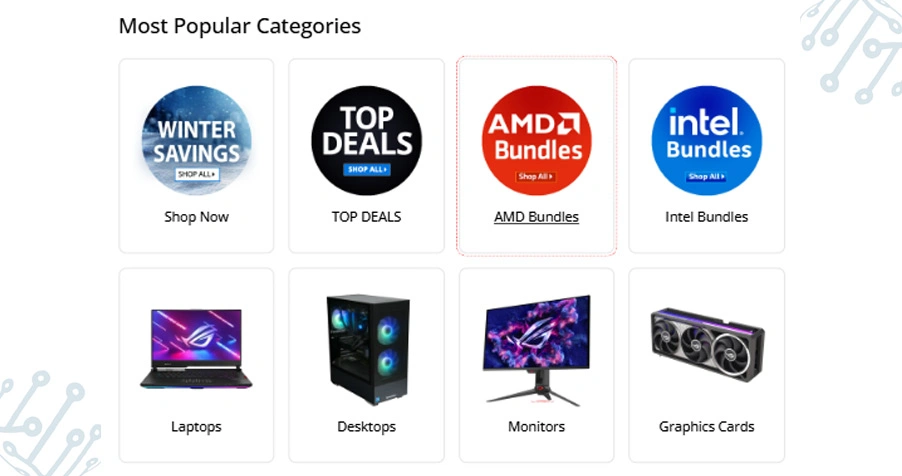
A closer examination of In-Store vs Online Electronics Pricing Trends shows that product categories such as GPUs, SSDs, and gaming peripherals are more prone to price divergence, particularly during seasonal sales and new product releases. These shifts are not arbitrary; they mirror inventory pressure, competitive positioning, and customer traffic objectives.
Retail intelligence methodologies originally developed for Supermarket Insights With Powerful Grocery are now being adapted for electronics markets. These models compare SKU-level pricing across channels to highlight where inconsistencies arise, how long they persist, and what business outcomes they support.
Sample Pricing Comparison Table:
| Product Category | In-Store Price ($) | Online Price ($) | Price Difference (%) |
|---|---|---|---|
| Graphics Cards | 749 | 849 | 13.4% |
| SSD Storage | 129 | 159 | 18.8% |
| Gaming Monitors | 299 | 349 | 14.3% |
| CPUs | 459 | 529 | 15.2% |
These differences reflect tactical decisions to optimize shelf space, respond to regional demand, and stimulate in-store purchases. The data highlights how pricing adjustments function as a lever for inventory management and customer acquisition.
Through structured review of Micro Center In-Store vs Online Pricing, retailers gain clarity on which categories are most volatile and which locations show consistent price sensitivity. This insight supports better promotional planning, localized pricing calibration, and channel harmonization strategies.
Regional Market Forces Influencing Price Structures
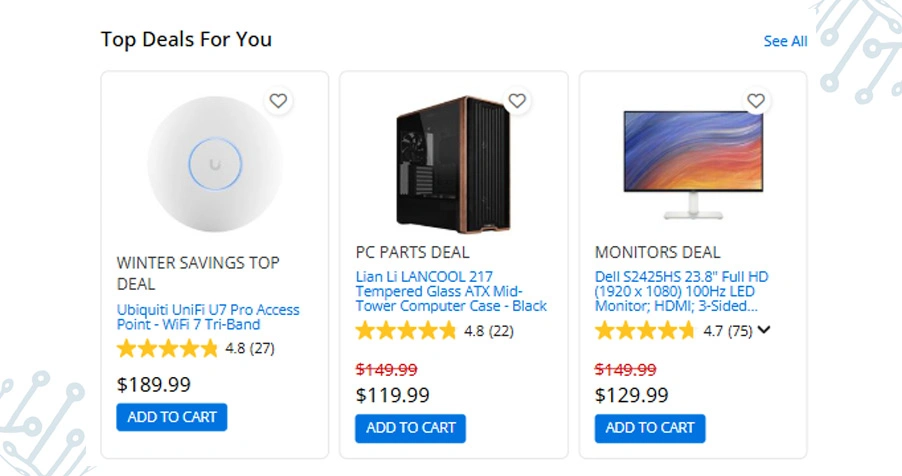
Pricing discrepancies also reveal how local market dynamics influence retail decisions. When in-store prices fall below online listings, it often signals competitive pressure from nearby electronics retailers or the need to accelerate inventory turnover. In contrast, online prices are typically aligned with broader national demand and shipping cost recovery.
Detailed examination of Micro Center Inventory and Pricing Data shows that regional demand intensity and stock availability directly shape pricing decisions. Stores in technology hubs experience tighter pricing alignment due to stronger competition, while suburban locations display wider variations driven by lower foot traffic and slower inventory movement.
Sample Regional Price Variance Table:
| City | In-Store Price ($) | Online Price ($) | Difference |
|---|---|---|---|
| Chicago | 699 | 799 | 14.3% |
| Dallas | 719 | 799 | 10.0% |
| Los Angeles | 749 | 799 | 6.7% |
| Denver | 679 | 799 | 17.7% |
These figures highlight how competitive saturation and inventory health affect pricing structures. Locations with surplus stock tend to display deeper discounts, while high-demand regions maintain tighter price control. Using structured evaluation of Micro Center In-Store vs Online Pricing, businesses can correlate pricing shifts with inventory turnover rates and regional competitor activity.
This connection strengthens demand forecasting accuracy and enables location-based promotional strategies. Such intelligence empowers retailers to respond proactively to market changes, refine regional pricing frameworks, and preserve consistent value perception across both sales channels.
Customer Reactions To Cross-Channel Price Gaps
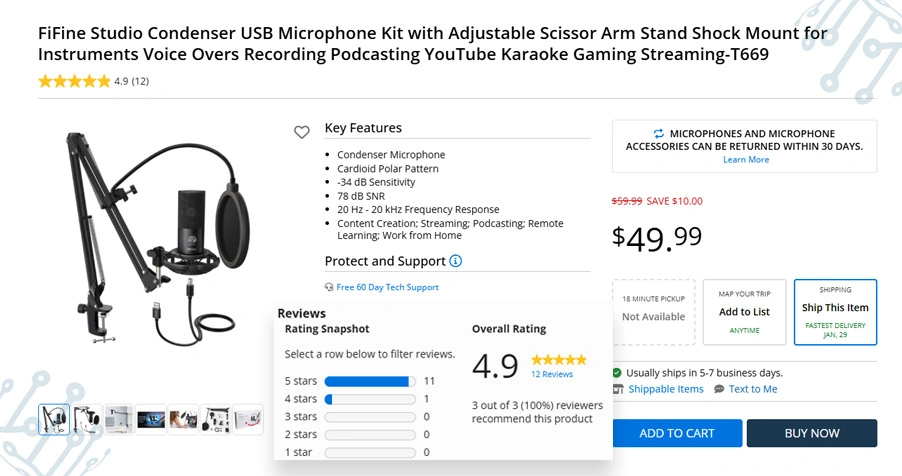
Pricing differences between channels significantly influence customer perception and purchasing behavior. Modern shoppers routinely compare in-store and online prices before making a decision, creating heightened expectations for transparency and fairness across touchpoints.
Through Electronics Pricing Behavior Analysis, retailers observe how customers react to visible price gaps. Lower in-store prices often increase foot traffic but may reduce online conversions, while lower online pricing shifts demand toward digital purchases at the expense of physical outlets.
Sample Consumer Response Table:
| Scenario | In-Store Sales | Online Sales | Customer Feedback Trend |
|---|---|---|---|
| Lower In-Store Price | +22% | -9% | Positive for value |
| Equal Pricing Across Channels | +10% | +11% | High trust |
| Lower Online Price | -12% | +18% | Convenience-driven |
These behavioral indicators provide actionable signals for refining pricing strategies. Channel parity often delivers balanced revenue growth, while strategic discrepancies can be used to steer demand during inventory surpluses or promotional campaigns.
By synthesizing insights from consumer response metrics and price comparison datasets, brands can identify optimal pricing thresholds that maximize total revenue without undermining channel performance. Such intelligence helps retailers adjust promotional timing, introduce targeted bundles, and align pricing narratives with evolving customer expectations.
How ArcTechnolabs Can Help You?
With Analyzing Micro Center In-Store vs Online Pricing, We help brands uncover actionable insights across channels. Our analytics pipelines integrate real-time pricing feeds, historical comparisons, and regional demand indicators to support smarter pricing strategies.
Our Capabilities Include:
- Cross-channel pricing intelligence systems.
- Real-time product price tracking.
- Regional market comparison frameworks.
- Demand forecasting models.
- Inventory optimization analytics.
- Custom retail dashboards.
In the final stage of insight generation, our systems integrate Scraping Micro Center Pricing Data for Analysis to deliver high-fidelity datasets that drive precision pricing and competitive benchmarking.
Conclusion
Pricing differences between physical stores and digital platforms are not accidental; they reflect strategic responses to market demand, inventory health, and competitive pressure. Through Analyzing Micro Center In-Store vs Online Pricing, retailers can identify where margins shift, how consumers react, and which categories experience the most volatility.
At the same time, combining such analysis with Micro Center In-Store vs Online Pricing intelligence strengthens competitive benchmarking and demand forecasting. Contact ArcTechnolabs today for a tailored analytics solution that drives smarter decisions and measurable growth.