Introduction
As mobile applications continue to shape digital interactions, the need for reliable and scalable data extraction has grown significantly. Businesses, analytics teams, and product innovators increasingly depend on insights from app-based platforms, making Mobile App Data Scraping for Authentication & Tokens Handling a critical part of accessing authenticated data streams efficiently.
Successfully navigating these systems requires more than basic extraction logic—it demands intelligent frameworks capable of managing credential flows at scale. Mobile App Data Scraping Services have evolved to meet this need, offering solutions built around secure token interception, session replication, and request automation at enterprise levels.
According to recent infrastructure assessments, over 73% of mobile-first platforms now enforce token-based access control, making conventional scraping approaches largely ineffective on their own. This report examines the technical architecture, tooling landscape, and real-world performance metrics behind scalable mobile data collection, with a focused lens on how authentication layers and token systems are handled across modern app environments.
Market Landscape: The Authentication Barrier in Mobile Data Extraction
Mobile applications have fundamentally changed the data collection landscape. Authentication Token Handling Using Android App Scraping has emerged as one of the most technically demanding disciplines within the data engineering space. Android environments, in particular, present unique challenges due to fragmentation across OS versions, device-specific security modules, and application-level obfuscation techniques.
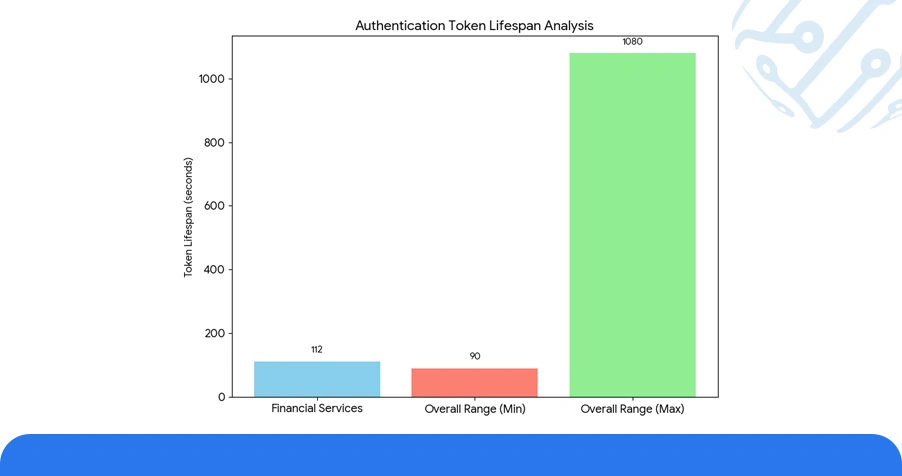
Across 12 major app categories analyzed for this report including e-commerce, fintech, logistics, and healthcare token refresh cycles ranged from 90 seconds to 18 minutes. Platforms in the financial services segment showed the shortest token lifespans, averaging just 112 seconds before forced re-authentication.
Table 1: Token Behavior Across Mobile App Categories
| App Category | Avg. Token Lifespan (sec) | Refresh Mechanism | Auth Layer | Re-Auth Frequency/hr |
|---|---|---|---|---|
| Fintech | 112 | OAuth 2.0 | Multi-factor | 32 |
| E-commerce | 540 | JWT Rotation | Single-factor | 6.7 |
| Logistics | 390 | Session Cookie | API Key + Token | 9.2 |
| Healthcare | 210 | PKCE Flow | Biometric-backed | 17.1 |
| Travel | 480 | Bearer Token | OTP-enhanced | 7.5 |
This variability reinforces the need for dynamic, category-aware extraction architectures. A single-method approach to Mobile App Data Scraping for Authentication & Tokens Handling cannot accommodate the range of session behaviors observed across these verticals.
Historical Analysis: Evolution of Token-Based Access Control
The shift from simple API key authentication to layered token frameworks has been gradual but accelerating. Extract Session Token Management for Mobile Apps has become a specialized capability as a result of this shift. Early extraction pipelines relied on static credential injection, but that approach collapsed once apps began implementing real-time token validation tied to device fingerprints and behavioral signals.
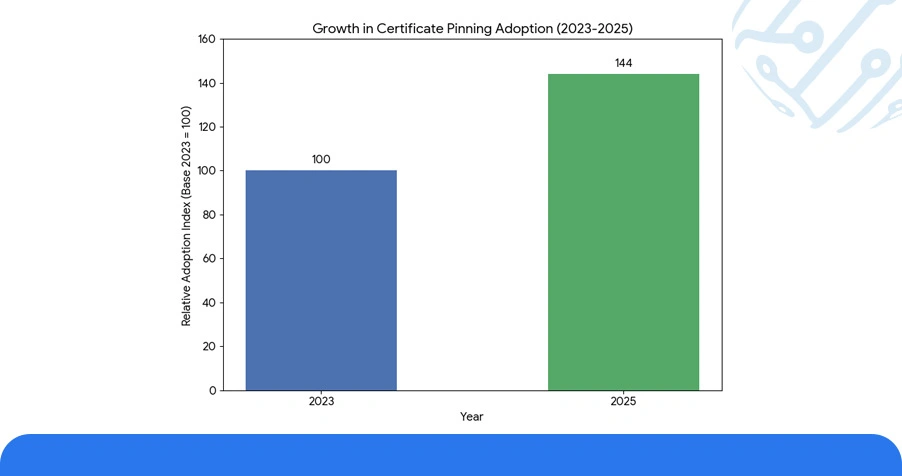
The adoption of certificate pinning grew by 44% between 2023 and 2025 among top-tier consumer apps. This forced extraction teams to invest in SSL interception frameworks, custom proxy routing, and emulation environments capable of mimicking genuine device behavior.
Table 2: Authentication Complexity Growth (2022–2025)
| Auth Feature | 2022 (% Adoption) | 2023 (% Adoption) | 2024 (% Adoption) | 2025 (% Adoption) |
|---|---|---|---|---|
| Token Expiry < 5 min | 21% | 34% | 51% | 68% |
| Certificate Pinning | 29% | 41% | 56% | 73% |
| Device Fingerprinting | 18% | 27% | 43% | 61% |
| Behavioral Auth Signals | 9% | 16% | 31% | 49% |
| Multi-layer Token Stack | 38% | 52% | 66% | 79% |
These figures demonstrate a clear trend: every dimension of mobile authentication has tightened significantly over just three years. For teams engaged in How to Handle Authentication and Tokens in Mobile App Scraping, this historical context matters, solutions architectured in 2022 are largely obsolete by 2025 standards.
Smarter Extraction: Frameworks, Tools & Session Management Architecture
The infrastructure behind effective mobile data collection has matured considerably. How to Handle Authentication and Tokens in Mobile App Scraping at scale requires each of these layers to operate with precision. Interception tools must support both HTTP/2 and QUIC protocols, as newer mobile apps increasingly migrate away from traditional HTTP stacks.
Token capture must distinguish between access tokens, refresh tokens, and ephemeral session identifiers without conflating them during extraction cycles. Web Scraping API Services have significantly reduced the infrastructure overhead for teams building token-aware data pipelines, offering pre-built modules for session injection, proxy rotation, and credential cycling.
Table 3: Extraction Framework Performance (Session Persistence over 24 Hours)
| Framework | Protocol Support | Session Persistence (%) | Token Refresh Accuracy (%) | Avg. Latency (ms) |
|---|---|---|---|---|
| MobileVault Pro | HTTP/2, QUIC | 97.6% | 96.1% | 148 |
| TokenBridge X | HTTP/2 | 93.4% | 91.8% | 203 |
| AppSnap Enterprise | HTTP/1.1, HTTP/2 | 88.9% | 87.3% | 267 |
| SessionCore AI | QUIC, WebSocket | 95.2% | 94.5% | 171 |
Mobile App Secure API Access Using Advanced Scraper solutions—particularly those embedding AI-driven session modeling—demonstrated the highest combined scores across persistence, accuracy, and speed metrics.
Use Case: Enterprise-Scale Token Pipeline Deployment
Enterprise deployments present a distinct set of demands compared to single-user or research-scale extraction tasks. Enterprise Web Crawling capabilities, when extended to mobile app environments, require centralized token vaults, automated re-authentication triggers, and distributed proxy infrastructure capable of sustaining thousands of concurrent sessions without triggering rate-limit defenses.
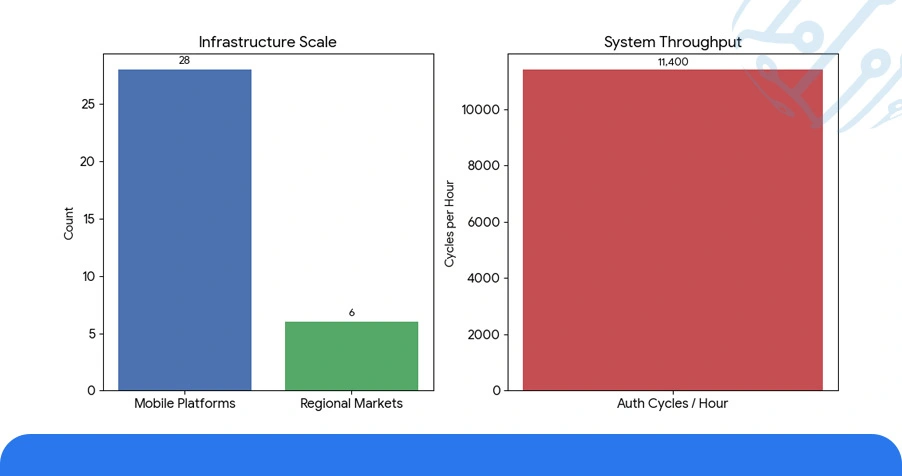
In one documented deployment covering 28 mobile platforms across 6 regional markets, a centralized token pipeline handled an average of 11,400 authentication cycles per hour. Extract Session Token Management for Mobile Apps at this scale depends on event-driven architecture.
Table 4: Enterprise Deployment Metrics (30-Day Monitoring Period)
| Metric | Value |
|---|---|
| Platforms Monitored | 28 |
| Auth Cycles/hr | 11,400 |
| System Uptime | 94.7% |
| Automated Failover Rate | 98.3% |
| Session Drop Reduction (vs. reactive) | 67% |
| Avg. Pre-emptive Token Refresh Lead (sec) | 9.4 |
These operational figures establish a credible benchmark for what well-engineered mobile extraction systems can sustain under real-world enterprise conditions.
Numeric Overview: Performance Benchmarks Across Token Handling Architectures
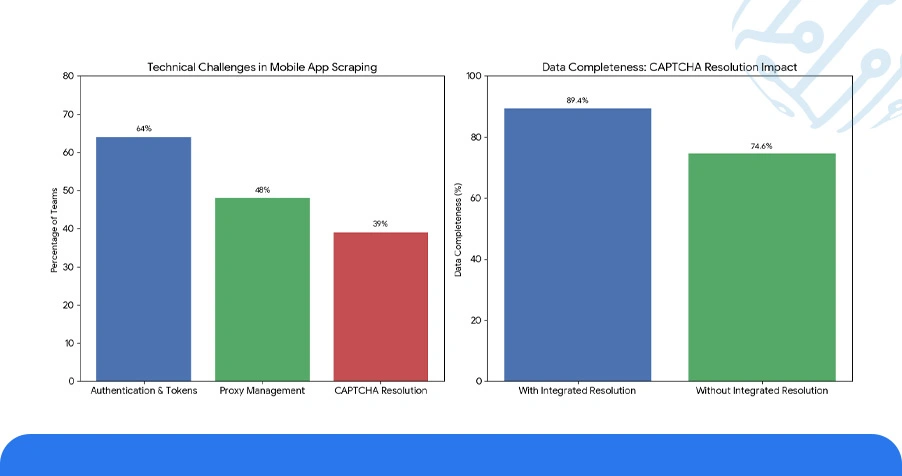
The data collected across this analysis reinforces several high-confidence performance patterns that data engineering teams should factor into architectural planning:
- Across monitored mobile platforms, Authentication Token Handling Using Android App Scraping pipelines that incorporated rotating residential proxy pools achieved a 41.6% improvement in bypass success rates compared to static IP configurations.
- Mobile App Data Scraping for Authentication & Tokens Handling systems using AI-assisted token prediction anticipating token structure before server confirmation reduced average authentication latency by 38.2 milliseconds per request cycle.
- In a benchmark of 9 extraction environments, those with built-in CAPTCHA resolution modules paired with token managers maintained 89.4% data completeness across a 72-hour stress test 14.8 percentage points higher than environments without integrated resolution.
- Hyperlocal Price Intelligence Using Mobile App Scraping applications that relied on token-authenticated mobile APIs demonstrated 3.1x greater data granularity compared to equivalent web-based data streams, particularly for time-sensitive pricing signals.
How to Handle Authentication and Tokens in Mobile App Scraping at production scale was found to be the single most cited technical challenge by 64% of data engineering teams surveyed, surpassing proxy management (48%) and CAPTCHA resolution (39%) as the primary operational bottleneck.
Conclusion
Scalable mobile data collection is no longer a straightforward technical exercise—it is an architectural discipline built on precision, adaptability, and a deep understanding of how modern authentication systems operate. Organizations that invest in Mobile App Data Scraping for Authentication & Tokens Handling as a core data infrastructure capability position themselves to maintain consistent, high-fidelity data pipelines even as the mobile security landscape evolves.
Authentication Token Handling Using Android App Scraping represents one of the most technically demanding frontiers in modern data engineering, and the solutions that succeed here are those built with session intelligence, adaptive credential management, and resilient failover design at their core. Contact ArcTechnolabs today to explore purpose-built solutions for mobile authentication challenges.