Introduction
Businesses today collect enormous volumes of digital data from multiple online sources, but raw data alone rarely delivers meaningful outcomes. The real challenge lies in structuring, cleaning, and organizing that data into actionable intelligence. Raw Scraped Data Processing for Business Analytics has emerged as a foundational practice for organizations seeking reliable, consistent datasets that power strategic decisions across departments.
We recognized this gap early and built specialized capabilities to transform fragmented, unstructured data into clean, analysis-ready formats. Organizations across retail, finance, e-commerce, and logistics sectors increasingly depend on Web Scraping Data Analysis for Business Intelligence to monitor market behavior, track competitors, and evaluate consumer patterns with precision. Our Web Scraping Services have helped businesses move beyond guesswork toward structured intelligence.
When data arrives in inconsistent formats, contains duplicate entries, or lacks contextual tagging, analytical outcomes become unreliable. This case study explores how we partnered with a data-driven enterprise to overhaul its raw data processing pipeline, eliminate recurring quality issues, and deliver business intelligence outputs that stakeholders could trust completely.
The Client
The client is a mid-sized market intelligence firm operating across seven industry verticals, including consumer goods, pharmaceutical, real estate, and B2B technology services. Their dependency on Raw Scraped Data Processing for Business Analytics was significant, yet the internal infrastructure was built on manual workflows that were slow, inconsistent, and prone to errors.
The firm had ambitious goals around building a centralized data intelligence platform that would serve both internal analysts and external enterprise clients. They relied heavily on Extracted Web Data Analysis for Market Trends to deliver industry reports, but inconsistencies in data formatting and completeness were damaging the quality of their deliverables and eroding client trust.
Their teams spent over 60 percent of working hours cleaning and reformatting data instead of analyzing it. They needed an experienced partner capable of redesigning their data processing infrastructure to ensure every extracted dataset was structured, verified, and ready for direct integration into visualization and reporting tools without additional manual intervention.
Key Challenges
The client's data quality issues affected every stage, from extraction to delivery. Integrating Web Scraping API Services into the workflow required technical improvements and process restructuring to ensure consistent, reliable data.
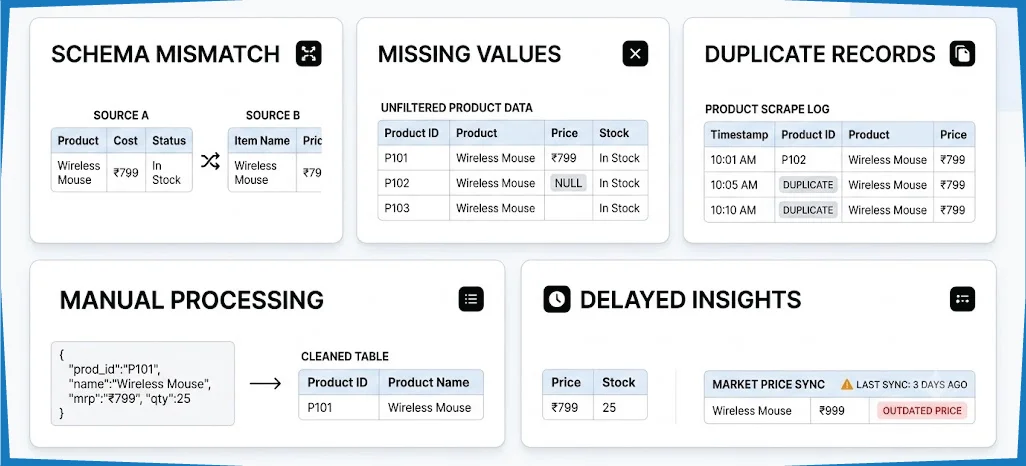
The primary obstacles included:
- Inconsistent schema formats received from different source websites, making cross-platform comparison unreliable.
- Missing and null values appearing frequently across critical data fields like pricing, dates, and categorical identifiers.
- Duplicate records generated through overlapping scraping schedules or multi-source extraction without deduplication logic.
- The absence of a scalable API for Converting Raw Data Into Structured Insights, which forced teams to manually reformat batches for every client.
- Difficulty maintaining Real-Time Market Insights From Scraped Data because delayed processing created stale outputs delivered to clients hours after market movements occurred.
These overlapping problems made it impossible to maintain data integrity at scale, and each new data source added to the pipeline introduced further variability rather than adding analytical value.
Key Solution
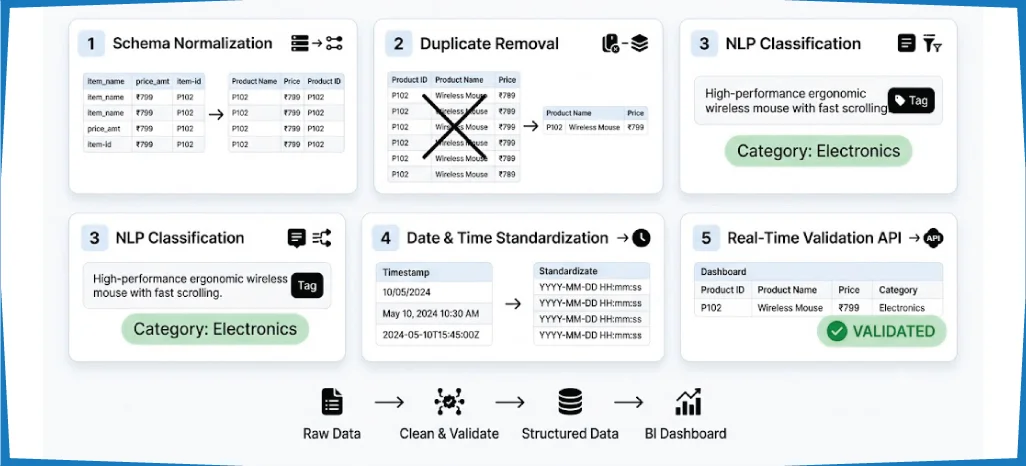
We deployed a multi-layered data engineering framework tailored specifically to the client's industry verticals and output requirements. The solution covered ingestion, transformation, validation, and delivery as a fully connected workflow.
- Automated schema normalization that mapped incoming data fields to predefined analytical taxonomies.
- A deduplication engine using record fingerprinting to eliminate redundant entries before storage.
- NLP-based text classification modules that convert unstructured descriptions into tagged, searchable categories.
- Standardized date and timezone normalization across all incoming records using Mobile App Data Scraping Services for mobile-sourced data streams.
- A centralized API for Converting Raw Data Into Structured Insights, enabling direct integration with the client's BI tools, dashboards, and reporting systems.
- A real-time anomaly detection layer that flagged records deviating from established data quality thresholds before they entered analytical pipelines.
This architecture transformed raw, inconsistent data into structured, trustworthy datasets that analysts could access directly within their existing tools without any preprocessing burden.
Data Quality Benchmarks Before and After Implementation
The following table illustrates measurable improvements across critical data quality dimensions following our implementation. These figures reflect averages calculated across a 90-day evaluation period compared against the client's baseline performance metrics from the previous quarter.
Before implementation, the client's data pipelines suffered from compounding quality failures that affected every stage of the analytical process. Analyst teams spent the majority of their productive hours on data correction rather than insight generation, resulting in delayed deliverables and inconsistent outputs across client reports.
| Data Quality Dimension | Before Implementation | After Implementation |
|---|---|---|
| Schema Consistency Rate | 41% | 97% |
| Duplicate Record Rate | 23% | 1.2% |
| Null Value Frequency | 18% per dataset | 2.4% per dataset |
| Data Processing Time Per Batch | 6.8 hours | 38 minutes |
| Anomaly Detection Coverage | 0% (manual) | 100% (automated) |
| Analyst Time on Data Cleaning | 62% of working hours | 11% of working hours |
| Real-Time Data Delivery Lag | 4–6 hours | Under 12 minutes |
| Client Report Accuracy Score | 68% | 96% |
After implementation, the transformation across every measured dimension was substantial. The client's analytical teams shifted their primary focus from reactive data correction toward proactive insight generation, significantly improving the quality, consistency, and timeliness of intelligence delivered to enterprise clients.
Advantages of Implementing ArcTechnolabs
-
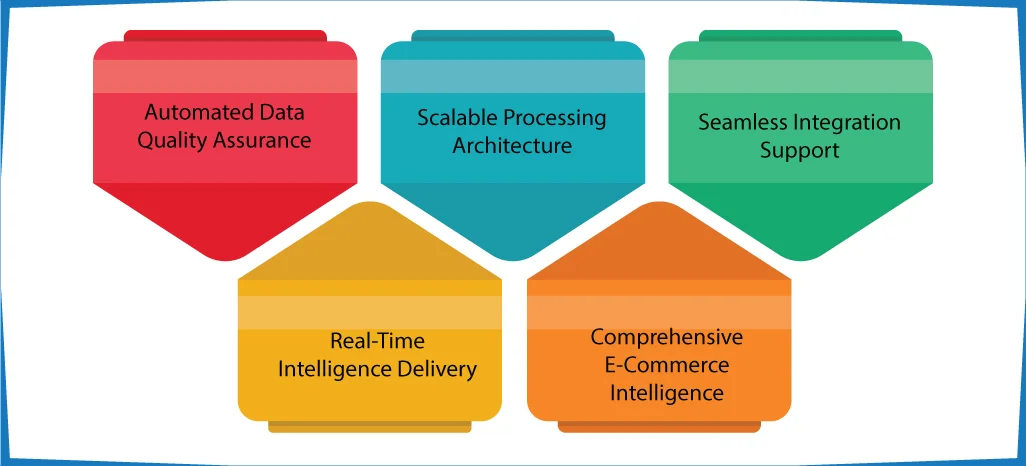
Automated Data Quality Assurance
Our validation pipelines automatically detect and resolve schema inconsistencies, null values, and duplicate entries, delivering clean Web Scraping Data Analysis for Business Intelligence outputs every time.
-
Scalable Processing Architecture
We build elastic data pipelines that expand seamlessly with growing source volumes, ensuring consistent Raw Scraped Data Processing for Business Analytics performance without infrastructure bottlenecks.
-
Seamless Integration Support
Every structured dataset is delivered through a dedicated API for Converting Raw Data Into Structured Insights, connecting directly to clients' existing BI platforms, dashboards, and data warehouses.
-
Real-Time Intelligence Delivery
Our processing infrastructure minimizes data latency across all pipelines, enabling businesses to act on Real-Time Market Insights From Scraped Data within minutes of source updates occurring.
-
Comprehensive E-Commerce Intelligence
We provide ready-to-analyze E-Commerce Datasets covering pricing, product availability, reviews, and competitor positioning across platforms for retail and marketplace intelligence teams.
Client's Testimonial
"Before working with ArcTechnolabs, our teams were constantly firefighting data quality issues that delayed every deliverable. Their approach to Raw Scraped Data Processing for Business Analytics completely transformed how we handle incoming data. The automated pipelines, validation layers, and the structured API for Converting Raw Data Into Structured Insights gave us a foundation we could build confidently on. The difference in our analytical output quality has been genuinely remarkable."
– Director of Data Operations, Market Intelligence Firm
Conclusion
Businesses that depend on scraped data for strategic decisions cannot afford to operate with inconsistent, error-prone pipelines. Reliable Raw Scraped Data Processing for Business Analytics is not simply a technical requirement, it is a business-critical capability that directly influences the quality of decisions made at every organizational level.
Our solutions are built to evolve with your data environment, whether you are managing dozens of sources or thousands. With Web Scraping Data Analysis for Business Intelligence, we help organizations eliminate the inefficiencies of manual data handling and replace them with automated, auditable, and scalable workflows that analysts and executives can rely on completely.
Contact ArcTechnolabs today to redesign your data processing pipeline. Our team of data engineers and analytics specialists is ready to assess your current infrastructure, identify quality gaps, and deliver a tailored solution that ensures every dataset entering your systems is clean, structured, and immediately ready for analysis.