Introduction
Pricing decisions increasingly depend on how quickly businesses can understand competitor movements, product availability, demand signals, and market fluctuations. Real-Time Competitor Pricing Data Scraping for AI Agents provides continuously refreshed competitive information that AI systems can process when evaluating pricing opportunities across large product catalogs and changing market conditions.
AI models require structured and timely information to produce useful recommendations. With Enterprise Web Crawling, businesses can collect product prices, discounts, promotional changes, availability, and other competitive signals from multiple digital sources. This creates a consistent data layer that supports automated analysis while reducing dependence on fragmented manual research and outdated pricing records.
Rather than relying on periodic spreadsheet updates, organizations can connect fresh competitive information with pricing rules and machine learning workflows. This approach enables pricing teams to evaluate market movements faster, identify meaningful price differences, and establish more responsive decision-making processes across products, regions, and sales channels.
Faster Market Signals Strengthen Automated Competitive Pricing Decisions
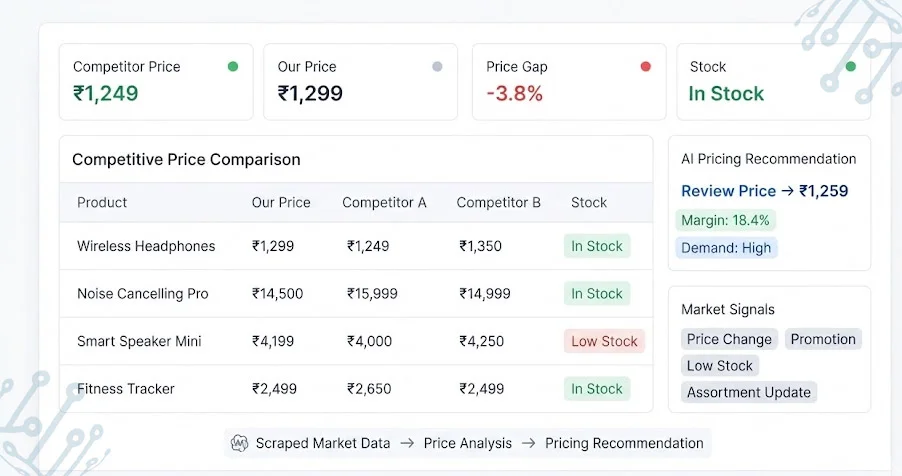
Competitive pricing becomes more responsive when AI systems receive fresh market information instead of relying on outdated snapshots. Product prices, promotional changes, stock conditions, and assortment movements can be collected at regular intervals and organized into structured datasets. This allows pricing workflows to compare multiple competitors before recommendations are generated.
When AI Agents for Real-Time Price Optimization via Scraping receive consistent market signals, they can evaluate pricing conditions alongside internal factors such as margins, inventory levels, and demand patterns. The resulting workflow can help businesses identify relevant price differences and establish defined rules for when a pricing adjustment requires further review or automated action.
Recurring collection also reduces the operational effort associated with manually checking multiple websites and applications. With Dynamic Pricing Decisions Using Competitive Price Data Scraping, pricing teams can establish repeatable processes for gathering comparable product information. Web Scraping Services can support these workflows through scheduled extraction, structured outputs, validation, and source-specific collection requirements.
Key pricing signals can include:
- Current competitor product prices
- Promotional and discount movements
- Product availability changes
- Competitor assortment variations
- Regional pricing differences
| Market Factor | Business Relevance |
|---|---|
| Current pricing | Competitive comparison |
| Promotions | Offer evaluation |
| Availability | Supply awareness |
| Assortment | Catalog assessment |
Broader Competitive Coverage Gives AI Better Pricing Context
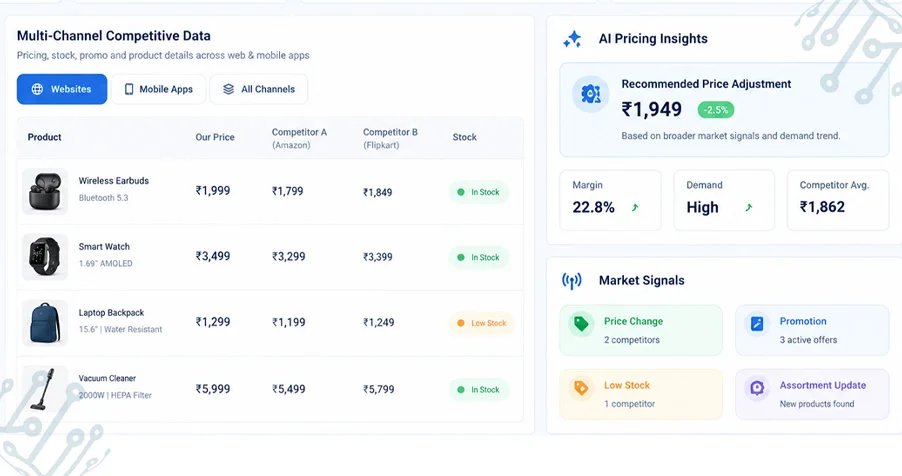
AI pricing models can produce more useful recommendations when their inputs represent a broader view of market conditions. Competitive datasets can include pricing, product specifications, promotional activity, availability, ratings, and category information. Combining these elements provides additional context for interpreting why prices change rather than examining price differences in isolation.
Scraped Retail Data for AI Dynamic Pricing can organize these market signals into structured records that pricing models can process consistently. For example, a price reduction may be interpreted differently when a competitor has excess inventory, launches a promotion, or changes its product assortment. Broader data coverage therefore supports more informed analysis across individual products and categories.
Modern commerce also extends beyond traditional desktop websites. Mobile applications can contain different prices, promotions, stock information, or product availability. By Using Web Scraped Data for AI Pricing Optimization, businesses can connect information from multiple digital environments. Mobile App Data Scraping Services can further support collection from application-based commerce channels.
Broader market coverage can help teams monitor:
- Website and application-based pricing
- Product-level promotional activity
- Regional availability differences
- Competitor catalog changes
- Ratings and product attributes
| Data Category | Analytical Purpose |
|---|---|
| Product information | Catalog matching |
| Price movement | Market comparison |
| Promotions | Commercial analysis |
| Availability | Supply assessment |
Continuous Monitoring Creates Reliable Inputs For AI Pricing Systems
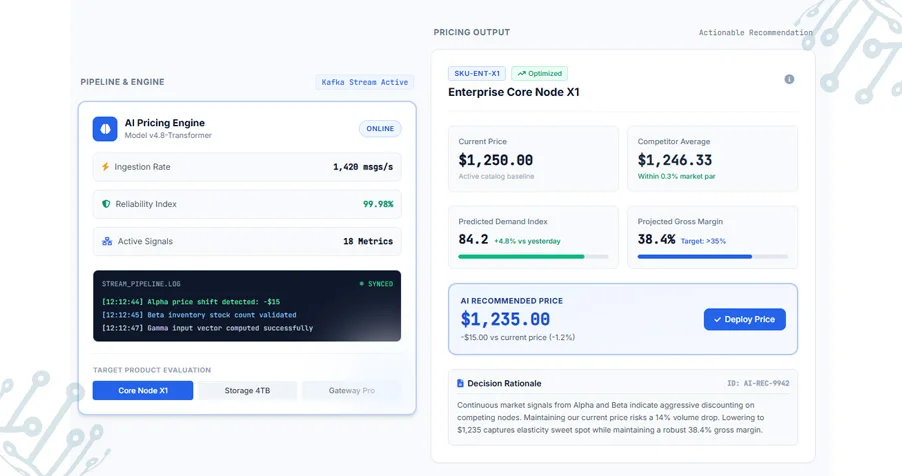
Consistent monitoring gives pricing systems a recurring stream of competitive information that can be processed according to defined business schedules. Instead of waiting for periodic research, organizations can collect changes in prices, promotions, availability, and product information at selected intervals. This creates a repeatable foundation for automated pricing analysis.
Through AI-Powered Competitor Price Monitoring Using Web Scraping, businesses can establish workflows that identify meaningful changes and route relevant information toward analytical systems. These signals can be combined with internal sales, inventory, margin, and demand information to provide broader context before pricing recommendations are generated.
Automated delivery can further reduce friction between data collection and pricing applications. Retail Price Scraping for Dynamic Pricing Strategies can provide structured competitive observations that connect with dashboards, pricing engines, and machine learning workflows. With Web Scraping API Services, these datasets can be delivered directly to systems that require regularly refreshed competitive information.
A continuous monitoring framework can support:
- Scheduled competitor price collection
- Change detection across products
- Promotion and offer tracking
- Structured data delivery
- Integration with pricing workflows
| Monitoring Element | Operational Role |
|---|---|
| Price updates | Change identification |
| Offers | Promotion tracking |
| Stock status | Availability monitoring |
| Product changes | Catalog monitoring |
How ArcTechnolabs Can Help You?
We can support businesses that require reliable competitive intelligence for automated pricing environments. Real-Time Competitor Pricing Data Scraping for AI Agents can be incorporated into customized data collection workflows designed around product categories, competitor sources, geographic markets, and collection frequency. The approach can accommodate both focused monitoring programs and large-scale product catalogs.
A structured implementation can connect external competitive information with internal pricing systems, analytics platforms, and AI workflows. Data can be collected from selected sources, standardized into consistent formats, checked for quality, and prepared according to downstream requirements.
Key capabilities can include:
- Competitor source identification and mapping
- Product and category-level data extraction
- Automated price and promotion monitoring
- Data cleaning, normalization, and validation
- Structured delivery for AI and analytics systems
- Scalable recurring data collection workflows
By Using Web Scraped Data for AI Pricing Optimization, organizations can connect competitive market information with internal pricing processes and analytical models. We can tailor collection schedules, source coverage, required fields, validation processes, and delivery formats according to specific business requirements, helping create a consistent data pipeline for AI-supported pricing operations.
Conclusion
Pricing intelligence becomes more actionable when AI systems receive current, structured, and relevant market signals. Real-Time Competitor Pricing Data Scraping for AI Agents can provide competitive inputs covering prices, promotions, availability, and product changes, helping organizations establish consistent workflows around changing market conditions and product-level pricing requirements.
When these inputs are integrated with AI-Powered Competitor Price Monitoring Using Web Scraping, pricing teams can create automated processes for identifying competitive movements and supporting model-based decisions. A connected workflow can bring together data collection, validation, analysis, and pricing actions within a repeatable operational framework. Connect with ArcTechnolabs to build a customized competitive pricing data workflow for your AI-driven pricing operations.