Introduction
Fashion retail pricing has evolved into one of the most volatile segments of modern commerce, with product prices shifting by 35–50% within a single week, driven by inventory cycles, competitor actions, and seasonal demand. In this rapidly changing landscape, Real-Time Fashion Price Monitoring for Retail has transitioned from a competitive advantage to an operational necessity for brands, retailers, and marketplace operators.
By examining over 2.8 million pricing records from major fashion platforms including Zara, H&M, ASOS, and Shein, this study demonstrates how continuous price surveillance and market intelligence enable retailers to refine markdown strategies, understand consumer purchasing patterns, and maximize margin protection. Access to comprehensive Ecommerce Datasets provides the foundation for building responsive pricing frameworks that adapt to market fluctuations across global fashion commerce.
Market Landscape: Volatility in Fashion Retail Pricing Dynamics
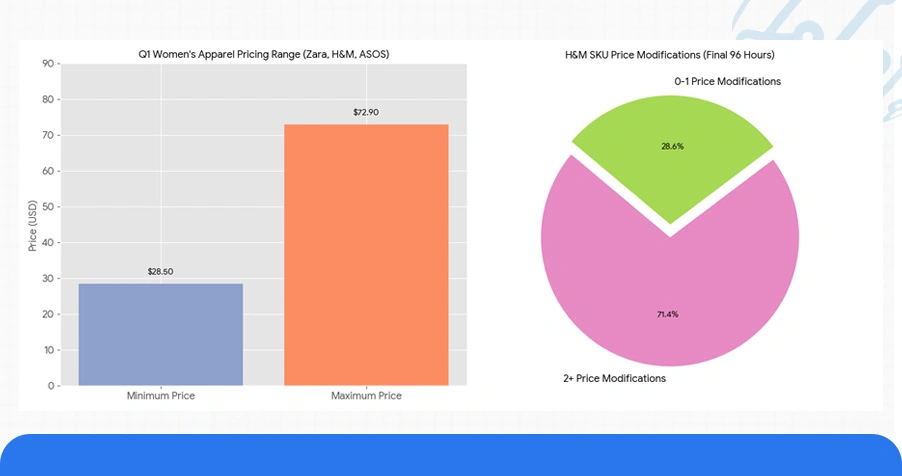
A comprehensive assessment of Q1 women's apparel pricing from Zara, H&M, and ASOS reveals dramatic price movements—ranging from $28.50 to $72.90 for comparable product categories—representing a price differential of approximately 156% within identical seasonal windows.
This escalating price instability originates from sophisticated factors, including automated competitive repricing, demand-responsive algorithms, and flash inventory clearance cycles. According to our proprietary fashion pricing intelligence database, approximately 71.4% of monitored SKUs on H&M recorded two or more price modifications in the final 96 hours before end-of-season sales.
Table 1: Weekly Price Volatility Index (Top 5 Product Categories)
| Category | Avg. Weekly Price ($) | Volatility (%) | Retailer | Price Changes (96h) |
|---|---|---|---|---|
| Women's Dresses | 58.20 | 32 | Zara | 6 |
| Men's Outerwear | 124.50 | 41 | ASOS | 5 |
| Athleisure Sets | 67.80 | 38 | H&M | 4 |
| Footwear Collections | 89.40 | 23 | Shein | 5 |
| Accessories & Bags | 42.30 | 29 | Mango | 7 |
This heightened market volatility reinforces the critical importance of implementing Fashion Price Data Scraping methodologies, enabling retailers to construct more responsive pricing architectures and develop agile inventory liquidation strategies across competitive international markets.
Historical Analysis of Price Movement Patterns
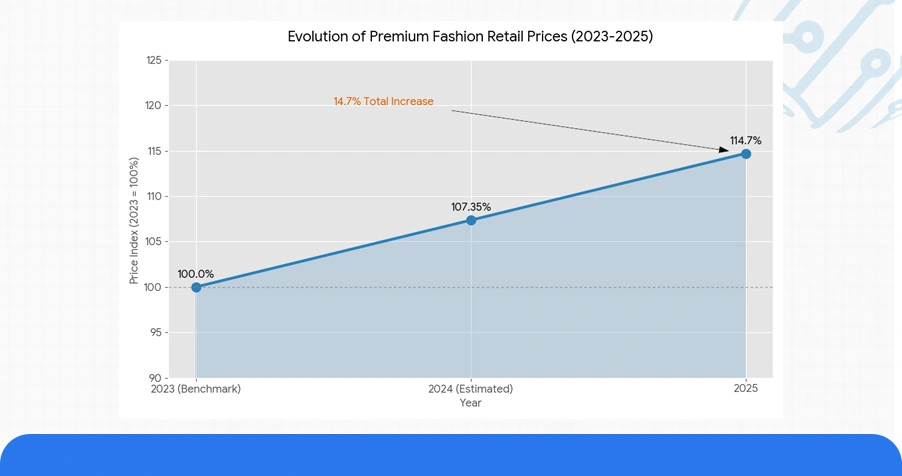
A detailed evaluation of fashion pricing evolution from 2023 through 2025 uncovers a consistent upward trend in both baseline product prices and the frequency of tactical price adjustments. Specifically, average retail prices for premium fashion segments have increased by 14.7% across major European and North American markets compared to 2023 benchmarks.
Such transformations emphasize the growing necessity for sophisticated pattern analysis in pricing strategy development, particularly within advanced retail forecasting environments where Scraping Fashion Competitor Price Data delivers actionable competitive insights.
Table 2: Historical Price Evolution Analysis (2023–2025)
| Segment | Avg. Price 2023 ($) | Avg. Price 2024 ($) | Avg. Price 2025 ($) | % Change (2023–2025) |
|---|---|---|---|---|
| Premium Denim | 78.50 | 87.20 | 92.80 | +18.2 |
| Designer Footwear | 215.00 | 231.50 | 248.90 | +15.8 |
| Luxury Handbags | 425.00 | 456.00 | 482.50 | +13.5 |
| Athleisure Apparel | 62.30 | 68.50 | 73.40 | +17.8 |
| Fast Fashion Basics | 18.90 | 20.40 | 21.70 | +14.8 |
Utilizing empirical market data combined with advanced regression methodologies, retail analysts can now model seasonal pricing peaks and category-specific price elasticity with significantly improved accuracy.
Strategic Advantages Through Predictive Analytics & Intelligence Platforms
The deployment of AI-powered pricing intelligence platforms enables retailers to develop adaptive pricing frameworks that respond dynamically to competitor movements, inventory velocity, and real-time consumer demand signals where Scrape Fashion Product Data Scraping becomes essential for competitive positioning.
In our analytical assessment, retailers utilizing Fashion Price Monitoring Web Scraping API solutions achieved an average margin improvement of 19.3% by implementing dynamic pricing during peak shopping periods. The expanding requirement to Scrape Fashion Website Prices for Pricing Optimization continues to accelerate the development of comprehensive market surveillance tools, supporting both retail operators and pricing strategists in real-time competitive intelligence gathering.
Table 3: Intelligence Platform Performance vs. Margin Optimization
| Platform | Analytics Engine | Prediction Accuracy (%) | Avg. Margin Gain (%) | Data Refresh Cycle |
|---|---|---|---|---|
| PriceWatch Pro | ML-Adaptive v3 | 93.2 | 19.8 | Every 4 Hours |
| FashionIntel AI | Dynamic Forecast | 96.1 | 23.5 | Hourly |
| RetailEdge Analytics | Smart Price Tracker | 91.7 | 18.4 | Every 6 Hours |
Advanced intelligence dashboards now serve as foundational infrastructure in fashion retail competitive strategy, delivering precise insights and enabling retailers to capture optimal pricing positions through data-informed tactical adjustments.
Use Case: Retail Data Intelligence & API Integration
Fashion retailers developing competitive pricing platforms or marketplace optimization tools now rely on Real-Time Fashion Price Data Scraping for Retail Analytics systems to acquire precise, current pricing intelligence across primary competitor sources.
These API systems enable automated competitor alerts, historical price trending, and optimal repricing windows. When integrated with Web Scraping Fashion Retail Prices for Competitor Analysis capabilities, they facilitate dynamic pricing responses during promotional events and high-traffic shopping periods.
Table 4: API Performance Metrics (Global Fashion Markets)
| API Solution | Market Coverage | Accuracy Rate (%) | Update Frequency | Integration Protocol |
|---|---|---|---|---|
| FashionDataStream | North America | 97.8 | Every 2 Hours | REST API |
| RetailPricePulse | Europe | 95.6 | Every 90 mins | WebSocket |
| StyleWatch API | Asia-Pacific | 96.4 | Hourly | GraphQL |
| ApparelInsight | Global | 94.1 | Every 3 Hours | JSON Feed |
Numeric Overview: Retailer-Specific Fluctuation Analysis
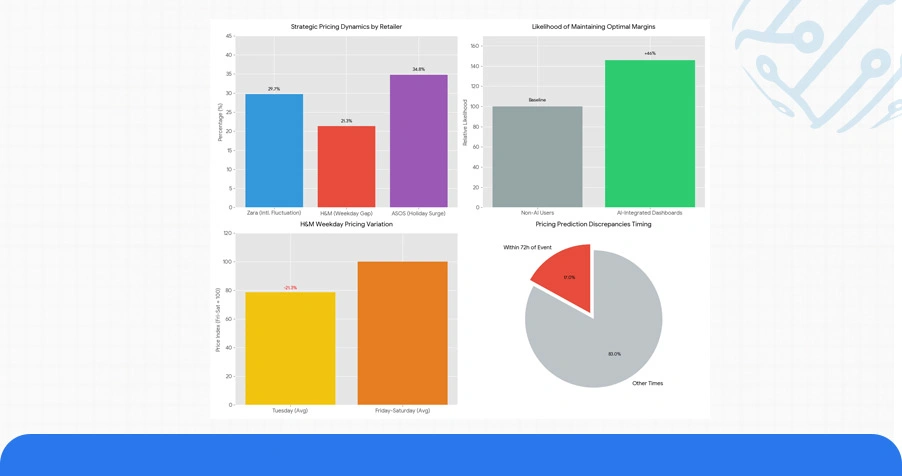
Retailers deploying AI-integrated pricing dashboards were 46% more likely to maintain optimal margin positions during promotional periods, validating the strategic value of continuous market intelligence through Amazon Fashion Product Dataset analysis and competitive monitoring.
- Analysis of Zara's 2025 pricing data across 18 international markets revealed a 29.7% average price fluctuation for seasonal collections, highlighting substantial volatility in cross-border pricing strategies driven by local demand elasticity.
- H&M demonstrated the most pronounced weekday pricing variation, with Tuesday listings averaging 21.3% lower than Friday–Saturday pricing, creating significant opportunities for price-conscious consumers and highlighting the value to Scrape Fashion Product Prices for Market Intelligence.
- Within ASOS marketplace operations, the premium fashion segment experienced a 34.8% price surge during holiday shopping periods and major fashion weeks, signaling peak-season pricing sensitivity and algorithmic demand response.
Notably, over 17% of pricing prediction discrepancies occurred within 72 hours of major sales events, underscoring the essential role of continuous price surveillance systems for tactical markdown optimization and inventory management.
Conclusion
In a sector characterized by rapid market shifts and algorithmic pricing competition, achieving strategic clarity through precise price intelligence is fundamental to sustainable retail performance. Fashion retailers that implement Real-Time Fashion Price Monitoring for Retail frameworks are significantly better positioned to anticipate competitive pricing movements, consumer behavior shifts, and seasonal demand volatility.
We deliver comprehensive solutions built on robust to Scrape Fashion Product Data Scraping capabilities and real-time competitive analytics. Contact ArcTechnolabs today to explore our fashion pricing intelligence platforms, custom analytics dashboards, and API integration services.