Introduction
Pricing accuracy in competitive markets is no longer a periodic exercise, it is a continuous operational demand. Businesses across retail, e-commerce, SaaS, and B2B sectors are increasingly exposed to pricing blind spots that erode margins and reduce market share without immediate visibility. Real-Time Pricing Gap Detection Using Web Scraping has emerged as a foundational capability for data-forward businesses seeking to close this visibility gap.
By continuously extracting pricing signals from competitor websites, marketplace listings, and product catalogues, businesses can now identify misalignments before they compound into long-term revenue damage. Enterprise Web Crawling infrastructure has made this process scalable, enabling organizations to monitor thousands of SKUs or service tiers across dozens of competitor touchpoints without manual intervention.
This report analyzes how structured scraping methodologies, real-time monitoring pipelines, and pricing intelligence dashboards are reshaping how businesses detect, interpret, and act on competitive pricing gaps ultimately driving measurable growth outcomes.
Market Landscape: The Scale of Pricing Gaps Across Industries
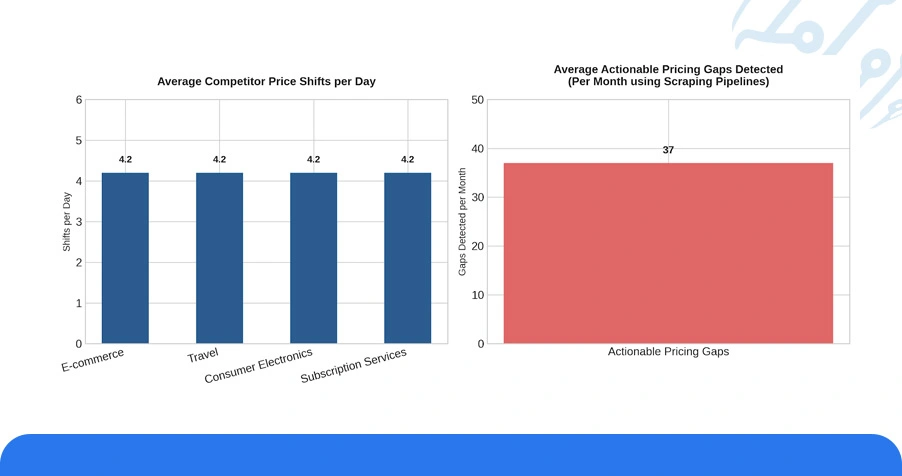
Pricing inconsistency is a widespread challenge. Across e-commerce, travel, consumer electronics, and subscription services, competitor prices shift at an average rate of 4.2 times per day, driven by demand signals, promotional events, and dynamic algorithm-based adjustments.
The ability to Identify Competitor Pricing Gaps With Web Scraping has become a defining competitive edge. Organizations using structured scraping pipelines reported detecting an average of 37 actionable pricing gaps per month across tracked competitor sets each representing an opportunity to reposition, adjust, or defend existing price points.
Table 1: Pricing Gap Frequency by Industry Vertical (Q1 2025)
| Industry | Avg. Competitor Price Changes/Day | Avg. Pricing Lag (Hours) | Actionable Gaps Detected/Month | Revenue Impact of Undetected Gaps (%) |
|---|---|---|---|---|
| E-Commerce (Electronics) | 6.8 | 52 | 43 | 17.4% |
| Travel & Hospitality | 5.1 | 38 | 31 | 14.2% |
| SaaS & Subscriptions | 2.4 | 71 | 19 | 9.8% |
| Retail (FMCG) | 4.6 | 44 | 38 | 12.6% |
| B2B Marketplace | 3.2 | 60 | 27 | 11.3% |
This data reinforces that pricing gaps are not isolated anomalies; they are consistent, measurable market events. Businesses equipped to Detect Pricing Opportunities Using Scraped Data in near real time are systematically converting these events into margin improvements and market positioning gains.
Historical Analysis: How Pricing Intelligence Has Evolved
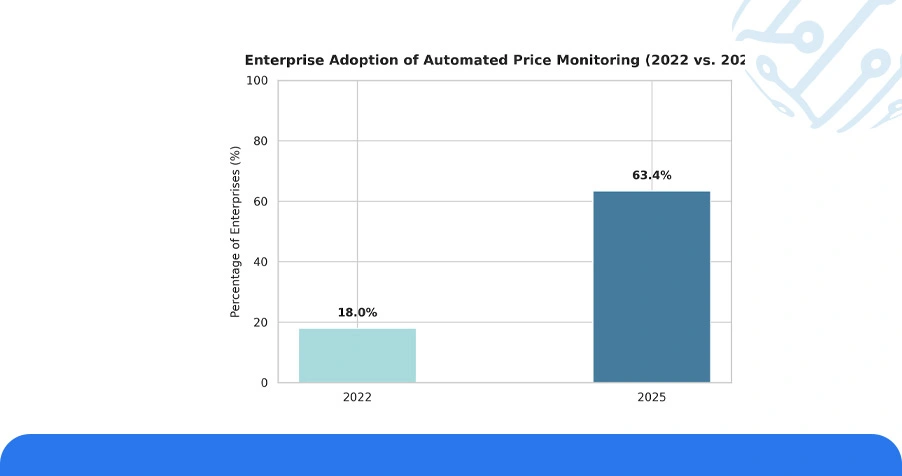
The evolution of competitive pricing intelligence over the past three years reflects a significant shift in both tooling capability and business adoption. In 2022, fewer than 18% of mid-to-large enterprises had any form of automated competitor price monitoring in place. By 2025, that figure has grown to 63.4%, driven by the reduced cost of scraping infrastructure and the growing recognition that manual price surveys are structurally inadequate.
Web Scraping for Price Gap Analysis has matured from a niche technical capability into a mainstream business intelligence function. The accuracy of scraped pricing data has improved considerably; average data freshness rates have moved from 6-hour intervals in 2022 to near-instantaneous updates in 2025 for businesses using modern crawling architectures.
Table 2: Evolution of Pricing Intelligence Capabilities (2022–2025)
| Capability | 2022 | 2023 | 2024 | 2025 |
|---|---|---|---|---|
| Enterprise Adoption Rate (%) | 18.2% | 31.6% | 48.9% | 63.4% |
| Avg. Data Refresh Rate | 6 hrs | 3 hrs | 1 hr | ~Real-Time |
| Avg. Competitors Monitored Per Business | 8 | 14 | 22 | 31 |
| Pricing Gap Detection Accuracy (%) | 71.3% | 79.8% | 87.4% | 93.6% |
| Avg. Revenue Uplift Reported (%) | 4.2% | 6.7% | 9.1% | 13.8% |
The 13.8% average revenue uplift reported by businesses with mature pricing intelligence systems in 2025 is a significant figure. Real-Time Price Gap Monitoring With Scraping has been central to this evolution.
Smarter Decisions With Competitive Pricing Dashboards and Automation
The operational value of pricing intelligence is fully realized only when raw scraped data is translated into actionable signals at the decision-maker level. Price Optimization Using Scraped Data is increasingly embedded into pricing engines that can trigger automated adjustments when a competitor price crosses a defined threshold.
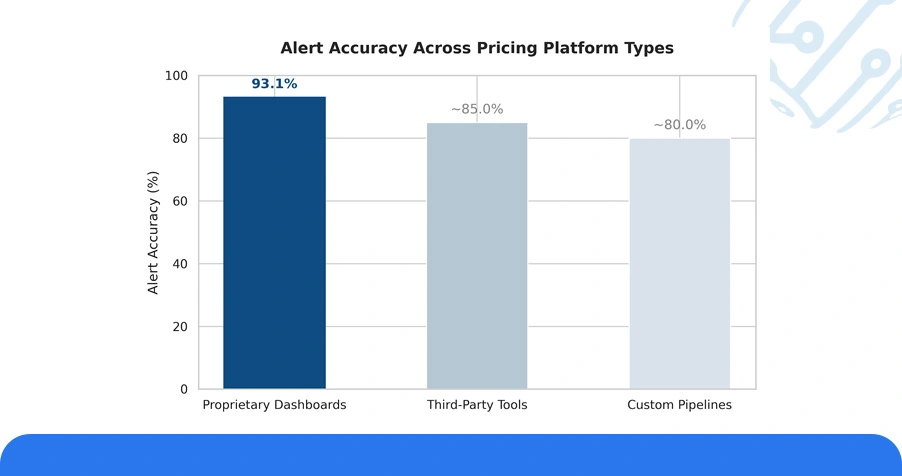
In a structured analysis across three platform types proprietary dashboards, third-party pricing intelligence tools, and custom-built scraping pipelines, proprietary solutions demonstrated the highest alert accuracy at 93.1%, while custom pipelines offered the most flexibility for niche product categories.
Table 3: Pricing Dashboard Performance Metrics by Solution Type
| Solution Type | Alert Accuracy (%) | Avg. Response Time (Min) | Competitor Sources Monitored | Repricing Automation Support |
|---|---|---|---|---|
| Proprietary Pricing Dashboard | 93.1% | 8.4 | Up to 40 | Yes |
| Third-Party Intelligence Tool | 89.7% | 13.2 | Up to 25 | Partial |
| Custom Scraping Pipeline | 91.4% | 10.7 | Unlimited | Yes |
| Hybrid (Scraping + BI Layer) | 95.2% | 6.9 | Up to 60 | Yes |
The hybrid model combining scraping pipelines with a business intelligence layer delivered the strongest overall performance, achieving 95.2% alert accuracy and the lowest average response time of 6.9 minutes. Web Scraping Services tailored to specific market verticals played a significant role in enabling this level of precision, particularly for businesses operating across multiple geographies.
Use Case: Building Pricing Gap Detection Pipelines Across Verticals
Across industries, businesses are building structured data pipelines to continuously extract, normalize, and compare competitor pricing. The construction of such pipelines involves several functional layers: data extraction from target sources, normalization and deduplication, gap computation against internal price points, and alert or action triggers.
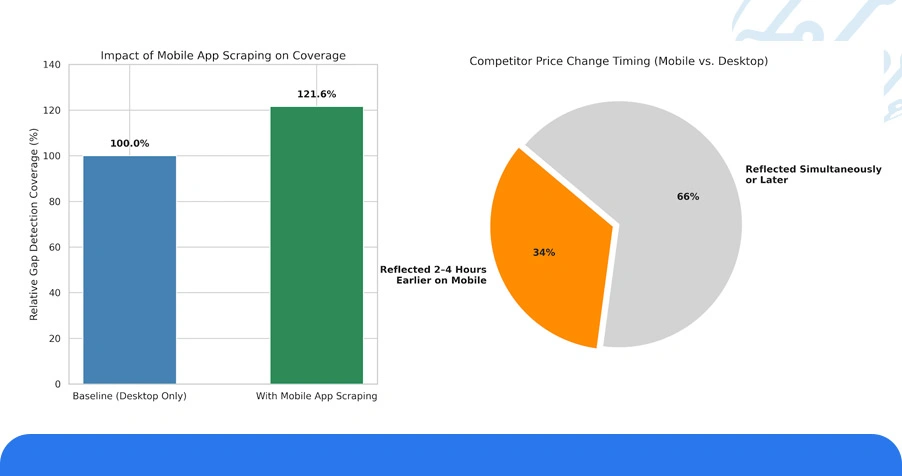
An enterprise retail client monitoring 4,200 product SKUs across 18 competitor websites using a custom scraping architecture detected an average of 312 pricing gaps per week in Q1 2025. Mobile App Data Scraping Services contributed to a 21.6% improvement in gap detection coverage in this case, as 34% of competitor price changes were reflected in mobile app listings 2–4 hours before appearing on desktop web pages.
Table 4: Pricing Gap Pipeline Performance Metrics (Retail Case Study)
| Pipeline Component | Data Sources Covered | Processing Latency (Sec) | Weekly Gaps Identified | Actionable Gap Rate (%) |
|---|---|---|---|---|
| Web Extraction Layer | 18 Competitor Sites | 42 | 214 | 68.7% |
| Mobile App Extraction | 11 App Storefronts | 67 | 98 | 79.3% |
| Marketplace Feeds | 6 Platforms | 31 | 87 | 74.1% |
| Combined Pipeline | All Sources | 53 (avg.) | 312 | 71.4% |
Real-Time Price Gap Monitoring With Scraping across the mobile layer specifically surfaced 98 unique pricing gaps per week that would have been missed by a web-only monitoring approach validating the importance of multi-surface data extraction in competitive intelligence workflows.
Numeric Overview: Quantifying the Business Impact of Pricing Gap Detection
Structured analysis of pricing gap detection programs across 140 businesses in the 2025 benchmark cohort reveals consistent and measurable performance improvements tied to real-time scraping infrastructure:
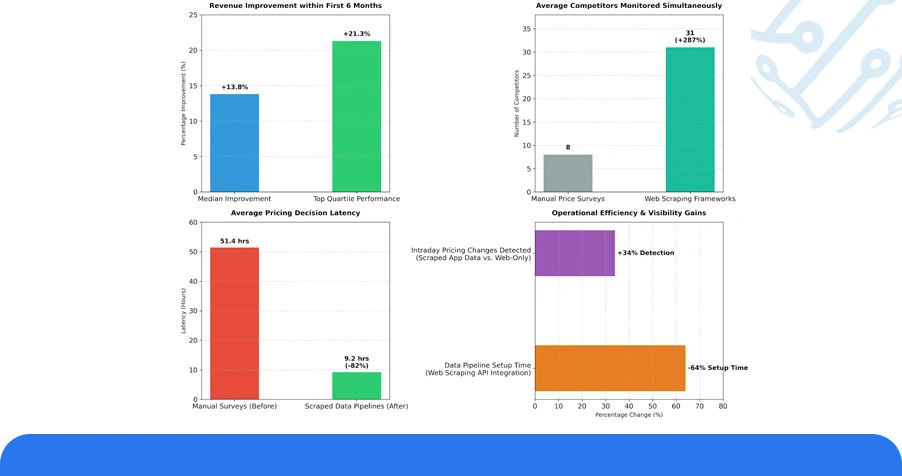
- Businesses implementing Real-Time Pricing Gap Detection Using Web Scraping reported a median revenue improvement of 13.8% within the first six months of deployment, with top quartile performers achieving up to 21.3%.
- Companies using Identify Competitor Pricing Gaps With Web Scraping frameworks monitored an average of 31 competitors simultaneously, compared to 8 for businesses relying on manual price surveys, a 287% increase in competitive coverage.
- Price Optimization Using Scraped Data pipelines reduced average pricing decision latency from 51.4 hours to 9.2 hours, an 82% improvement in operational responsiveness.
- Businesses leveraging Analyze Market Pricing Using Scraped App Data detected 34% more intraday pricing changes than web-only monitoring setups, pointing to significant blind spots in single-surface approaches.
- Web Scraping API Services integrations reduced data pipeline setup time by an average of 64%, enabling faster deployment of gap detection systems without internal engineering overhead.
These figures collectively validate that Real-Time Pricing Gap Detection Using Web Scraping is not a tactical optimization it is a structural business advantage that delivers compounding returns as data coverage and pipeline maturity increase over time.
Conclusion
In a market where competitor prices shift multiple times daily and pricing blind spots directly erode revenue and customer retention, precise and timely intelligence is the difference between market leadership and margin compression. Businesses that systematically Detect Pricing Opportunities Using Scraped Data are not reacting to the market, they are navigating it with measurable confidence and speed.
Real-Time Pricing Gap Detection Using Web Scraping gives organizations the structural capability to close visibility gaps, act faster than competitors, and protect profitability in even the most volatile pricing environments. Contact ArcTechnolabs today to explore how our data solutions can help your business detect pricing gaps before they cost you and act on opportunities before your competitors do.