Introduction
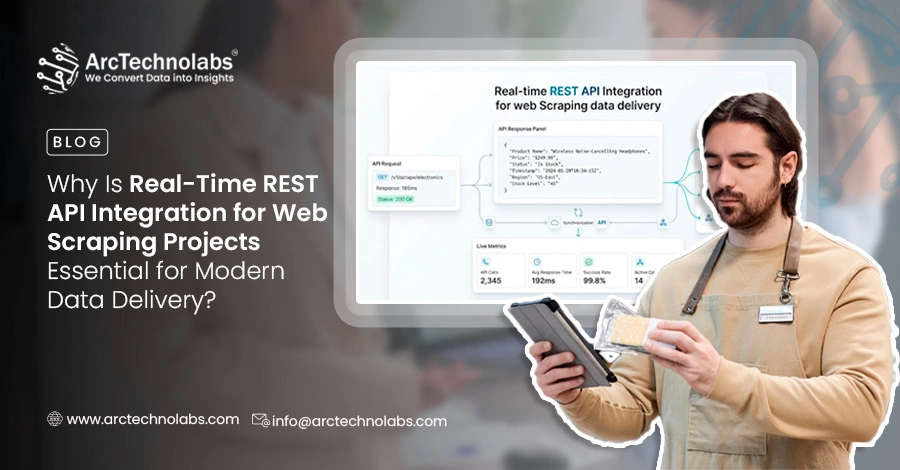
Businesses today rely on instant access to structured information to support pricing, market intelligence, customer insights, and operational decisions. Traditional methods of exporting scraped datasets into spreadsheets or static files often create delays that reduce the value of time-sensitive information. Modern development teams increasingly prefer connected systems that move information seamlessly between scraping engines, business applications, and analytics platforms without manual intervention.
A well-designed API layer bridges this gap by transforming extracted information into structured, accessible endpoints that applications can consume immediately. Companies involved in Enterprise Web Crawling increasingly depend on API-driven architectures to deliver synchronized datasets across CRM platforms, dashboards, inventory systems, and reporting tools.
The demand for Real-Time REST API Integration for Web Scraping Projects continues to grow because organizations require reliable data delivery that scales alongside expanding business operations. Industry reports indicate that over 80% of enterprises now prioritize API-based integrations for digital transformation initiatives, while organizations implementing automated data pipelines often report significantly faster reporting cycles and improved operational efficiency.
Accelerating Continuous Information Flow Across Business Operations Efficiently
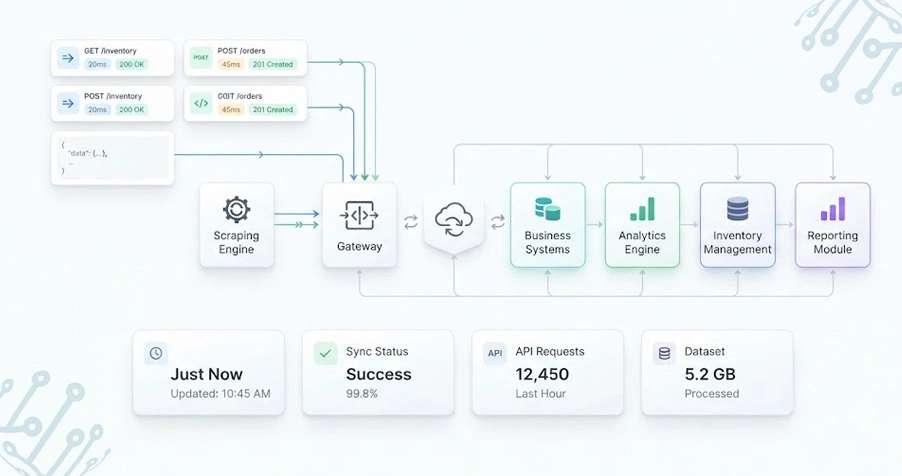
Modern businesses depend on accurate information reaching decision-makers without unnecessary delays. Businesses using professional Web Scraping Services can eliminate repetitive workflows while maintaining consistent information delivery across internal systems. Industry research suggests that organizations implementing automated integration frameworks can reduce manual processing time by nearly 60%, leading to improved operational productivity and faster business responses.
A structured API layer creates a reliable bridge between scraping infrastructure and enterprise applications. Instead of downloading files repeatedly, organizations can Build REST APIs for Scraped Data Delivery so business platforms retrieve updated datasets automatically whenever needed. This process minimizes synchronization delays, improves consistency, and enables different departments to work from the same reliable information source.
Organizations increasingly invest in automation because real-time information directly influences pricing strategies, customer engagement, inventory planning, and competitive intelligence. Consistent delivery improves reporting accuracy and strengthens operational efficiency across distributed business environments. Studies indicate companies using automated data exchange frameworks experience significantly shorter reporting cycles and improved collaboration between departments.
| Business Challenge | Recommended Solution | Business Outcome |
|---|---|---|
| Delayed reporting | Automated API integration | Faster decisions |
| Manual exports | Standardized delivery workflows | Reduced operational effort |
| Inconsistent updates | Continuous synchronization | Improved accuracy |
| Multiple business tools | Centralized connectivity | Better collaboration |
Reliable implementation requires thoughtful planning, standardized architecture, continuous monitoring, and scalable deployment practices. Businesses that modernize their information delivery strategies often achieve greater flexibility while preparing for future expansion without disrupting existing digital ecosystems.
Managing Expanding Data Ecosystems Through Connected Automation Frameworks
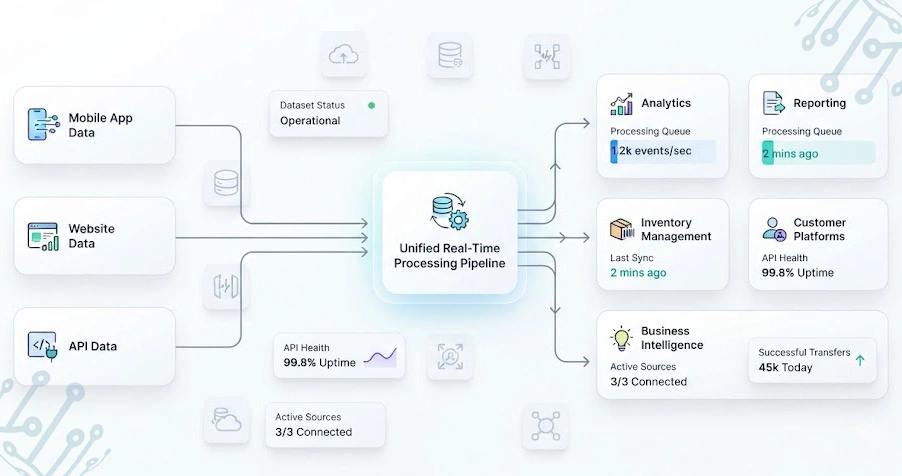
As organizations collect information from numerous websites and applications, handling increasing data volumes becomes significantly more complex. Integrating Mobile App Data Scraping Services into automated workflows allows organizations to collect valuable mobile application information alongside web-based datasets while maintaining consistency across business systems.
Building a dependable automation environment requires a robust Real-Time Data Pipeline for Web Scraping that transfers extracted information directly into reporting tools, operational dashboards, customer platforms, and analytics systems. Instead of relying on scheduled exports, automated pipelines continuously process incoming datasets while minimizing delays and improving accessibility for multiple business teams.
Businesses implementing Scalable Data Scraping and API Distribution Solutions can efficiently manage expanding datasets while maintaining high availability across different enterprise applications. Industry benchmarks indicate scalable architectures improve processing efficiency by nearly 50%, allowing organizations to support larger information volumes while maintaining consistent performance under demanding operational conditions.
| Operational Need | Automation Strategy | Expected Benefit |
|---|---|---|
| Growing datasets | Continuous processing | Faster performance |
| Multiple applications | Unified integration | Better consistency |
| High traffic | Elastic infrastructure | Improved scalability |
| Future expansion | Flexible architecture | Sustainable growth |
A well-designed automation strategy also simplifies maintenance, strengthens resource allocation, and reduces infrastructure bottlenecks as business requirements evolve. Continuous optimization ensures data collection, processing, and distribution remain aligned with organizational objectives while supporting future expansion.
Strengthening Reliable Connectivity Through Secure Integration Standards Today
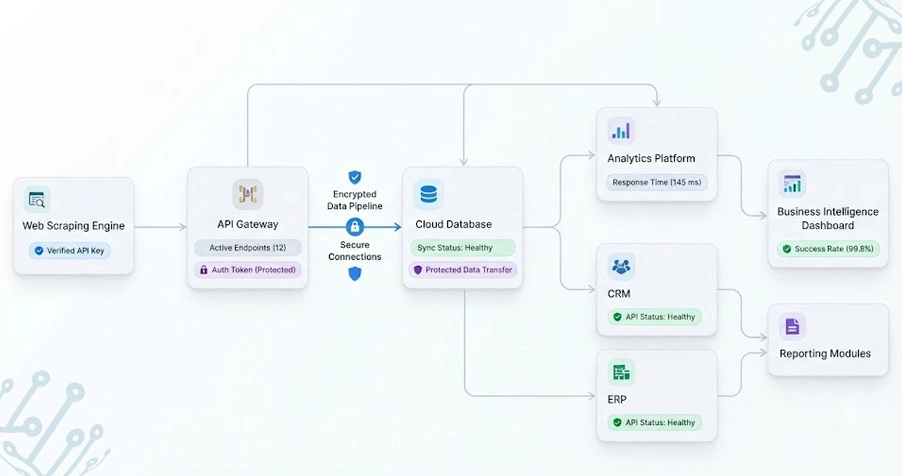
Successful information delivery depends on carefully structured integration frameworks that prioritize consistency, security, and dependable communication. Businesses implementing Web Scraping API Services can simplify the movement of extracted information between scraping platforms, operational software, business intelligence dashboards, and customer-facing applications.
Developing resilient infrastructure also requires a carefully planned API Architecture for Real-Time Web Scraping Systems that supports efficient request handling, standardized response formats, and reliable endpoint management. Well-designed APIs improve maintainability while reducing operational disruptions caused by inconsistent implementation standards.
Organizations adopting Secure REST API Delivery for Extracted Web Data protect sensitive business information through authentication mechanisms, encrypted communication protocols, and controlled access permissions. Industry studies consistently show that businesses implementing comprehensive API security strategies experience fewer integration failures while strengthening regulatory compliance and improving customer confidence in digital operations.
| Security Requirement | Recommended Practice | Business Advantage |
|---|---|---|
| Authentication | Token-based verification | Protected access |
| Standardized communication | Structured API responses | Reliable integration |
| Secure transmission | Encrypted protocols | Improved security |
| Governance | Controlled permissions | Regulatory compliance |
Combining structured architecture with strong security practices creates dependable environments capable of supporting enterprise-scale automation. Investing in secure integration frameworks ensures business applications continue exchanging accurate information efficiently as technology ecosystems expand and organizational requirements evolve.
How ArcTechnolabs Can Help You?
Modern organizations require more than accurate data extraction, they need dependable delivery systems that integrate seamlessly with existing business platforms. Through Real-Time REST API Integration for Web Scraping Projects, we ensure collected information is delivered quickly, securely, and in structured formats that fit your operational requirements.
Our approach includes:
- Design customized API-driven scraping workflows
- Develop reliable automation for continuous data delivery
- Create secure authentication and access management
- Integrate business dashboards and reporting platforms
- Optimize infrastructure for high-volume processing
- Provide ongoing maintenance and technical support
Additionally, our team helps businesses implement Scalable Data Scraping and API Distribution Solutions that simplify enterprise integrations, improve operational efficiency, and support future expansion without disrupting existing workflows.
Conclusion
Modern businesses increasingly depend on automated delivery systems that keep information flowing without delays. Implementing Real-Time REST API Integration for Web Scraping Projects enables organizations to distribute reliable datasets efficiently while improving overall operational performance.
Businesses also benefit when they Build REST APIs for Scraped Data Delivery, allowing applications to access structured information whenever it becomes available. Contact ArcTechnolabs today to transform your web scraping workflows into real-time business intelligence with scalable API integration.