Introduction
Modern enterprises are no longer short on data, they are short on the right systems to collect, process, and act on it at scale. We recognized this gap early and built its offerings around the growing need for Scalable Web Scraping Infrastructure for Enterprise Businesses that can adapt to evolving digital demands without compromising data quality or operational continuity. Organizations working with our Web Scraping Services have reported measurable improvements in both data freshness and downstream analytics performance.
What separates high-performing enterprises from the rest is not the volume of data they collect but the reliability and structure behind that collection. Inconsistent pipelines, missed data windows, and siloed outputs create friction that slows every function that depends on external intelligence. The demand for Raw Scraped Data Processing for Business Analytics has surged as companies realize that unstructured, disorganized data feeds are nearly as costly as having no data at all.
We work with enterprise clients to build scraping ecosystems that are not only powerful at launch but remain resilient as business needs scale. This case study outlines how we helped a large-scale enterprise overhaul its data infrastructure and move from reactive data collection to a proactive, automated intelligence operation. The result was a complete transformation in how teams across departments consumed, trusted, and acted on external data.
The Client
The client is a diversified enterprise conglomerate operating across retail, financial services, and logistics verticals, with active data requirements spanning twelve countries. Their internal analytics teams had long struggled with the absence of a unified Scalable Web Scraping Infrastructure for Enterprise Businesses capable of feeding all departments with consistent, structured, and timely data. They depended on a combination of third-party vendors, manual exports, and semi-automated tools, none of which communicated effectively with each other.
With growing pressure from leadership to improve competitive intelligence, pricing responsiveness, and supply chain visibility, the client initiated a formal search for a technology partner who could consolidate their data acquisition layer. The need for robust High-Volume Web Data Scraping Infrastructure became a non-negotiable requirement, particularly as the client's analytics workloads had grown to process tens of millions of data points daily across multiple source categories.
The client had made prior investments in BI platforms and cloud data warehouses but found them chronically underutilized because the input data layer was unreliable. Clean, structured, and continuously refreshed data was the missing link. They approached us with a clear mandate: build a system that scales with the business, integrates cleanly with existing tools, and requires minimal human oversight after deployment.
Key Challenges
Enterprise data environments are rarely clean starting points. The client's situation reflected challenges that are surprisingly common among large organizations attempting to modernize their data operations.
The core obstacles included:
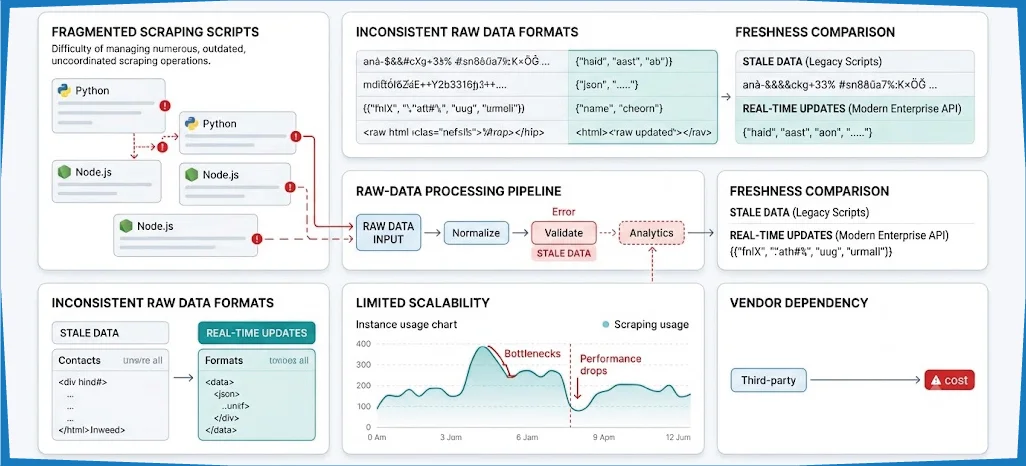
- Fragmented scraping scripts maintained by different teams with no shared governance or update protocols.
- Inconsistent output formats that required manual transformation before feeding into analytics pipelines.
- Limited capacity to scale during high-demand periods such as quarterly reporting cycles or market events.
- Vendor dependencies that created bottlenecks whenever scraping targets changed structure or introduced access restrictions.
- An absence of Raw Scraped Data Processing for Business Analytics workflows that could normalize, validate, and route data automatically.
The client also lacked a coherent approach to Real-Time Web Scraping Pipelines for Market Intelligence, which left time-sensitive functions like competitive pricing and inventory benchmarking perpetually working from stale inputs. Every day of delay translated directly into missed commercial opportunities or suboptimal decisions made on outdated information.
Key Solution
We approached this engagement as an infrastructure transformation project rather than a simple tool deployment. The solution was designed in phases, with each layer building on the previous to create a fully integrated, observable, and self-sustaining data acquisition environment.
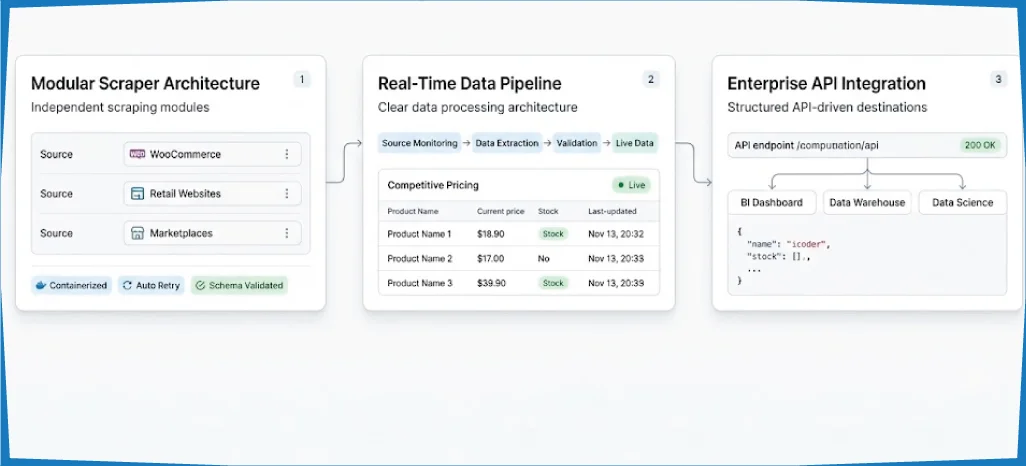
- The foundation was a modular Scalable Web Data Scraper Architecture for Business Applications that could be extended to new data sources without disrupting existing pipelines.
- Each scraping module was containerized, independently deployable, and equipped with built-in retry logic, rate management, and output schema enforcement.
- With Web Scraping for WooCommerce Stores, adding new data sources became a simple configuration task rather than a complex development project.
- On top of this foundation, we implemented Real-Time Web Scraping Pipelines for Market Intelligence that gave the client's commercial and strategy teams access to fresh competitive data within minutes of changes occurring across monitored sources.
- Latency, which had previously been measured in days, was reduced to near-real-time for priority data categories.
The third major component was an API-Based Web Scraping Architecture for Enterprise Data Workflows that allowed internal applications, BI dashboards, and data science environments to pull structured data on demand without touching the scraping layer directly.
Performance Metrics at a Glance
The following table captures the quantified improvements measured across key operational dimensions before and after we deployed the new infrastructure:
The improvements below reflect a 90-day post-deployment evaluation period across all active data verticals.
| Performance Dimension | Before Implement | After Implement |
|---|---|---|
| Data Freshness (avg. lag) | 18–36 hours | Under 8 minutes |
| Pipeline Failure Rate | 23% weekly | Under 1.5% weekly |
| Manual Intervention Needed | Daily | Near zero |
| Sources Monitored Simultaneously | 40 | 310+ |
| Data Output Accuracy | 67% clean on arrival | 98.4% clean on arrival |
| Time to Integrate New Data Source | 3–5 days | 4–6 hours |
| Analytics Team Utilization of Live Data | 28% | 91% |
These results reflect the compounding benefit of clean architecture decisions. When each layer of the data pipeline is designed for reliability and scale, the gains are visible not just in system logs but in the quality of decisions made by the teams consuming that data.
The improvements in pipeline reliability and source expansion also allowed the client to retire several costly third-party data subscriptions, creating direct cost savings that partially offset the engagement investment within the first six months.
Advantages of Implementing ArcTechnolabs
We provide scalable, enterprise-ready scraping solutions across industries and data environments, supporting Web Scraping For AI Data needs with reliable, structured information.
-
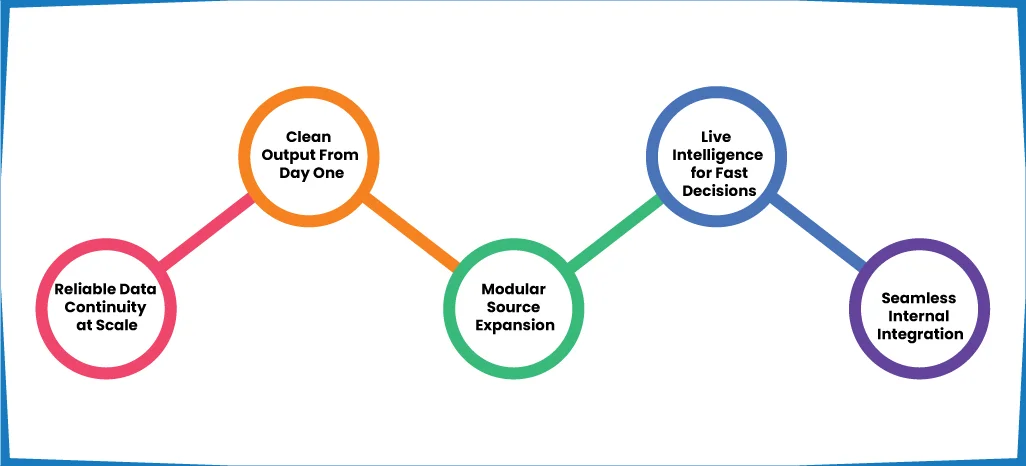
Reliable Data Continuity at Scale
Our systems maintain uninterrupted data collection through self-healing pipelines powered by High-Volume Web Data Scraping Infrastructure designed for enterprise-grade uptime and resilience.
-
Clean Output From Day One
Every raw feed passes through structured normalization workflows where Raw Scraped Data Processing for Business Analytics converts messy inputs into analytics-ready outputs automatically.
-
Modular Source Expansion
New data targets integrate through a Scalable Web Data Scraper Architecture for Business Applications that adds coverage without disrupting active pipelines or requiring extended development cycles.
-
Live Intelligence for Fast Decisions
Time-critical teams receive fresh competitive and market signals through Real-Time Web Scraping Pipelines for Market Intelligence that reduce data latency from days to minutes.
-
Seamless Internal Integration
Structured data reaches every internal tool through an API-Based Web Scraping Architecture for Enterprise Data Workflows that keeps the scraping layer clean and consumption layer flexible.
Client's Testimonial
ArcTechnolabs did not just build us a scraping tool, they rebuilt how our entire organization thinks about external data. When Scalable Web Scraping Infrastructure for Enterprise Businesses is deployed thoughtfully, the effects are not confined to the data team, they ripple across every function that depends on timely, trustworthy external intelligence. Our Web Scraping API Services further extend these capabilities for organizations needing programmatic, on-demand data access across distributed applications.
– Vice President of Enterprise Analytics, Global Conglomerate
Conclusion
Enterprise data operations are only as strong as the infrastructure feeding them. Fragmented, unreliable, or outdated scraping systems create a ceiling on how far analytics investments can go, regardless of how sophisticated the downstream tools are. We removed that ceiling by delivering Scalable Web Scraping Infrastructure for Enterprise Businesses that is built to perform at the pace and complexity modern enterprises require.
Our work with this client demonstrated that the right infrastructure does not just solve today's data problems, it creates the foundation for capabilities that were previously out of reach. Whether your organization operates across two markets or twenty, the need for clean, continuous, and structured external data remains constant.
Our solutions span Web Scraping for Woocommerce Stores and complex multi-vertical enterprise environments alike, reflecting the breadth of our implementation expertise. Contact ArcTechnolabs today to discuss your data infrastructure requirements and discover what becomes possible when your scraping foundation is finally built right.

