Introduction
The retail and e-commerce space has grown increasingly competitive, pushing brands to seek deeper intelligence from platforms they cannot always access directly. We addressed this challenge by helping a prominent retail brand gain structured visibility through Scraping Android Apps Hidden APIs for Product Data Insights, converting inaccessible app-layer data into actionable intelligence. The client engaged our Mobile App Data Scraping Services to build a reliable extraction pipeline across multiple competitor applications.
Retail businesses today cannot afford to make pricing or inventory decisions based on incomplete information. When competitor product data lives inside Android applications rather than publicly indexed web pages, brands are often left guessing. We developed a targeted solution that intercepted and decoded hidden API calls within Android apps, enabling the client to monitor product availability, pricing variations, and listing changes in real time.
The project demanded a careful balance of technical precision and structured data delivery. Beyond raw extraction, the team focused on transforming the pulled data into clean, analytics-ready formats. Product Catalog Data Extraction Through Android App environments was one of the core capabilities applied here, giving the client an organized view of how competing products were listed, categorized, and promoted inside popular retail applications.
The Client
The client is a mid-to-large retail brand specializing in consumer electronics and lifestyle products, with an active presence on major e-commerce platforms and its own branded Android application. The need for Scraping Android Apps Hidden APIs for Product Data Insights arose when the client noticed pricing inconsistencies between their app listings and competitor applications that were difficult to track manually.
Their internal teams lacked the technical capability to decode hidden API structures within third-party Android applications. This gap meant missed opportunities in pricing adjustments, promotional timing, and product bundling strategies. Mobile Application Scraping for User Behaviour Analytics was identified as a secondary priority, as the client also wanted to understand how user engagement signals such as review velocity and rating trends correlated with product ranking changes inside competitor apps.
With operations scaling rapidly and catalog sizes growing, the client required an automated, scalable, and reliable partner. Manual audits were no longer sustainable, and existing tools could not penetrate app-layer data structures. We were selected based on its proven track record in mobile data extraction and its ability to deliver structured, compliance-aware scraping solutions that fit the client's product intelligence roadmap and quarterly planning cycles.
Business Obstacles Faced
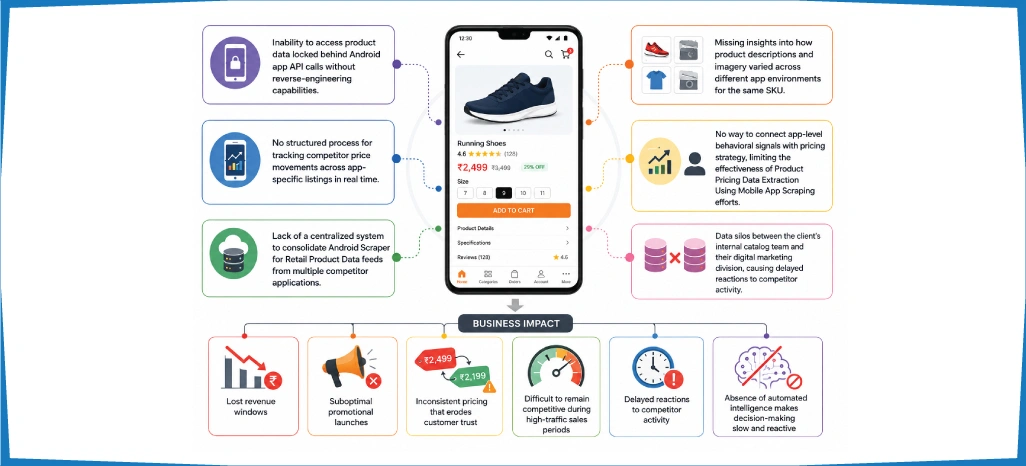
The mobile app data landscape presents unique technical and strategic barriers that are fundamentally different from conventional web environments. The client encountered several interconnected challenges that were slowing down their ability to respond to market shifts with confidence and speed.
- Inability to access product data locked behind Android app API calls without reverse-engineering capabilities.
- No structured process for tracking competitor price movements across app-specific listings in real time.
- Lack of a centralized system to consolidate Android Scraper for Retail Product Data feeds from multiple competitor applications.
- Missing insights into how product descriptions and imagery varied across different app environments for the same SKU.
- No way to connect app-level behavioral signals with pricing strategy, limiting the effectiveness of Product Pricing Data Extraction Using Mobile App Scraping efforts.
- Data silos between the client's internal catalog team and their digital marketing division, causing delayed reactions to competitor activity.
These challenges collectively resulted in lost revenue windows, suboptimal promotional launches, and inconsistent pricing that eroded customer trust over time. The absence of automated intelligence made it difficult for the client to remain competitive during high-traffic sales periods.
The Strategic Solution Delivered
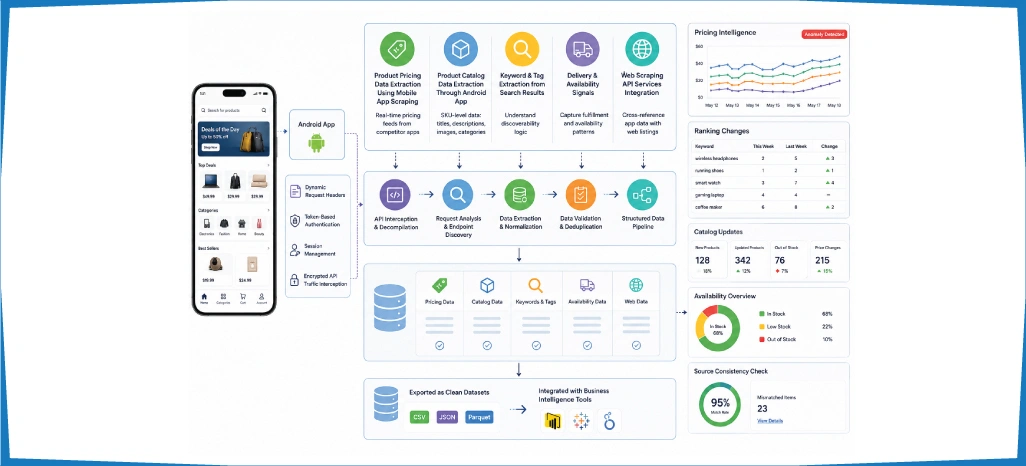
We engineered a multi-layered extraction architecture designed specifically to intercept and decode hidden API endpoints within Android applications. The pipeline was built to handle dynamic request headers, token-based authentication patterns, and session-specific data flows that are common in retail apps.
The solution covered the following extraction areas:
- Real-time product pricing feeds from competitor Android apps using Product Pricing Data Extraction Using Mobile App Scraping pipelines.
- SKU-level catalog data including titles, descriptions, images, and category hierarchies through Product Catalog Data Extraction Through Android App workflows.
- Keyword and tag extraction from app-based search result pages to understand discoverability logic.
- Delivery and availability signals captured from app API responses to map fulfillment patterns.
- Integration of Web Scraping API Services to cross-reference app data with web-based listings for consistency checks.
All extracted data was pushed into structured pipelines and delivered as clean datasets synced with the client's internal business intelligence tools. Visual dashboards were configured to highlight pricing anomalies, ranking changes, and competitor catalog updates in near real time, giving the client's teams a single source of competitive truth.
Performance Metrics at a Glance
The following table summarizes the measurable outcomes observed after we deployed the Android hidden API scraping solution across a 90-day monitoring window.
We tracked performance across multiple operational dimensions to give the client a full picture of impact. From pricing agility to catalog completeness, each metric reflected the value of structured mobile app intelligence when applied systematically.
| Performance Metric | Before Implementation | After Implementation |
|---|---|---|
| Competitor Pricing Visibility | 22% coverage | 91% coverage |
| Catalog Monitoring Frequency | Weekly manual audits | Real-time automated feeds |
| Pricing Response Time | 3–5 business days | Under 6 hours |
| SKUs Tracked Across Competitor Apps | ~800 SKUs | 6,400+ SKUs |
| Review Trend Monitoring | Not available | Daily sentiment updates |
| Promotional Activity Detection | Ad-hoc observation | Automated banner capture |
| BI Dashboard Integration | Manual CSV uploads | Live API-connected feeds |
By enabling Grocery Price Comparison Extraction With API Delivery within the data collection workflow, organizations gained access to deeper, more accurate, and real-time insights that were otherwise difficult to obtain through surface-level data extraction techniques.
These numbers also revealed secondary benefits the client had not initially anticipated. Catalog completeness improved significantly, enabling the merchandising team to identify product gaps and optimize their own listings based on how competitors structured high-performing SKUs.
Advantages of Implementing ArcTechnolabs
-
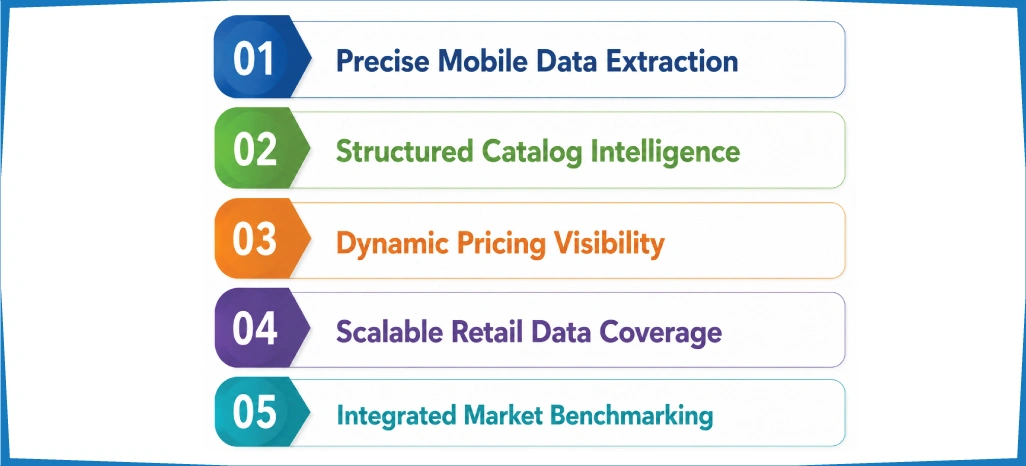
Precise Mobile Data Extraction
We decode hidden Android API structures with precision, delivering Mobile Application Scraping for User Behaviour Analytics insights that help brands understand competitor engagement patterns and product performance signals within mobile environments.
-
Structured Catalog Intelligence
Our pipelines deliver organized, SKU-level product data through Product Catalog Data Extraction Through Android App methods, enabling merchandising teams to benchmark listings, identify content gaps, and improve their own catalog quality systematically.
-
Dynamic Pricing Visibility
We continuously monitor competitor price movements using Product Pricing Data Extraction Using Mobile App Scraping systems, ensuring brands can respond to market shifts in hours rather than days, protecting margin and conversion rates.
-
Scalable Retail Data Coverage
Businesses benefit from expansive competitor monitoring via an Android Scraper for Retail Product Data framework, covering thousands of SKUs across multiple applications simultaneously without manual effort or data quality compromise.
-
Integrated Market Benchmarking
We connect extracted app data with Custom Datasets tailored to the client's product verticals, enabling richer benchmarking, trend analysis, and strategic planning that goes well beyond standard competitor tracking capabilities.
Client Testimonial
The depth of intelligence ArcTechnolabs brought through Scraping Android Apps Hidden APIs for Product Data Insights was unlike anything our internal teams had achieved. We could finally see what competitors were doing inside their apps and respond with precision. The Android Scraper for Retail Product Data pipeline they built gave us a live view of the market that completely changed how we approach pricing and promotions.
– Head of Product Intelligence, Consumer Electronics Retail Brand
Conclusion
Retail brands competing in app-first marketplaces need intelligence that goes deeper than what is visible on a screen. Scraping Android Apps Hidden APIs for Product Data Insights is the kind of technical capability that separates data-mature organizations from those reacting late to market shifts.
The impact of Grocery Price Comparison Extraction With API Delivery and broader mobile data extraction programs proves that structured, real-time product intelligence directly improves pricing decisions, catalog quality, and competitive positioning across every channel. Contact ArcTechnolabs today to build a custom Android app data extraction solution for your brand.