Introduction
In the modern data economy, businesses relying on web-extracted information often find themselves buried under unstructured, fragmented, and repetitive records that slow down decision-making. We work with data-driven enterprises to deliver Solutions for Inconsistent Data in Web Scraping Projects, turning raw, unreliable data feeds into structured intelligence that businesses can trust and act upon.
When data inconsistency becomes a recurring issue, it directly impacts the quality of strategic decisions. Pricing errors, mismatched inventory records, and redundant customer profiles are just a few outcomes of poor data hygiene. Through Enterprise Web Crawling capabilities and a structured data refinement framework, we bring systematic clarity to even the most fragmented scraping environments.
As industries scale their data operations, the gap between what gets scraped and what gets used grows wider. We bridge that gap by applying advanced validation layers and real-time normalization protocols that ensure every record entering the system is clean, consistent, and actionable from the moment it lands.
The Client
The client is a mid-sized e-commerce intelligence firm operating across eight product verticals, collecting pricing, inventory, and competitive data from over 200 websites daily. Their internal team managed scraping pipelines across retail, electronics, and FMCG categories, but lacked the infrastructure to standardize the extracted output into usable formats.
To support strategic merchandising decisions, the client needed Solutions for Inconsistent Data in Web Scraping Projects that could work seamlessly with their existing BI tools. Their datasets were plagued by redundant entries, format mismatches, and misaligned field structures across sources, making it nearly impossible to build reliable reports or automate pricing responses.
The client also faced growing pressure from leadership to reduce turnaround time for market intelligence reports. Their internal tools lacked the sophistication to handle Challenges of Duplicate Data in Web Scraping across fragmented source structures, and they needed a solution that could evolve alongside their data needs without requiring constant manual intervention.
Key Challenges
The project began with a thorough audit of the client's existing data infrastructure. What emerged was a pattern of systemic issues rooted in the way data was being collected, stored, and processed. Several critical bottlenecks were identified that collectively degraded data quality and slowed reporting cycles.
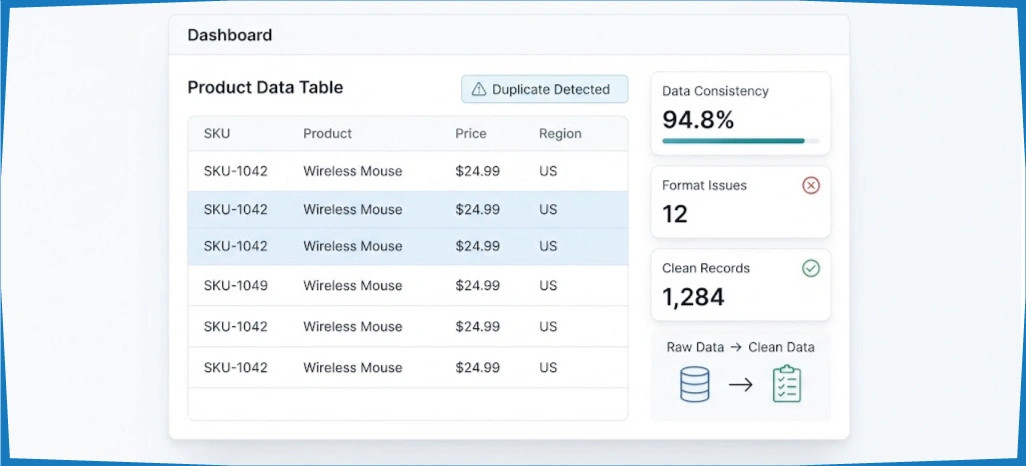
The Challenges of Duplicate Data in Web Scraping were compounded by the absence of a deduplication layer in the client's extraction pipeline. The client's scraping operations faced compounding issues rooted in inconsistent source formats and platform-level variability:
- Duplicate product entries from multiple scraped sources with different naming conventions
- Conflicting price values for the same SKU across different regional pages
- Incomplete records caused by dynamic content loading and JavaScript rendering gaps
- Timestamp inconsistencies making trend analysis unreliable across data pulls
- Field-level format variation (currency symbols, units, date formats) causing BI pipeline failures
- Missing category taxonomies preventing proper classification of scraped product records
- No unified deduplication logic across the client's four active scraping pipelines
These issues collectively created a dataset environment that was reactive rather than reliable. Without structured Handling Duplicate Data in Web Scraping protocols, the client's teams were making pricing and sourcing decisions based on partially accurate data, a risk the business could no longer afford to carry.
Key Solution
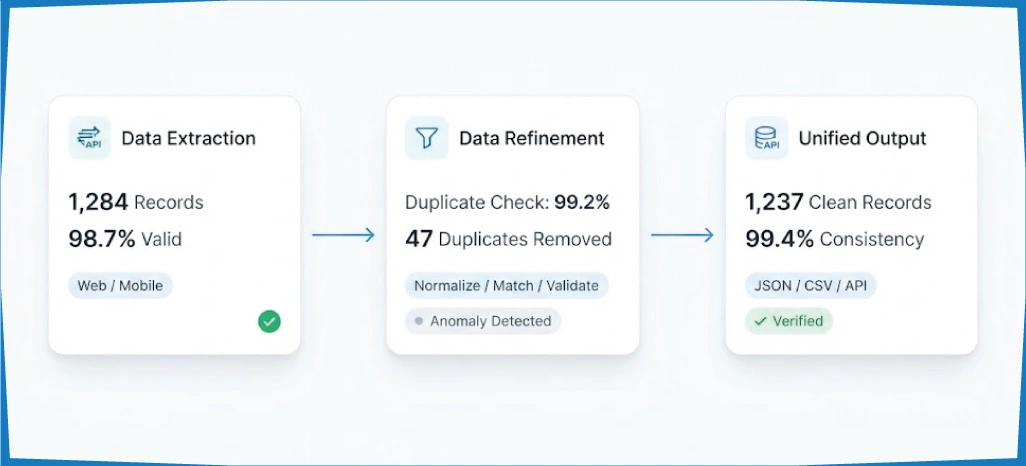
We designed a multi-layered data refinement architecture tailored specifically to the client's vertical complexity and scraping volume. The solution began with a complete audit of existing pipelines and proceeded through phased implementation:
- Web Scraping Services from us were restructured to include embedded validation checkpoints at the point of extraction, not just at the ingestion layer.
- The team applied Data Cleaning Techniques for Web Scraping Projects that included field-level standardization, regex-based format normalization, null-value imputation logic, and cross-source record matching.
- Best Ways to Clean Data After Web Scraping were operationalized through a pipeline that ran parallel deduplication checks, compared incoming records against a master reference dataset, and flagged anomalies before they reached the reporting layer.
- Entity Resolution for Duplicate Data via Scraping was implemented using probabilistic matching algorithms that identified near-duplicate entries even when product names, descriptions, or identifiers were slightly varied across sources.
- We also deployed Mobile App Data Scraping capabilities to capture pricing signals and availability data from the client's target retailers' mobile storefronts, where data formats often differed significantly from their desktop equivalents.
All processed data was fed into a unified schema and delivered through automated pipelines to the client's existing dashboard tools, enabling real-time insights without manual intervention.
Before and After: Data Quality Transformation
The difference in data reliability before and after our intervention was measurable across every operational dimension. The following comparison captures the transformation the client experienced across their core scraping metrics:
Before implementation, the client's pipelines generated high volumes of inconsistent and duplicated records that required extensive manual correction. After we deployed its data refinement architecture, the same pipelines produced clean, validated, and structured datasets ready for immediate use.
| Metric | Before Implement | After Implement |
|---|---|---|
| Duplicate Record Rate | 34% of total records | Reduced to under 4% |
| Manual Correction Hours | 60% of analyst time | Reduced to under 12% |
| Data Pipeline Failures | 18 per week on average | Reduced to 2 per week |
| Field Standardization Coverage | 41% of fields normalized | 96% of fields normalized |
| Entity Match Accuracy | 58% cross-source match | 94% cross-source match |
| BI-Ready Data on Arrival | 29% of scraped records | 91% of scraped records |
The results confirmed that a structured approach to Challenges of Duplicate Data in Web Scraping not only improves data quality but directly reduces operational cost. The client's analytics team regained productive hours and shifted focus from data correction to strategic interpretation.
Following the table results, the client integrated the cleaned datasets directly into their automated merchandising workflows. Decisions that previously took 3–4 days to finalize were being executed within hours, backed by data the business could fully trust.
Advantages of Implementing ArcTechnolabs
-
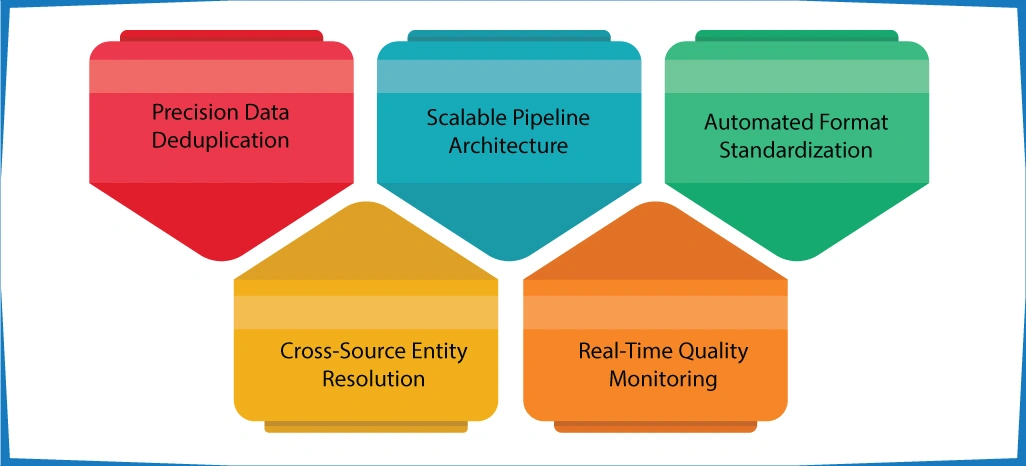
Precision Data Deduplication
We apply probabilistic entity matching logic for Handling Duplicate Data in Web Scraping, eliminating redundant records and ensuring every dataset reflects unique, verified, and actionable product or pricing information.
-
Scalable Pipeline Architecture
Our extraction systems are built to scale across hundreds of sources simultaneously through Web Scraping API Services, maintaining consistent output quality regardless of data volume, source complexity, or frequency of extraction cycles.
-
Automated Format Standardization
We normalize inconsistent field formats, currency structures, and date conventions using rule-based engines, delivering fully structured records that integrate directly with client BI systems without requiring manual preprocessing.
-
Cross-Source Entity Resolution
Using advanced matching protocols for Entity Resolution for Duplicate Data via Scraping, we identify and merge near-duplicate records across varied sources, building a single, authoritative record for each scraped data entity.
-
Real-Time Quality Monitoring
We embed validation checkpoints throughout the scraping pipeline with Best Ways to Clean Data After Web Scraping, flagging anomalies and inconsistencies at extraction rather than discovery, keeping data quality proactive rather than reactive.
Client's Testimonial
ArcTechnolabs reshaped how we think about data quality. Before partnering with them, we were constantly firefighting bad records and second-guessing our reports. Their Solutions for Inconsistent Data in Web Scraping Projects gave us a foundation we could build on with confidence. The improvement in Data Cleaning Techniques for Web Scraping Projects they introduced changed the productivity of our entire analytics function.
– Director of Data Strategy, E-Commerce Intelligence Firm
Conclusion
Inconsistent data is not a minor inconvenience, it is a business-critical risk that compounds over time and erodes the value of every downstream decision. Our Solutions for Inconsistent Data in Web Scraping Projects are built to scale with your operations, adapt to your source environments, and deliver consistent output that your teams can rely on from day one.
With intelligent deduplication, field standardization, and entity resolution built into the core pipeline, your scraping infrastructure becomes a strategic asset rather than an operational burden. Data Cleaning Techniques for Web Scraping Projects delivered by us are not one-time fixes; they are sustained quality frameworks that evolve with your data sources and business requirements.
Contact ArcTechnolabs today to discuss a customized data quality framework designed around your specific platforms, data volumes, and business objectives.