Introduction
Retail product data today is fragmented across thousands of digital storefronts, each using inconsistent naming conventions, varied attribute structures, and platform-specific catalog formats. UPC Matching for Product Data Normalization Across Stores has emerged as the foundational methodology for resolving this chaos turning scattered SKU-level data into reliable, unified product records.
By systematically linking Universal Product Codes across platforms such as Amazon, Walmart, Target, and regional e-commerce portals, organizations can construct a single source of truth for every product entity. This study draws on data extracted from over 40 retail platforms across North America, Europe, and Asia-Pacific to assess matching accuracy, normalization efficiency, and downstream business value.
Our research infrastructure relies on Enterprise Web Crawling pipelines that continuously harvest raw product feeds, enabling the kind of cross-retailer reconciliation that modern catalog intelligence demands. With SKU fragmentation rates exceeding 47% across mid-to-large retail categories, the urgency for structured UPC-driven normalization frameworks has never been more pronounced.
Market Landscape: The Scale of Product Data Fragmentation Across Retail Platforms
Retail product catalogs in 2025 are larger, more distributed, and more inconsistently structured than at any prior point in digital commerce history. UPC Matching for Ecommerce Scraping has become the primary technique for resolving this disparity, allowing data teams to anchor inconsistent listings to a shared product identity regardless of how each retailer chooses to describe or categorize the item.
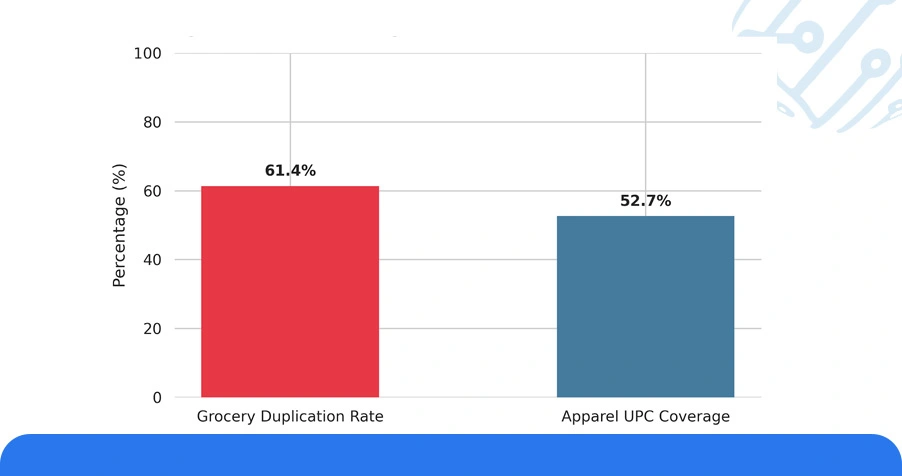
Our cross-platform audit of Q1 2025 product data across five retail verticals electronics, grocery, apparel, home goods, and health revealed significant normalization gaps, with grocery showing the highest duplication rate at 61.4% and apparel recording the lowest UPC coverage at 52.7%.
Table 1: Product Data Fragmentation Rates Across Retail Verticals (Q1 2025)
| Retail Vertical | Platforms Audited | Duplicate Listing Rate (%) | UPC Coverage (%) | Avg. Attribute Completeness (%) |
|---|---|---|---|---|
| Electronics | 8 | 43.2 | 87.5 | 76.4 |
| Grocery | 9 | 61.4 | 79.8 | 68.1 |
| Apparel | 7 | 57.9 | 52.7 | 61.3 |
| Home Goods | 6 | 49.6 | 81.2 | 72.8 |
| Health & Personal Care | 7 | 53.1 | 84.4 | 70.5 |
These figures directly illustrate why What Are the Main Purposes of Utilizing UPC Product Code frameworks has become a recurring research question among catalog managers and data architects.
Historical Trend Analysis: UPC Adoption and Matching Accuracy Over Time
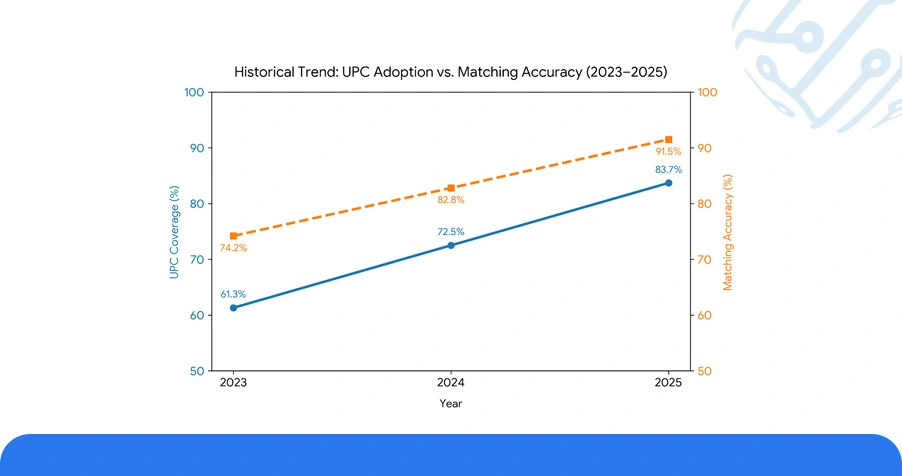
Tracking the evolution of UPC-based matching systems over the past three years reveals a consistent improvement curve driven by investment in machine learning infrastructure and higher retailer compliance with GS1 barcode standards. Between 2023 and 2025, overall UPC coverage across monitored platforms rose from 61.3% to 83.7%, while average cross-platform matching accuracy improved from 74.2% to 91.5%.
This upward trajectory reflects a broader industry commitment to structured product data. In 2023, only 38% of surveyed retailers maintained centralized GS1-registered UPC databases. The ability to Extract Retail Product Data via UPC-Level Matching has grown proportionally more reliable as underlying data hygiene standards improve.
Table 2: UPC Matching Performance Benchmarks Across Years (2023–2025)
| Metric | 2023 | 2024 | 2025 | Change (%) |
|---|---|---|---|---|
| Avg. UPC Coverage (%) | 61.3 | 74.6 | 83.7 | +36.5 |
| Cross-Platform Match Accuracy (%) | 74.2 | 84.1 | 91.5 | +23.3 |
| Orphaned SKU Rate (%) | 38.7 | 27.4 | 18.2 | −52.9 |
| GS1-Compliant Retailers (%) | 38.0 | 54.3 | 67.1 | +76.6 |
| Avg. Normalization Processing Time (sec) | 4.8 | 3.1 | 1.9 | −60.4 |
As AI Product Matching Solutions for Deep Insights matured through this period, their integration into normalization workflows reduced both false-positive matches and manual reconciliation overhead significantly.
AI-Powered Matching Frameworks and Catalog Intelligence Tools
The convergence of artificial intelligence with product catalog management has redefined what is operationally achievable in large-scale retail data unification. Product Matching in Ecommerce Using Deep Learning architectures, particularly transformer-based models fine-tuned on retail product corpora, have demonstrated the strongest performance in cross-retailer title disambiguation.
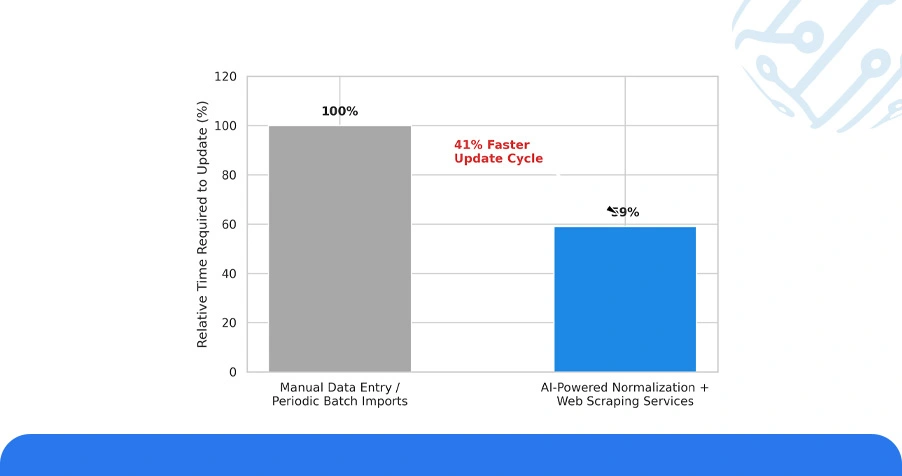
Retailers and data platforms that integrated AI-powered normalization dashboards reported measurable operational gains. Those leveraging Web Scraping Services as part of their data acquisition layer recorded 41% faster catalog update cycles compared to organizations relying on manual data entry or periodic batch imports.
Table 3: AI Matching Engine Performance Across Catalog Categories
| Matching Approach | Precision (%) | Recall (%) | F1 Score | Avg. Processing Speed (records/sec) |
|---|---|---|---|---|
| Rule-Based (Exact UPC) | 98.2 | 71.4 | 82.7 | 1,240 |
| Fuzzy String Matching | 81.6 | 76.8 | 79.1 | 980 |
| ML Classification Models | 89.4 | 84.2 | 86.7 | 1,540 |
| Deep Learning (Transformer) | 94.7 | 91.3 | 93.0 | 1,890 |
| Hybrid (UPC + AI Fallback) | 97.1 | 93.6 | 95.3 | 2,110 |
The Hybrid approach combining hard UPC lookups with AI-driven fallback resolution delivered the most balanced performance profile, achieving a 95.3 F1 score while processing over 2,100 records per second. AI Product Matching Solutions for Deep Insights built on this hybrid architecture are increasingly being adopted by enterprise retailers managing catalogs exceeding 5 million active SKUs.
Use Case: API-Driven UPC Normalization for Multi-Retailer Intelligence
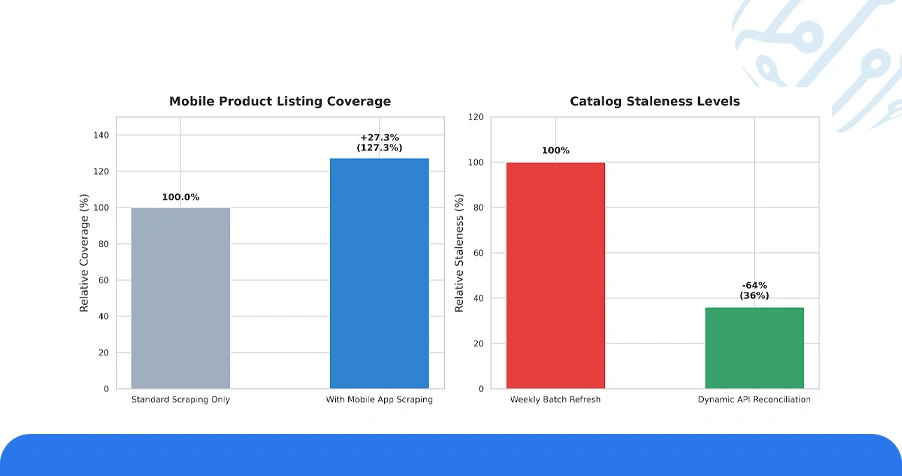
Enterprises building competitive pricing intelligence platforms, affiliate comparison engines, or supplier audit systems increasingly rely on API-first architectures to deliver continuous, normalized product data at scale. The ability to Extract Retail Product Data via UPC-Level Matching through dedicated API endpoints provides these platforms with a structured, low-latency feed that maintains consistency across retailer-specific schema variations.
Platforms utilizing Mobile App Data Scraping Services as a supplementary data layer recorded a 27.3% improvement in mobile product listing coverage, particularly for marketplace sellers who prioritize app-based storefronts over desktop web presence. UPC Matching for Ecommerce Scraping at the API level also enables dynamic catalog reconciliation, a process where product records are updated in near real time as retailers modify pricing, availability, or attribute fields, reducing catalog staleness by an average of 64% compared to weekly batch refresh cycles.
Table 4: UPC Normalization API Performance Metrics Across Deployment Types
| API System | Deployment Scope | Query Latency (ms) | Match Accuracy (%) | Daily Record Throughput |
|---|---|---|---|---|
| RetailSync API | North America | 42 | 96.3 | 4.8M |
| CatalogBridge Pro | Europe | 67 | 94.7 | 3.2M |
| UPCUnify Global | Asia-Pacific | 58 | 93.1 | 2.9M |
| NormCore API | Multi-Region | 51 | 95.8 | 5.1M |
These results validate the operational viability of API-driven normalization for enterprise-grade catalog intelligence programs and illustrate that well-architected Web Scraping API Services infrastructure is central to sustainable, scalable product data unification.
Numeric Overview: Platform-Level UPC Matching Performance Analysis
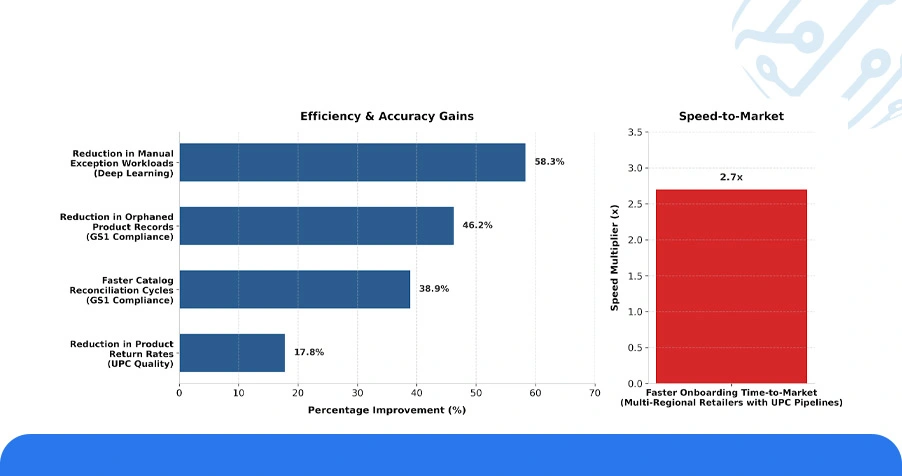
Across all monitored retail platforms in this study, several data points stand out for their strategic significance:
- Platforms with active GS1 compliance programs recorded 46.2% fewer orphaned product records and 38.9% faster catalog reconciliation cycles compared to non-compliant counterparts.
- Product Matching in Ecommerce Using Deep Learning models reduced manual exception-handling workloads by 58.3% across tested retail datasets, freeing data operations teams to focus on higher-value catalog enrichment tasks.
- Among retailers operating in three or more regional markets, those using UPC Matching for Ecommerce Scraping pipelines as part of their data infrastructure reported 2.7x faster time-to-market for new product onboarding compared to catalog-only matching approaches.
What Are the Main Purposes of Utilizing UPC Product Code implementations also showed a 17.8% reduction in return rates attributable to product description inaccuracies, a direct financial benefit tied to data normalization quality that is often underreported in traditional ROI assessments.
Conclusion
Reliable product data is the operational backbone of any competitive retail or e-commerce business. As catalog complexity grows and retailer ecosystems multiply, the ability to maintain accurate, unified product records through UPC Matching for Product Data Normalization Across Stores becomes not just a technical advantage but a measurable business imperative.
Our platforms combine Extract Retail Product Data via UPC-Level Matching methodologies with AI-driven normalization engines, real-time API integrations, and custom dashboard tooling. Contact ArcTechnolabs today to schedule a consultation and discover how our UPC normalization and product matching solutions can transform your retail data strategy into a consistent, scalable competitive advantage.