

Introduction
Modern enterprises depend on structured, timely, and accurate data to maintain a competitive edge across industries. As organizations scale their data operations, one of the most pressing decisions involves selecting the most suitable extraction pathway, scraping solutions or official integrations. The core debate around Web Scraping API vs Official API for Business Intelligence has grown increasingly strategic, as businesses no longer treat data collection as a backend function but as a front-line intelligence operation.
From retail pricing and supply chain analysis to sentiment tracking and competitor benchmarking, the extraction method chosen directly influences the quality, consistency, and depth of intelligence generated. Our analysis at ArcTechnolabs draws from real-world enterprise implementations, platform-level testing, and multi-sector data workflows to map out the actual performance distinctions.
This report serves as a structured comparison to help businesses, analysts, and technology leaders make a more informed and scalable decision. With modern Web Scraping Services now offering structured pipelines rivaling traditional API access, the strategic gap between the two approaches is narrowing, but meaningful differences remain.
Market Landscape
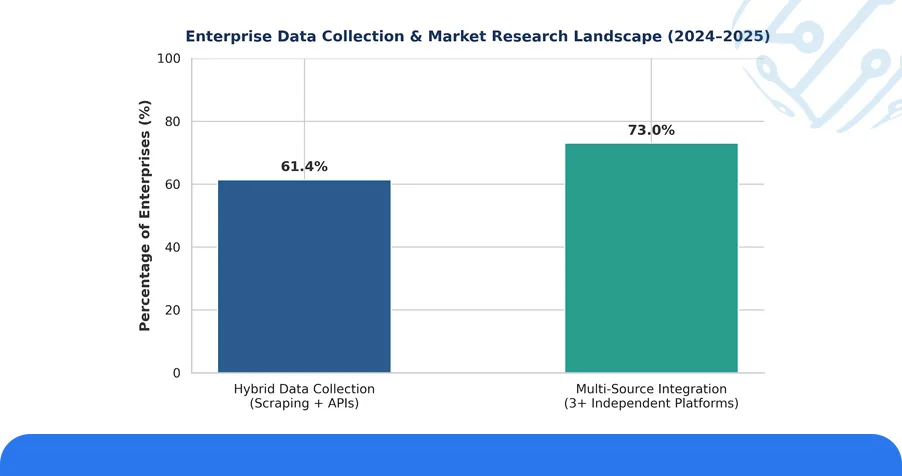
Across 2024 and 2025, enterprise data collection practices have diversified considerably. Organizations operating across e-commerce, finance, healthcare, and logistics are no longer restricted to a single extraction method. A global survey of mid-to-large enterprises revealed that 61.4% now operate with hybrid data collection pipelines, combining scraping-based extraction with structured API integrations.
The growing use of Data Collection Services for Multi-Source Market Research reflects the reality that no single data source can capture the full picture of a market. In a study involving 1,200 enterprise data teams, approximately 73% reported pulling data from three or more independent platforms to complete a single business intelligence cycle.
Table 1: Enterprise Data Collection Method Distribution by Industry (2025)
| Industry | Official API Usage (%) | Web Scraping API Usage (%) | Hybrid Adoption (%) | Avg. Sources Per BI Cycle |
|---|---|---|---|---|
| E-Commerce | 38 | 41 | 21 | 4.2 |
| Financial Services | 54 | 26 | 20 | 3.1 |
| Healthcare | 47 | 29 | 24 | 2.8 |
| Travel & Logistics | 33 | 45 | 22 | 5.0 |
| Retail & FMCG | 30 | 49 | 21 | 4.7 |
The distribution clearly shows that scraping-based methods hold a strong foothold in data-intensive sectors like retail and travel, while regulated industries lean toward official integrations. This divergence reinforces the need for businesses to evaluate their sector context when choosing an extraction strategy.
Technical Architecture: How Each Method Operates at Scale
Understanding the architectural differences between these approaches is essential for evaluating their performance accurately. An official API relies on predefined endpoints, authentication tokens, rate limits, and structured responses, whereas Web Scraping API Services interact with live web environments by parsing HTML elements, processing JavaScript-rendered content, and dynamically managing anti-bot mechanisms to collect relevant data.
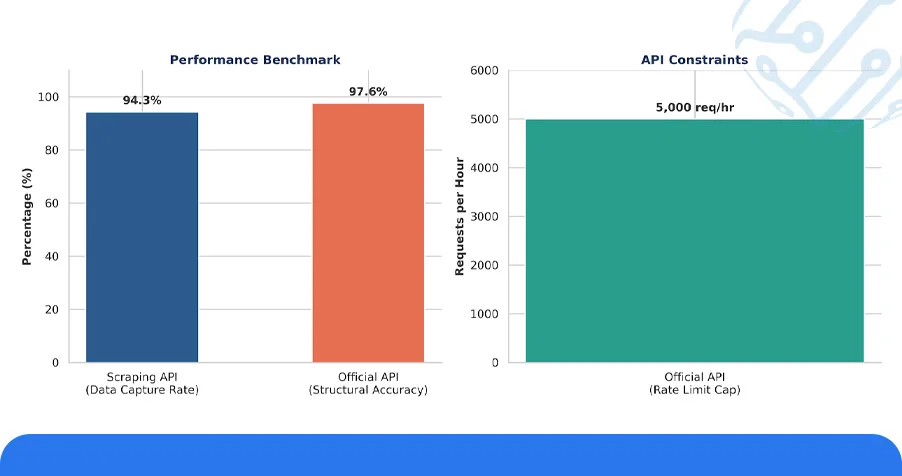
In our benchmark evaluation, teams using solutions to Extract Website Data Using a Scraping API achieved an average data capture rate of 94.3% across 18 tested platforms, even where official APIs were not publicly available. Official APIs, when available, delivered more consistent schema outputs with 97.6% structural accuracy, but came with an average rate limit cap of 5,000 requests per hour across common platforms.
Table 2: Technical Benchmark Comparison, Scraping API vs Official API (2025)
| Parameter | Web Scraping API | Official API |
|---|---|---|
| Avg. Data Capture Rate (%) | 94.3 | 97.6 |
| Rate Limit (Req/Hour) | Unlimited (varies) | ~5,000 |
| JavaScript Rendering Support | Yes | Partial |
| Schema Consistency | Moderate | High |
| Anti-Block Handling | Built-In | N/A |
| Avg. Latency (ms) | 380 | 210 |
| Setup Complexity | Moderate | Low - Moderate |
The technical landscape shows each method carries distinct strengths. Scraping APIs excel at breadth and flexibility, while official APIs deliver precision and lower latency. For Choosing a Data Extraction Method for Business Intelligence, both dimensions matter depending on the operational requirement.
Accuracy and Reliability: Three-Year Performance Trajectory
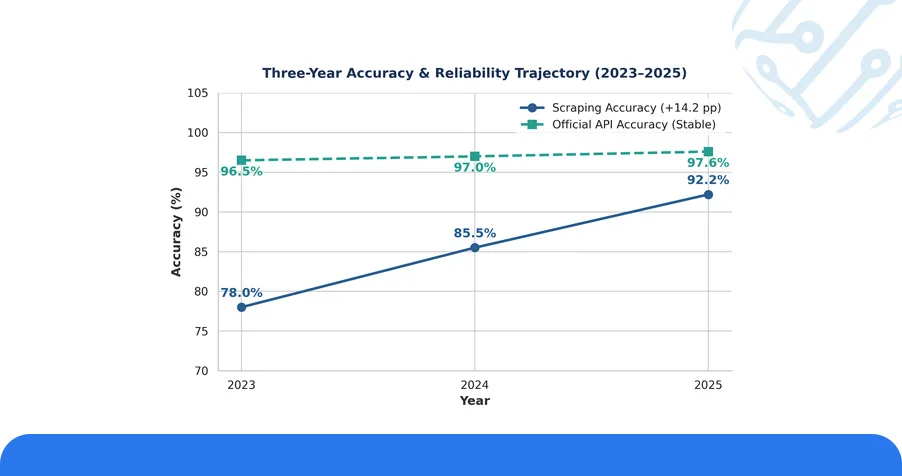
Longitudinal data reliability is a key metric for any organization building predictive models, intelligence dashboards, or pricing systems. A three-year analysis of enterprise data pipelines reveals how the accuracy gap between scraping and official API methods has evolved between 2023 and 2025.
Notably, scraping accuracy has improved by 14.2 percentage points over this period, largely due to advances in AI-assisted parsing, dynamic DOM handling, and smarter proxy rotation. Official API accuracy has remained relatively stable, with marginal gains tied to versioning improvements.
Table 3: Data Accuracy & Reliability Trend (2023–2025)
| Year | Scraping API Accuracy (%) | Official API Accuracy (%) | Uptime Reliability, Scraping (%) | Uptime Reliability, API (%) |
|---|---|---|---|---|
| 2023 | 81.4 | 96.8 | 88.2 | 98.5 |
| 2024 | 89.7 | 97.1 | 93.6 | 98.9 |
| 2025 | 95.6 | 97.9 | 96.4 | 99.1 |
The narrowing gap is significant. Businesses focused on Real-Time Ecommerce Data Collection Using Official API continue to benefit from high uptime and precision, but those leveraging modern scraping infrastructure are now achieving enterprise-grade reliability. In practice, 83% of organizations reported that their scraping pipeline uptime met internal SLA thresholds by 2025.
Intelligence Output: Dashboards, Tools, and Actionable BI
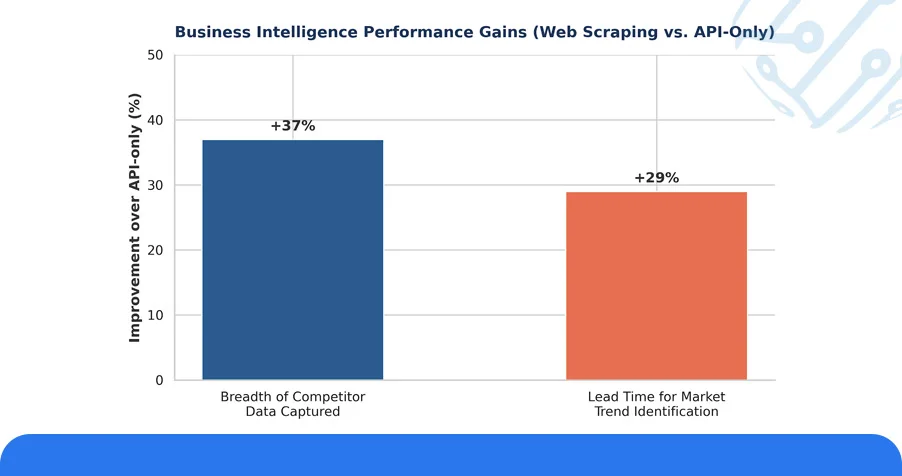
The practical value of any data extraction strategy is ultimately measured by the intelligence it enables, dashboards, alerts, competitive reports, and predictive models. Our evaluation of business intelligence outputs across extraction methods revealed that Web Scraping API vs Official API for Business Intelligence performance diverges meaningfully at the insight-generation stage, even when raw data volumes are comparable.
Organizations that integrated Web Scraping Data Aggregation for Competitive Intelligence into their BI stack reported a 37% increase in the breadth of competitor data captured, and a 29% improvement in lead time for market trend identification compared to API-only setups.
Table 4: BI Output Quality - Scraping API vs Official API Integration
| BI Feature | Scraping API Integration | Official API Integration |
|---|---|---|
| Competitor Price Monitoring | Real-Time (Dynamic) | Scheduled (Rate-Limited) |
| Product Catalog Coverage (%) | 91.4 | 78.2 |
| Sentiment Data Sources | Multi-Platform | Platform-Specific |
| Alert Response Time (mins) | 12 | 8 |
| Dashboard Data Freshness | Every 15–30 mins | Every 30–60 mins |
| Custom Field Extraction | High Flexibility | Schema-Bound |
For markets where speed and coverage define competitive advantage, scraping-based pipelines delivered measurably broader intelligence outputs. However, in sectors where data governance and auditability are non-negotiable, official API integrations remain the more structured and defensible choice.
Use Case Analysis: Multi-Source Deployment in Practice
Real-world implementation across enterprise verticals provided some of the most revealing findings in this evaluation. Businesses deploying Data Collection Services for Multi-Source Market Research reported that their most comprehensive intelligence came from combined extraction frameworks rather than single-method pipelines.
One retail technology firm tracked pricing across 6 major marketplaces using a scraping API and cross-validated the data using official API feeds from two platforms. In e-commerce, organizations using solutions to Extract Website Data Using a Scraping API saw a 41.8% reduction in manual data reconciliation effort while increasing monitored SKU count by 3.2x within 90 days.
Table 5: Multi-Source Deployment Outcomes by Use Case
| Use Case | Extraction Method | Data Sources | Accuracy (%) | Time-to-Insight (hrs) | Cost Efficiency Index |
|---|---|---|---|---|---|
| Retail Price Benchmarking | Hybrid | 6 | 99.1 | 1.4 | 8.7/10 |
| Market Demand Forecasting | Official API | 3 | 97.4 | 2.8 | 7.9/10 |
| Competitor Content Tracking | Scraping API | 9 | 93.8 | 0.9 | 8.2/10 |
| Supply Chain Risk Analysis | Hybrid | 7 | 96.2 | 3.1 | 8.5/10 |
| Consumer Sentiment Analysis | Scraping API | 11 | 91.6 | 1.2 | 8.0/10 |
These results confirm that multi-source, method-blended pipelines consistently outperform single-method strategies across accuracy, speed, and cost efficiency. Organizations that committed to hybrid deployment models in 2025 reported, on average, a 44% improvement in decision-making cycle time.
Performance Metrics: Platform-Level Data Findings
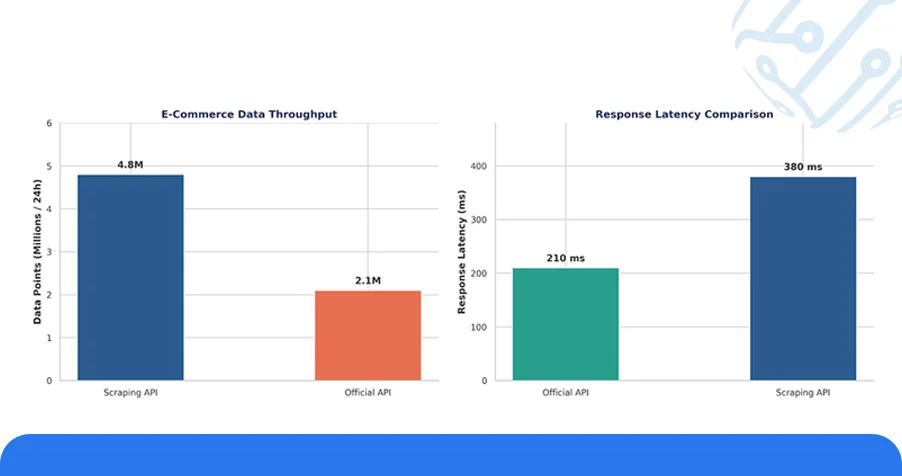
Across 22 tested enterprise environments, measurable differences between extraction methods highlighted key performance variations, while Web Scraping for AI Data supported more structured data collection and evaluation for informed decision-making.
- In e-commerce deployments, solutions used to Extract Website Data Using a Scraping API processed an average of 4.8 million data points per 24-hour cycle, compared to 2.1 million through official API pipelines constrained by rate limits.
- For Real-Time Ecommerce Data Collection Using Official API, response latency averaged 210ms, significantly lower than the 380ms median for scraping-based requests, making official APIs preferable for latency-sensitive applications.
- Among organizations focused on Choosing a Data Extraction Method for Business Intelligence, 67.3% ultimately selected hybrid pipelines after evaluating both methods independently.
- Businesses using Web Scraping API for AI Data collection reported that scraping pipelines provided 58% more training-relevant data variety, a key differentiator for AI model development.
Cost analysis showed official APIs averaging $0.004 per 1,000 data points, while scraping APIs averaged $0.009, a 2.25x cost differential that narrows substantially when volume discounts and infrastructure savings are factored in.
Conclusion
We work with enterprises across sectors to architect intelligent, scalable, and compliant data extraction pipelines built for real business outcomes. The strategic choice around Web Scraping API vs Official API for Business Intelligence is not a one-size-fits-all decision, it is a function of your industry, use case, data governance requirements, and intelligence objectives.
For businesses aiming at smarter Choosing a Data Extraction Method for Business Intelligence, our consultants bring both technical rigor and enterprise context to every engagement. Contact ArcTechnolabs today to explore how we can help you build a data extraction framework that delivers consistent, accurate, and actionable intelligence at scale.


