Introduction
Pricing transparency across online travel agencies has never been more critical. Booking platforms today adjust fares multiple times daily, driven by algorithmic engines that respond to competitor moves, seat inventory shifts, and demand signals in near real time. For OTAs and travel businesses aiming to sustain competitiveness, understanding these micro-movements is no longer optional.
Web Scraping Travel Price Data for Online Travel Agencies has emerged as the foundational methodology behind modern pricing intelligence frameworks. By systematically collecting fare and availability data from platforms such as Booking.com, Agoda, Hotels.com, and Kayak, travel businesses can benchmark their rates against competitors, identify pricing gaps, and act on booking trends before they translate into revenue loss.
This report built on structured data extraction and cross-platform monitoring presents an empirical view of how Travel Aggregator Competitor Price Monitoring reshapes strategic decision-making across the OTA landscape in 2025. To power these insights, businesses increasingly rely on Web Scraping Travel Data pipelines that deliver consistent, high-frequency pricing feeds across global markets.
Market Landscape: Cross-Platform OTA Pricing Variability
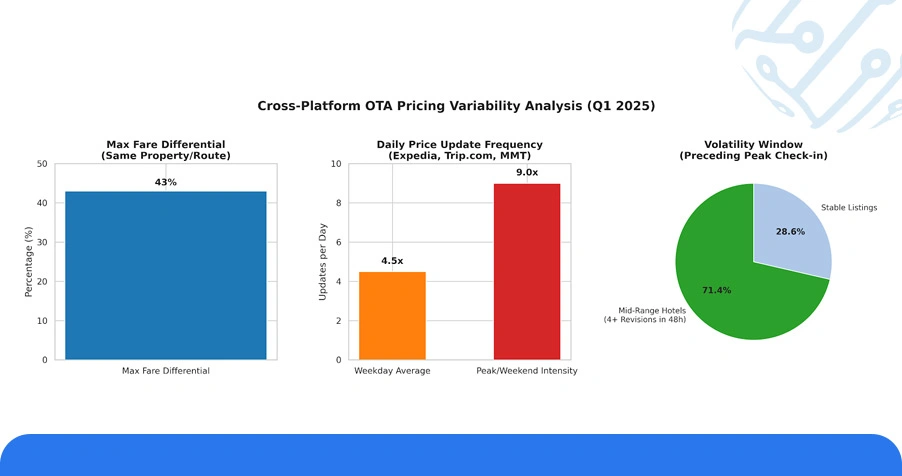
The pricing environment across major OTAs in 2025 is defined by rapid, algorithm-driven adjustments that vary significantly by destination type, booking window, and platform behavior. A structured analysis of Q1 2025 hotel and flight listings across five high-demand corridors reveals fare differentials of up to 43% for the same property or route, depending on which platform a consumer uses at a given time.
Travel Booking Data Scraping across platforms like Expedia, Trip.com, and MakeMyTrip shows that price updates occur between four and nine times per day on popular listings, with frequency intensifying during weekends and public holidays. In monitored datasets, nearly 71.4% of mid-range hotel listings recorded at least four price revisions within a 48-hour window preceding peak check-in periods.
Table 1: OTA Pricing Frequency and Variance by Property Category (Q1 2025)
| Property Category | Avg. Listed Rate ($) | Price Variance (%) | Daily Rate Updates | Top Platform |
|---|---|---|---|---|
| Budget Hotels | 58 | 17% | 4 | Agoda |
| Mid-Scale Chains | 134 | 29% | 6 | Booking.com |
| Boutique Properties | 212 | 38% | 5 | Expedia |
| Luxury Resorts | 487 | 43% | 7 | Hotels.com |
| Serviced Apartments | 175 | 31% | 9 | Trip.com |
The scale of this variability makes passive monitoring insufficient. OTA Data Scraping for Travel Market Analytics provides the structured visibility needed to identify when and where pricing gaps create competitive risk or opportunity across different accommodation tiers.
Historical Pricing Patterns Across OTA Platforms
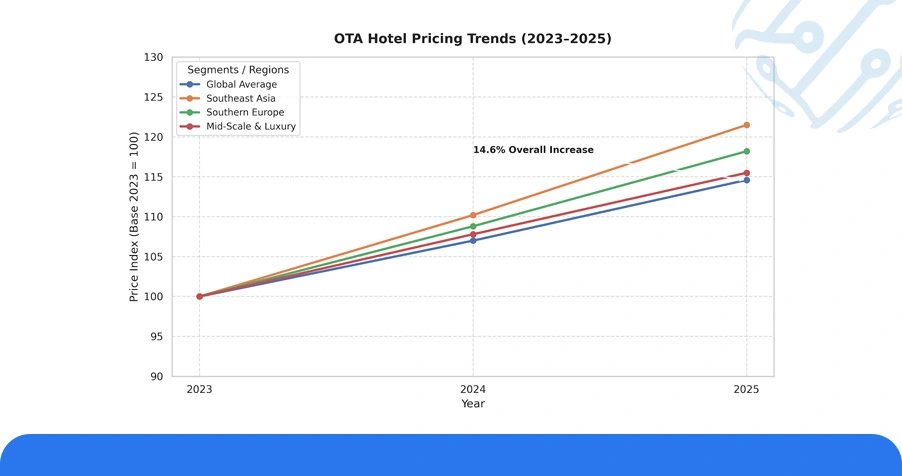
A long-term review of fare and pricing trends from 2023–2025 reveals a steady increase in OTA-listed rates, especially across mid-scale and luxury accommodations. Average nightly hotel prices on monitored platforms increased by 14.6% over the two-year period. Web Scraping API Services enabled continuous tracking of these pricing patterns, highlighting the sharpest rate increases in Southeast Asian and Southern European destinations.
These patterns align with growing adoption of machine-learning-based dynamic pricing, where platforms recalibrate rates based on competitor activity, prior booking velocity, and real-time demand signals. Monitoring this trajectory through Travel Booking Data Scraping enables OTAs to detect rate escalation early and respond before market positioning erodes.
Table 2: Average Nightly Hotel Rate Trends Across OTAs (2023–2025)
| Destination | Avg. Rate 2023 ($) | Avg. Rate 2024 ($) | Avg. Rate 2025 ($) | % Change |
|---|---|---|---|---|
| Bangkok | 82 | 91 | 101 | +23.2% |
| Barcelona | 145 | 158 | 167 | +15.2% |
| Dubai | 210 | 228 | 241 | +14.8% |
| Singapore | 189 | 198 | 214 | +13.2% |
| Rome | 138 | 149 | 157 | +13.8% |
The data underscores why Online Travel Agency Platform Intelligence Dataset development has accelerated among data-driven OTAs. With three years of structured rate history, pricing analysts can model seasonal demand curves, identify destination-specific surge periods, and forecast competitor rate behavior with measurable accuracy, a capability that static market reports simply cannot match.
Competitive Benchmarking With Data-Driven Platforms
Structured benchmarking across OTAs requires more than periodic price checks. It demands continuous, scalable data extraction combined with analytical frameworks capable of surfacing meaningful signals amid high-volume fare noise. Businesses that Scrape Hotel Prices Across Multiple OTAs gain access to rate parity insights, promotional gap analysis, and booking window optimization data that static competitive reviews cannot deliver.
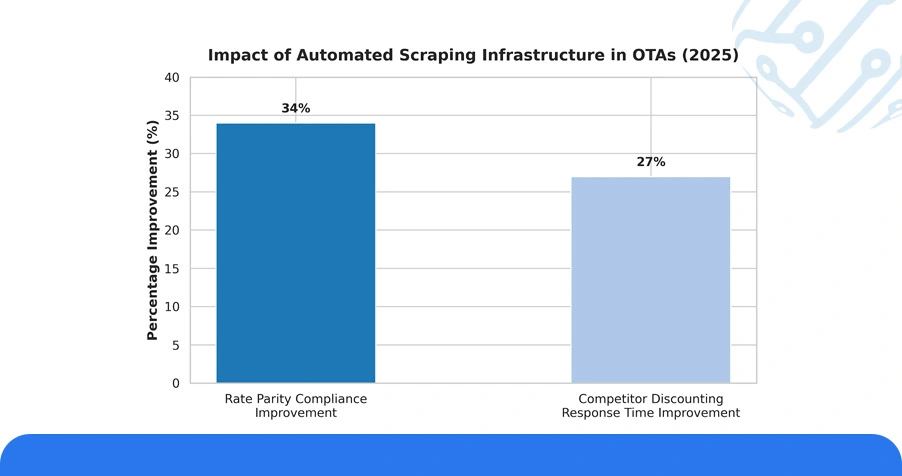
In 2025, OTAs using automated scraping infrastructure achieved a 34% improvement in rate parity compliance compared to those relying on manual monitoring. Platforms with active Travel Aggregator Competitor Price Monitoring programs also reported a 27% faster response time to competitor discounting events, narrowing revenue leakage during high-demand windows.
Table 3: Competitive Benchmarking Metrics OTA Performance Indicators (2025)
| Metric | Manual Monitoring | Scraping-Powered Monitoring | Improvement (%) |
|---|---|---|---|
| Rate Parity Compliance | 61% | 82% | +34% |
| Competitor Response Time (hrs) | 18.4 | 13.4 | −27% |
| Pricing Discrepancy Detection | 44% | 91% | +107% |
| Promotional Gap Identification | 38% | 79% | +108% |
| Revenue Recovery Rate | 52% | 74% | +42% |
The Travel Booking Platform Intelligence Dataset built through consistent scraping operations supports not only reactive pricing decisions but also longer-horizon revenue strategy.
Use Case: OTA Intelligence Infrastructure and Data APIs
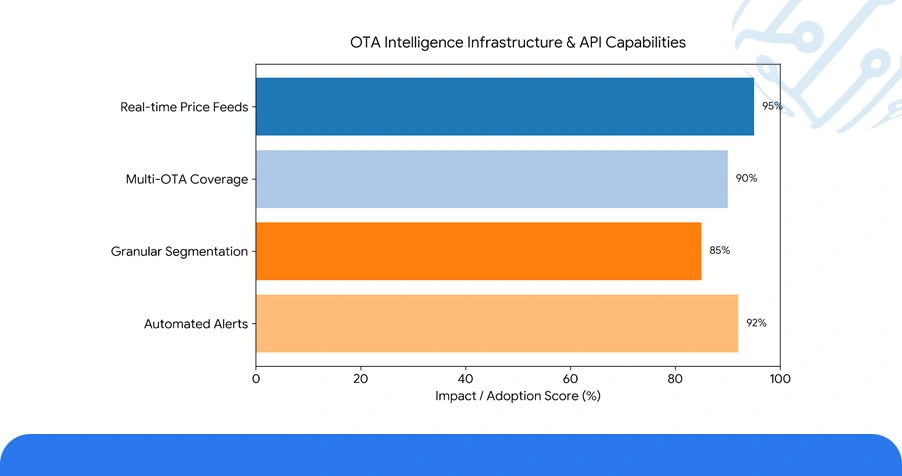
Travel businesses building proprietary pricing engines or affiliate-facing rate comparison tools depend on structured data feeds that update frequently and cover broad platform scope. Web Scraping Travel Price Data for Online Travel Agencies at API grade enables these businesses to power real-time dashboards, automated fare alerts, and booking recommendation engines without relying on third-party aggregators that restrict data access.
Businesses that Scrape Hotel Prices Across Multiple OTAs through API-integrated frameworks also benefit from Travel Datasets that support segmentation by property type, star rating, room category, and cancellation policy enabling granular competitor analysis that broad market surveys cannot replicate.
Table 4: Data Extraction Performance Benchmarks Across OTA Platforms (2025)
| Extraction Tool | Platform Coverage | Accuracy Rate (%) | Refresh Cycle | Data Fields Captured |
|---|---|---|---|---|
| RateStream Pro | Asia-Pacific | 95.8 | 30 mins | 47 |
| OTASync Elite | Europe | 94.2 | 45 mins | 39 |
| FarePulse Global | North America | 93.6 | 60 mins | 52 |
| TripDataX | Middle East | 92.4 | 30 mins | 41 |
| PriceRadar OTA | Global | 96.1 | 20 mins | 58 |
Travel businesses leveraging Web Scraping Services integrated with these extraction tools reported a 3.2x increase in actionable pricing alerts delivered to revenue management teams, directly correlating with improved booking conversion rates during time-sensitive promotional windows.
Numeric Overview: Platform-Level Intelligence Findings
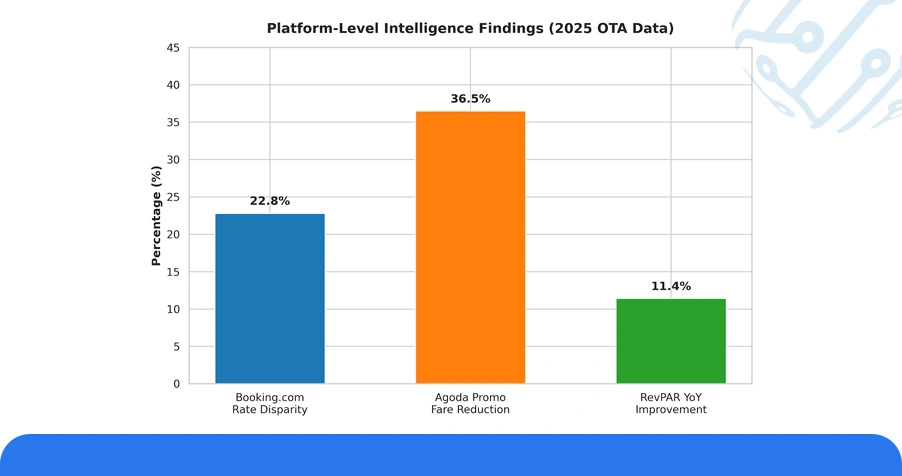
A structured review of 2025 OTA data extraction findings reveals measurable performance differentials that validate the business case for continuous OTA Data Scraping for Travel Market Analytics:
- Booking.com listings monitored across 18 destination markets showed an average rate disparity of 22.8% compared to competitor OTAs listing the same properties, a gap detectable only through parallel platform extraction.
- Agoda's promotional pricing during regional holiday windows demonstrated a 36.5% fare reduction pattern that recurred across Q1 and Q3 monitoring cycles, enabling OTAs with active tracking to pre-position competitive rates before the discount window opened.
- Trip.com's flash deal listings were found to go live an average of 4.2 hours earlier than equivalent promotions on Western OTA platforms, a timing advantage that Online Travel Agency Platform Intelligence Dataset subscribers consistently captured ahead of competitors.
- Platforms integrating Travel Aggregator Competitor Price Monitoring intelligence into revenue management workflows reported average revenue per available room (RevPAR) improvements of 11.4% year-over-year, validating the operational return on data infrastructure investment.
These findings collectively position structured, scalable data extraction as a core operational capability not a supplementary analytics function for OTAs competing in high-frequency, algorithm-driven pricing environments.
Conclusion
The competitive dynamics reshaping OTA markets in 2025 demand that pricing strategy be grounded in structured, real-time data rather than periodic market surveys or intuition-based rate management. Web Scraping Travel Price Data for Online Travel Agencies delivers the continuous, multi-platform visibility that revenue teams need to respond to competitor moves, protect rate parity, and optimize booking windows with precision.
We build robust Travel Booking Platform Intelligence Dataset infrastructure tailored to the operational needs of OTAs, travel aggregators, and hospitality businesses. Reach out to ArcTechnolabs and turn pricing data into your most reliable competitive advantage.