Introduction
Retail grocery brands today face mounting pressure to predict demand accurately, avoid stockouts, and reduce wasteful overstocking. Consumer preferences shift quickly, and quick commerce platforms have become a goldmine of behavioral and transactional signals. We partnered with a growing grocery retail brand to implement Quick Commerce Data Scraping for Inventory Demand Forecasting, helping them build a smarter, data-driven supply chain from the ground up.
The ability to Track Product Stock Availability Across Quick Commerce Apps gave the client a real-time window into category-level demand movements, enabling proactive procurement decisions rather than reactive ones. This early-warning system became the backbone of their planning cycle, reducing guesswork across dozens of SKU categories and regional warehouses.
By tapping into a continuously refreshed pool of platform data, the client could align inventory levels with actual consumption trends rather than historical averages. Quick Commerce Data Scraping for Inventory Demand Forecasting gave decision-makers the confidence to act on live signals, improving their stock replenishment cycles significantly and building a more resilient grocery supply chain across markets.
The Client
The client is a mid-to-large grocery retail chain operating across 20+ urban and semi-urban locations in India, with active listings on quick commerce platforms like Blinkit, Zepto, and Swiggy Instamart. Their product catalog spans over 5,000 SKUs across fresh produce, packaged goods, dairy, and FMCG categories. They rely heavily on platform-driven sales, making real-time data critical to their operations.
Despite having a strong offline network, the client struggled to predict which SKUs would face demand surges in specific zones and time windows. Their planning teams depended on weekly manual reports, which could not account for rapid market changes. Quick Commerce Data Scraping for Inventory Demand Forecasting was identified as the most effective path toward building a predictive, automated inventory strategy.
The client required a solution capable of Grocery Demand Analytics Using Product and Sales Data Scraping to unify signals from multiple platforms into one coherent planning view. They needed structured datasets reflecting competitor stock behavior, pricing shifts, and category-level velocity so they could allocate inventory more intelligently across their distribution centers and dark stores.
Key Challenges
The grocery retail and quick commerce space is volatile by nature, driven by micro-seasonal demand, regional preferences, and hyperlocal supply disruptions. The client's core challenges included several compounding operational problems:
- Forecasting demand manually for 5,000+ SKUs without real-time platform inputs
- Identifying stockout patterns in competitor listings to capitalize on availability gaps
- Syncing procurement cycles with actual demand signals from live platform data
- Responding to flash demand spikes triggered by weather, promotions, or local events
- Building reliable Grocery Sales Forecasting Using Scraping without a centralized data pipeline
The client also lacked visibility into how product ranking, pricing, and availability on quick commerce apps directly affected their own order volumes. Without Grocery Inventory Data Scraping for Retail Intelligence, they were making high-stakes inventory decisions based on outdated, incomplete inputs that could not reflect the real market pace.
Key Solution
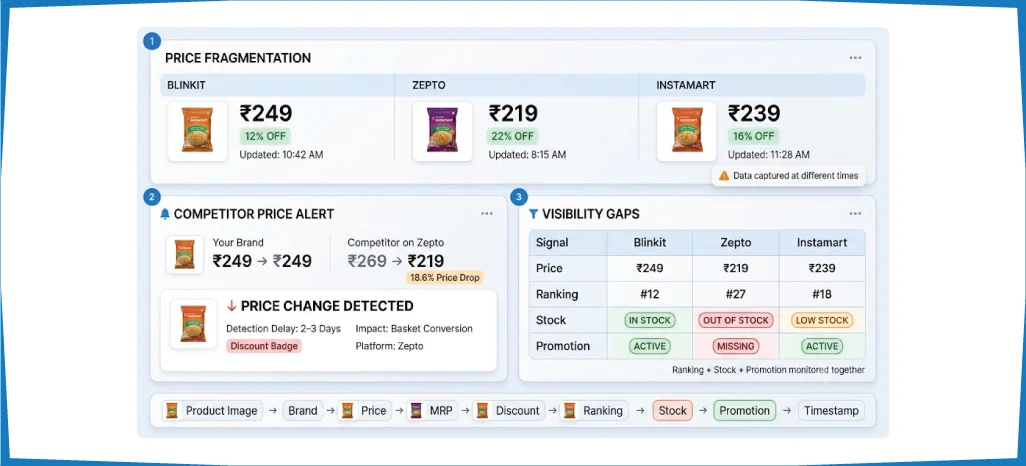
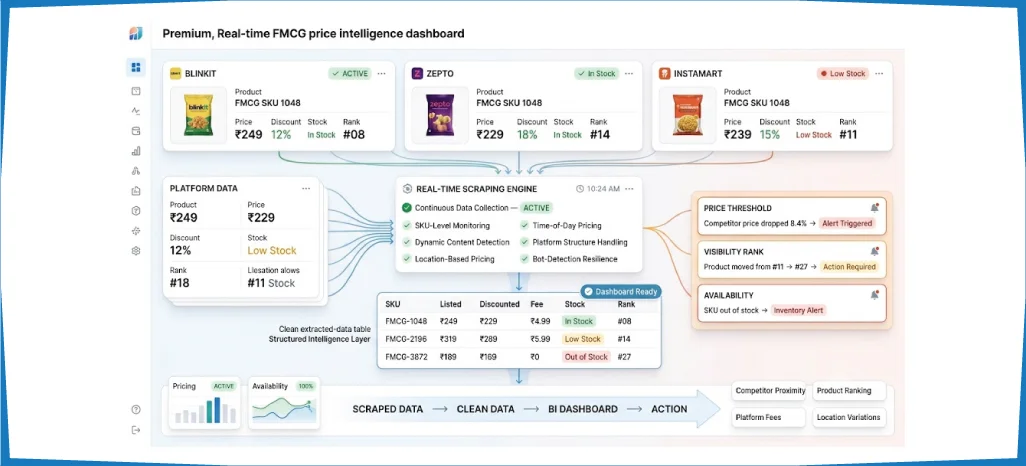
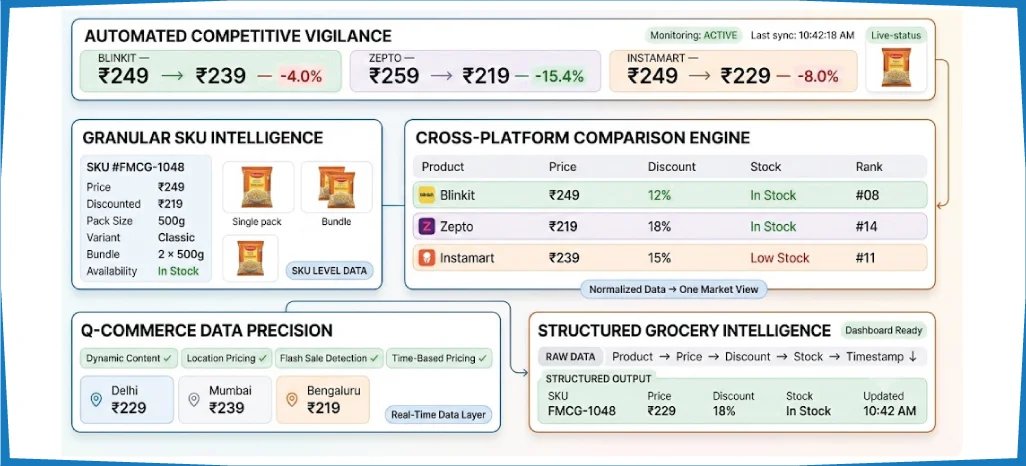
We designed a comprehensive scraping and analytics framework tailored for grocery and quick commerce environments. The solution was built to extract, structure, and deliver actionable inventory intelligence from all major platforms in near real-time. Using Web Scraping Quick Commerce Data, the team built category-level demand signals that fed directly into the client's procurement planning tools.
- SKU-level availability tracking across Blinkit, Zepto, and Swiggy Instamart
- Competitor pricing and discount pattern monitoring for 200+ product categories
- Regional demand velocity profiling using Quick Commerce Datasets for Grocery Demand Forecasting
- Dark store and warehouse-level stock gap identification
- Time-based demand indexing for peak-hour and event-driven purchasing behavior
- Integration of scraped data into the client's ERP and procurement platforms
We also applied Web Scraping Quick Commerce Data for Grocery Demand Prediction to map the correlation between competitor stockouts and the client's own order spikes. This allowed procurement teams to pre-position inventory for categories where competitor gaps were predictable and repeatable. All data was cleaned, categorized, and delivered through automated pipelines with daily and hourly refresh cycles to ensure maximum forecast accuracy.
Performance Metrics at a Glance
The following table reflects measurable outcomes recorded over a six-month implementation period. Grocery Sales Forecasting Using Scraping together enabled consistent gains across multiple operational KPIs.
Our data solutions created compounding operational benefits for the client. As the scraping pipeline matured and learned seasonal patterns, forecast accuracy continued to improve, and the client's procurement team reduced its manual intervention time by over 60%.
The gains documented below reflect the transition from intuition-based planning to structured, data-backed inventory management, powered entirely by automated quick commerce intelligence:
| Performance Indicator | Before Implementation | After Implementation |
|---|---|---|
| SKU Stockout Frequency | 34% monthly average | Reduced to 11% |
| Demand Forecast Accuracy | ~58% | Improved to 87% |
| Overstock Write-Off Cost | ₹18L/month | Reduced to ₹6.4L/month |
| Manual Reporting Hours | 120 hrs/week | Reduced to 18 hrs/week |
| Procurement Lead Time | 5–6 days average | Optimized to 2–3 days |
| Competitor Gap Capture Rate | Not tracked | 73% opportunity capture |
| Platform Visibility Score | Below category average | Above average in 14 zones |
This structured performance view helped leadership justify continued investment in scraping infrastructure, while Web Scraping API Services supported more effective inventory planning and ROI validation.
Advantages of Implementing ArcTechnolabs
We bring specialized capabilities that go beyond standard scraping to deliver grocery and retail intelligence that is accurate, scalable, and operationally relevant from day one.
-
Real-Time Inventory Tracking
Our scraping systems continuously monitor SKU availability using Web Scraping Quick Commerce Data, capturing stock changes across platforms to keep procurement teams informed before shortages escalate.
-
Competitive Demand Mapping
We identify competitor stockout trends and availability gaps through Grocery Demand Forecasting Using Quick Commerce Data Scraping, enabling clients to capture unmet demand and strengthen category presence proactively.
-
Predictive SKU Intelligence
Our models analyze sales velocity patterns using Grocery Inventory Data Scraping for Retail Intelligence, giving procurement managers granular category-level signals that reduce overstocking and eliminate reactive purchasing.
-
Multi-Platform Data Integration
We connect scraped platform data with existing ERP and BI tools using Web Scraping Quick Commerce Data for Grocery Demand Prediction, creating a single source of truth for inventory planning without manual data handling.
-
Automated Forecasting Pipelines
We deploy fully automated extraction and delivery workflows using Grocery Demand Analytics Using Product and Sales Data Scraping, enabling continuous, hourly-refreshed forecasting without requiring team-level manual data collection.
Client's Testimonial
"ArcTechnolabs completely changed how we approach stock planning. Their ability to deliver structured, real-time data through Quick Commerce Data Scraping for Inventory Demand Forecasting gave us visibility we never had before. Grocery Demand Forecasting Using Quick Commerce Data Scraping turned out to be the deciding factor that helped us reduce stockouts and serve customers better across all our zones."
— Head of Supply Chain, Grocery Retail Chain
Conclusion
Grocery businesses that rely on gut-feel procurement are constantly playing catch-up with the market. We offer a proven path to precision through Quick Commerce Data Scraping for Inventory Demand Forecasting, turning platform data into structured, decision-ready intelligence that drives efficiency at every level of the supply chain.
Whether you are managing 500 SKUs or 50,000, our scraping infrastructure is built to scale with your needs and adapt to new platforms as your retail footprint grows. We also offer access to curated Quick Commerce & FMCG Datasets that complement live scraping pipelines, giving your team both historical benchmarks and real-time signals in one unified environment.
From dark store optimization to regional demand mapping, our solutions are built for grocery retailers who want to lead rather than follow. Contact ArcTechnolabs today to schedule a consultation and find out how predictive inventory intelligence can reduce waste, capture demand gaps, and position your brand for sustained growth in the quick commerce economy.